
The very modern old Ningbo


Play
Past and future harmonize in the Chinese port city, home to stirring temples, Silk Road memories and a Sci-Tech City
IT DOESN’T get the same media attention or tourist hordes as Shanghai, its cosmopolitan neighbour to the north, but Ningbo – a three-hour drive away in Zhejiang province – is even more steeped in history. It was an important seaport 2,000 years ago and a terminus of the fabled Silk Road.
As if capitalising on its venerable position in the international “line of communications”, Ningbo is today touted as a state-of-the-art logistics hub for the Asia-Pacific region.
I am immediately taken by the city on my first visit to China, arriving as a guest of the China Daily – The Nation’s sister newspaper in the Asia News Network. Glimpsed through the car window, the tranquil quayside surprises me with its ribbon of five-star hotels, shopping complexes and high-rise office buildings of outstanding modern design.
With marine trade booming, the port itself is drawing scores of leading enterprises. It handles 525 million tonnes of cargo annually, placing it fourth in the world for volume. That’s the old way, still thriving. The new way is embodied in Ningbo New Material Sci-Tech City, founded in 2013 to foster innovation for the benefit of various arms of industry.
The name Ningbo means “calm waves”, an allusion to the fine harbour shielded from high winds and ocean tumult by a ring of mountains and outlying islands. There are six urban districts – Haishu, Jiangdong, Jiangbei, Zhenhai, Beilun and Yinzhou – that in recent decades have been shepherded into a well-organised layout with specific zones for housing, education, culture, commerce and industry.
Getting around is easy enough on the mass-transit system, though a map is essential, since China’s restrictive “Great Firewall” leaves your mobile without Google or Facebook to offer assistance. Fortunately the residents are friendly and generous with their aid.
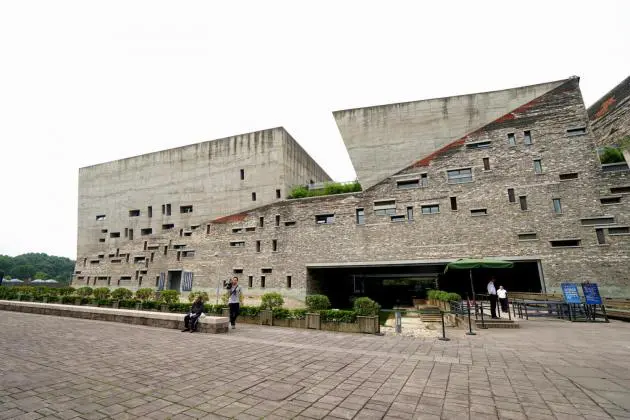
It is the culture, and especially the history, that can keep visitors transfixed for days. Our lessons begin with a tour of the Ningbo Museum, a building of splendid design by Wang Shu, who in 2012 became the first Chinese architect to win the top prize in the field, the Pritzker.
Opened in 2008, the museum combines traditional and modern architectural elements to symbolise the marine-and-mountain geography of Ningbo itself. The exterior wall bears locally made tiles and a bamboo structure formed in cement. Inside, three floors present 30,000 square metres of exhibits, more than 80,000 pieces in all, from ancient bronzes, porcelain, jade, gold and silverware to paintings both prehistoric and contemporary.
The History Gallery on the second floor has daily living utensils made from clay, stone, jade, wood, bone and animal horn, dating back to the Hemudu culture that thrived here 5,000 to 7,000 years ago, one of the most important Neolithic settlements found in southern China.
Yue ware from the Tang and Song dynasties – primarily celadon porcelain – was a major export to Japan, Korea, India and Southeast Asia. One celadon jar on display bears a lovely applied design, while a saucer takes the shape of a lotus leaf and a pitcher mimics a melon. Also on view is a stone carving of a flying apsara, demonstrating Buddhism’s influence.
In the Song Dynasty Hall, giant stone guardians wait at a towering red city gate, beyond which lies an intricate model of Mingzhou Port, crowded with boats and mariners at their labours. There’s a shrine room with a marvellous array of Buddha images and other icons in various materials and designs.
The Folk Gallery recreates the old Ningbo business area with wax models and mock-up buildings, and the Bamboo Carving Gallery is replete with stunning artefacts from the collection of Qin Kangxiang, a celebrated connoisseur of the craft.
Along with the museum, the Qing’an Hall is not to be missed. Resting at the confluence of the Yuyao, Fenghua and Yongjiang rivers, it was completed in 1853 as a temple assembly hall and a marine-trade centre, a match for the An’Lan Hall to the south, erected in 1826.
Known as the Queen of Heaven Palace, it comprises three buildings and has two performance stages, all adorned with traditional craftwork in brick, stone and lacquer, carved wood, the imagery drawn from folklore and nature. Four-metre-tall pillars standing in a line have phoenixes and dragons carved into them, symbols of good luck. The two main halls are dedicated to the Goddess Mazu, protector of sailors, and a showcase of Silk Road trading goods and old-fashioned weapons.
In 1997 the edifice gained a third purpose, as the Marine Folk Museum of East Zhejiang, with displays of merchant ships in miniature, both Chinese and Western in style.
For a better understanding of how Ningbo has continued to boom in modern times, Nantang Street is a worthwhile wander. A row of 150-year-old shophouses was refurbished for shopping and dining and opened just last month. For a distance of 1,200 metres there are dozens of beautifully decorated restaurants and cafes serving local and international treats, and souvenir shops and theatres offering classical fare.
On Ningbo’s eastern outskirts, the Temple of King Asoka stands alone on King Asoka Mountain, a sacred Buddhist pilgrimage site. The temple was established in AD 282 and is famous for its pagoda containing purported relics of the Shakyamuni Buddha.
Architecturally simple, the temple is vast enough to house more than 600 halls, including the Hall of Heavenly Kings and the Sutra Library.
The main shrine hall houses a likeness of the Buddha that attracts a constant stream of worshippers, as well as a statue of Guanyin, the goddess of mercy, whose life is recounted in a marvellous mural adorned with colourful stone carvings.
Back downtown I enjoy a class in classical Chinese art at the Red Peony Chinese Painting and Calligraphy Academy. Artist Jing “Jack” Hongsheng set up the academy three years ago as a combined studio and library, and anyone who’s interested can get free lessons. I spend a pleasant hour learning how to mix watercolours and use the brushes and then watch as Jack demonstrates how to paint a peony on paper already formed into a hand-fan. It’s perfect – I’m creating my very own souvenir!
