
Keeping in shape with karaoke


Play
Japanese seniors stay fit and have fun by singing and moving to their favourite tunes
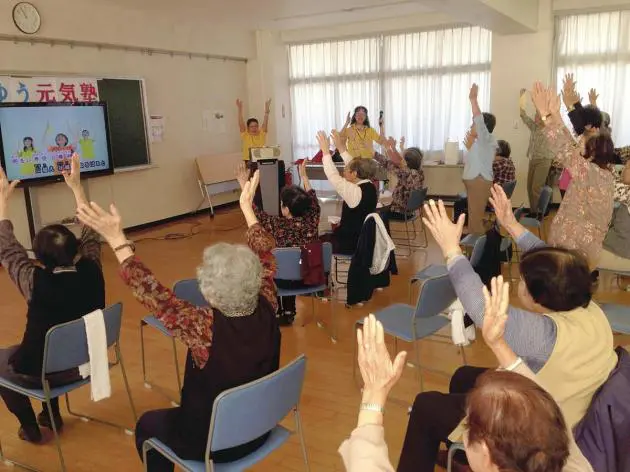
A ROOM IN a multipurpose facility in Kiyose, western Tokyo, is buzzing with excitement as some 40 men and women, aged from 66 to 93, sing along enthusiastically with a version of the popular tune “Kogen Resha wa Iku” (“There goes the plateau train”), waving their hands and stepping in time with the movements of a model on a TV screen.
“Waving my handkerchief from the train window, the girl from the ranch tosses a bouquet,” they happily sing.
Part of a project to reduce the need for nursing care, this karaoke activity was launched in June by the Kiyose municipal government. Local governments across the nation are increasingly making use of karaoke in projects to provide preventive care. These programmes, aimed at improving the health of seniors, usually include physical activities while singing. They are expected to prompt stay-at-home seniors to go out, as participants can enjoy themselves while taking part in the programmes.
The programme in Kiyose is held once a week at three locations in the city, charging participants 200 yen (Bt60) per session. Created with input from physicians and music therapists, it features karaoke machines equipped with songs that encourage physical movement while singing.
Under the eye of music therapist Miho Ogawa and other staff, the participants spend about 90 minutes performing activities including a mouth exercise that replaces the lyrics of the children’s song “Kamome no Suihei-san” (“Seagull sailors”). The participants also had the chance to sing their favourite enka songs.
“At home I have almost no opportunity to speak up or talk to other people. I look forward to participating in this programme every week,” a 91-year-old woman who lives by herself, tells the Japan News. Michiko Sekiguchi, a Kiyose municipal government official in charge of the programme, says there are examples of seniors who regularly participate in exercise karaoke being able to forgo the assistance of a walker to get around. Some of the participants have become more conscious of their appearance and begun to dress more neatly.
“They all have lively expressions. Conversations and interactions among them are also increasing,” she adds.
Karaoke machines equipped with simple exercise programmes to accompany the music came into use primarily at nursing care facilities in the early 2000s, according to the Tokyo-based All-Japan Karaoke Industrialist Association (JKA).
An increasing number of studies have found that the use of the karaoke machines helps improve health and quality of life by making mental functions more active, reducing stress and preventing infectious diseases and dry mouth through increased salivary secretion. That research has prompted local governments to adopt karaoke machines for programmes aimed at reducing the need for nursing care.
“I assume the aim is to extend people’s healthy life expectancy, which would result in the reduction of medical and nursing care expenses,” says a JKA official. Similar programmes are conducted in such cities as Machida, western Tokyo; Fukuoka and Sakai, Fukui Prefecture.
The city of Matsumoto, Nagano Prefecture, adopted a similar programme on a trial basis last year. Discovering that more men took part in the programme compared to other activities aimed at reducing the need for nursing care, this year the city is conducting the programme exclusively for retired male seniors.
“The karaoke machine is a piece of equipment many people have enjoyed for a long time, and it is something they can continue to enjoy. In addition to health benefits, karaoke can bring people together, helping participants make friends and vitalising communities,” Ichiro Saito, a professor at Tsurumi University’s dentistry department adds.
Staying healthy with karaoke
- Choose songs you like – old-time favourites are fine – and put your heart into your singing. This leads to a positive mind-set and improves memory recall. |Even just humming is fine.
- Singing as a group can eliminate feelings of |loneliness. Try singing a duet with a friend of the |opposite sex on occasion.
- Use of noisemakers, bells and other instruments offer light exercise.
- As voices become lower with age, the tone of songs on the karaoke machine should be lowered.
- Avoid singing too much, which places a burden on the vocal cords and elsewhere on the body. - Take a short break after each song.
