
LED for the urban lifestyle


Play
From urban farming to pain relief, Phillips has an LED gadget for you
ONE OF THE WORLD’S leading producers of everything from lighting and consumer items to medical equipment, Dutch giant Philips spends millions each year on developing new products to match the needs of an increasingly demanding society.
The company recently brought some of its latest innovations to Southeast Asia, staging the Philips Innovation Experience at the Fort Canning Park Hotel in Singapore earlier this month. Ranging from a natty noodle maker to a new LED gizmo that controls pain, it was the first event of this nature organised by Philips Asean and Pacific.
Divided into “Advancing Healthcare,” “Empowering Healthy Living,” and “Smarter Connected Cities” segments, the Philips Innovation Experience also showcased solutions to address the challenges facing the world of today and tomorrow, with much of the emphasis being placed on healthcare services.
Fabian Wong, chief executive of Philips Asean and Pacific, told XP that innovation continues to be the company top priority.
Diederik Zeven, vice president and general manager, added that even though modern medical equipment allows for more effective treatment, the growing grey society means that giving the elderly patients the means to take care of themselves at home will release the burden on over-stretched medical facilities.
While the company declared last year that that it would spin off its lighting operations into a standalone company and combine its healthcare and consumer-lifestyle divisions under the Royal Philips brand, a considerable amount of the research and development continues to rely on the lighting unit.
This was particularly evident in the showcase of healthcare products relying on LED technology using, for example, a certain visible light wavelength called BlueControl to heal psoriasis. The world’s first wearable phototherapy for this skin disease is designed for long-term sufferers of psoriasis with the blue LED light reducing the redness, scaling, thickness and extent of psoriasis vulgaris plaques across the body.
Another the healthcare product suitable for everyday use is the Philips PulseRelief. The app-enabled TENS (Trancutaneous Electronic Nerve Stimulation) device helps users choose and control treatment to relieve pain. PulseRelief offers a drug-free solution to help chronic pain sufferers manage their pain discreetly.
The app, which can be used on both the iOS and Android platforms, allows users to track their pain before and after treatment.
The two TENS units are connected easily with the self-adhesive electrodes by a magnet. The patient simply applies the self-adhesive electrodes to his/her body and snaps on the TENS units via the magnet connection. The TENS units come with a USB adapter and when fully charged can last for up to 8 hours of continuous pain therapy.
While the PulseRelief is suitable for small area, the BlueTouch pain relief patch has wider coverage. According to the Philips.co.uk website, the BlueTouch pain works by sending the blue LED light to the skin, prompting the body’s own supplies of nitric oxide (NO) molecules to be released and transported to the muscle causing pain.
Specially developed for use on the upper and/or lower regions of the back, the use of blue LED light for treating back pain is a world-first in new approaches to therapy. Again, BlueTouch makes pain relief possible without the use of drugs: the blue LED light exclusively supports the body’s own processes for helping with pain relief.
In another showcase of LED technology for the general market, the event demonstrated how the LED system could be applied in shops or supermarkets. Here, the customer downloads an app and then uses the system to check special offers relevant to their location in the store.
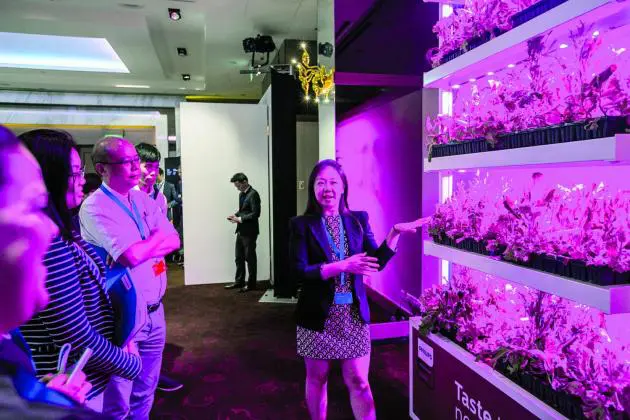
Those who live in condominiums will probably benefit the most from a new LED system that allows them to grow vegetables all the year round without the need for sun.
