
The Chinese fleet in Ayutthaya


Play
Historian Charnvit Kasetsiri examines the traces left in Siam of the great explorer Zheng He
THERE ARE THREE temples in Thailand associated with Sam Po Kong, the name by which Zheng He is known here. For noted historian Charnvit Kasetsiri, that is circumstantial evidence that the great Chinese admiral counted Siam among the ports of call on his globe-spanning explorations in the 15th century.
Charnvit cannot say with absolute conviction that the sailor who has been controversially credited with visiting the Americas long before Columbus actually came to Siam, but he certainly left his footprint in Thai history.
Charnvit, the former rector of Thammasat University, has just released a book, “Studies in Thai and Southeast Asian Histories”, in which he suggests that Zheng He very much has a presence in the Kingdom, even if he never came in person.
“Zheng He-Sam Po Kong: History and Myth in Thailand” is just one chapter in the 601-page book that began as an academic paper Charnvit presented at a conference in Beijing in 2005 marking the 600th anniversary of the admiral’s voyages.
The publication of the book is timely, given China’s ambition to establish a “21st-century Maritime Silk Road”, revitalising old sea routes linking to Southeast Asia and points west.
Though not claiming to be an expert on China or its history, Charnvit is a recognised scholar on Southeast Asia, and his research into Zheng He’s explorations have widened the perspective on China’s historical role in Thailand and the region.
He did his PhD thesis on the Ayutthaya Kingdom without ever directly mentioning the arrival of Chinese treasure fleets under the command of Zheng, and yet that is the place where begins the story he has now fleshed out.
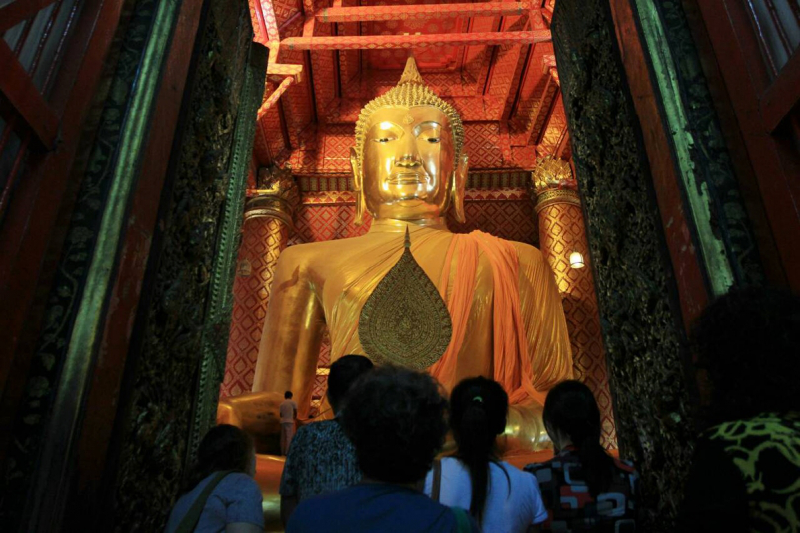
Wat Phanan Choeng in Ayutthaya, dating to its earliest period as the capital of Siam, has been associated with the name of Sam Po Kong, as have Wat Kalayanamit in Bangkok and Wat Uphai in eastern Chacheongsao province. “The latter two are relatively new, probably belonging to the first half of the 19th century,” he writes, but “they are like spiritual extensions, continuations and reproductions of the original temple in Ayutthaya.”
The Chinese were well acquainted with Siam, which they called Sien-lo. Ayutthaya and Sukhothai before it were required to pay tribute to the emperor in Peking (Beijing). “Ayutthaya became the new capital of Siam in 1351 and soon became a very important Southeast Asian enterpot. It sent regular tributary missions to China and at the same time attempted to extend its influence into the Malay Peninsula in the area of Melaka and present-day Singapore,” Charnvit notes.
In his time Zheng would have dispatched ships to carry these gifts home, along with coveted imports. However it’s a mystery why this commander, a Muslim and a eunuch by dint of his devotion to the imperial court, would be venerated in Siamese Buddhist temples.
Charnvit writes that the question of whether Zheng ever personally visited Siam remains unresolved (Wikipedia notwithstanding – it cites Lonely Planet in stating outright that he was here). Suebsaeng Promboon, another well-known historian, is of the school that believes he personally visited Ayutthaya during his second world expedition in 1407-9. On the other hand, the late American anthropologist and China scholar G William Skinner doubted it ever happened.
“It is likely that the grand eunuch admiral Zheng He never came to Siam-Ayutthaya,” Charnvit quotes Skinner as deciding. “But certainly, the capital and other parts of Siam were visited by several important member of his staff, including Ma Huan, Hung Pao and Fei Hsin.”
Interestingly, though, Skinner concluded that Luang Pho Tho, a much-revered Buddha statue at Wat Phanan Choeng – which was built in 1324 – bears the mark of Zheng. The statue is also known as Sam Pao Kong, and the admiral was alternatively called Sam Pao.
In the former case, the name is a literal Chinese translation of rattana trai – the concept of the three treasures of faith (the Buddha, the dharma and the sangkha). In the admiral’s case, the name means “protection” and is written differently but pronounced the same.
Ayutthaya had a sizeable Chinese community from early times and, according to Charnvit, even if Zheng never visited himself, a portion of his vast fleet would have had a presence. “And this is why his story has been remembered, reconstructed and reproduced for the last hundred years,” he says.
Charnvit investigated how well Zheng is “remembered” in Thailand today and of course found him best known among the present Chinese community. “For the Sino-Thai, Zheng is an ancestor as well as a protecting deity. Thais who aren’t well educated or globally connected have rarely heard the name Zheng He, but everyone knows the name Sam Po Kong. Even so, it is rather doubtful whether they regard Zheng He and Sam Po Kong as the same person.”
At the temple in Ayutthaya Charnvit found Chinese characters “almost everywhere”, but, to his “astonishment” no statue of Zheng.
Several kilometres down the river at Paknam Mae Bia is a small temple dedicated to one of Sam Po Kong’s chief lieutenants, revered as a deity who protects Chinese travelling by sea. A Sino-Thai vendor told Charnvit it was more likely that junks and other ships from overseas would dock there rather than at Wat Phanan Choeng, which would have put them too close to the city wall for the king’s comfort.
