
Lessons from the cocoon


Play
In Vietnam silkworms are being ‘trained’ to weave blankets
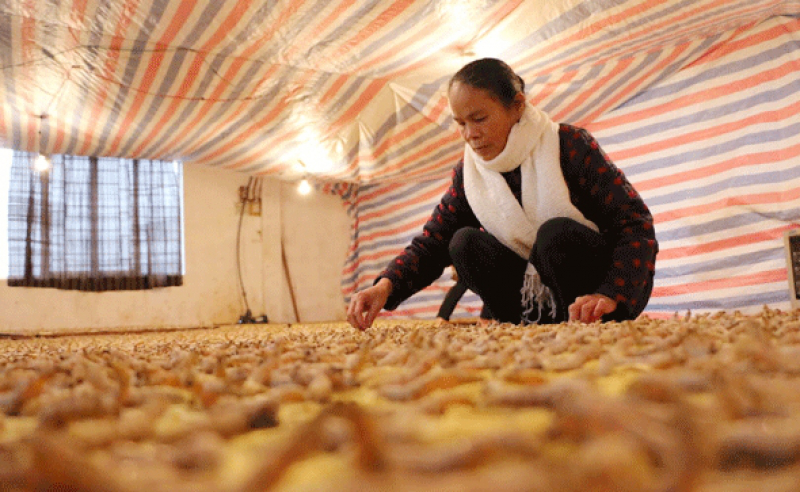
Carefully picking up a silkworm she’s spotted crawling out of line, Phan Thi Thuan gently puts it back into its right position. She then walks around the frame, which is about 2 metres long and 1.8m wide and covered with thousands of silkworms, to check whether all her silkworms are staying in order, stopping occasionally to replace a tired worm with a fresh one.
Thuan’s silkworm charges are “training” to secrete silk filaments to weave batting for silk blankets, a project she launched in her village in Hanoi’s My Duc district five years ago as a measure to counter dwindling silk production.
“My home in Phung Xa commune was famous for silk production 100 years ago but the production tapered off as we could no longer compete with Chinese products,” the 65 year-old explains.
Failing to find a market to sell their silk products, many of her fellow villagers returned to farming or looked for other occupations. Thuan was an exception.
Passionate about silk and involved in its production since she was a child, she was determined to find a more simple and efficient way to keep the traditional craft alive.
“One day, I was watching the silkworms secrete silk filaments to weave their cocoons and it struck me that we could perhaps use the silkworms themselves to produce our tailored fillings. After all, the strong cocoons they weave are superior to any handmade embroidery technique,” she says.
“I spent months watching, following and studying the habits as well as life cycles of the silkworms to find the most appropriate time to turn the silkworms into weavers to weave silk batting for blankets,” Thuan says.
“And then I experimented.”
Thuan admits that her neighbours thought she was crazy at first, and refused to believe that the silkworms could spin silk filaments into blankets.
“Time and effort helped answer their questions. After nearly a year, I had successfully trained the silkworms to secrete silk filaments and spin them into blankets,” she says.
“Of course, it’s not real training. I just put them together and create favourable weather conditions for them to secrete silk filament.”
Tuang puts suitable silkworms on a frame on flat ground (the size of the frame depends of the size of blankets). The first day she leaves the silkworms to grope around and make their nests. That task completed, she says, they start to secrete silk filament. Each silkworm will secrete around 400m to 500m of silk filament.
Forty kilograms of silkworms are required to make one kilogram of batting.
“The environment must feel as safe as in their cocoons. That means no sunlight, no wind and no loud noise. The silkworms will crawl in disorder immediately if there is sunlight, wind or a sound,” she says.
It takes fours to five days for silkworms to secrete all the silk filament on the flat and make a batting.
“After cleaning the batting, we get a soft and breathable silk layer,” she says.
The new technique has proved much better than the traditional methods of weaving silk batting by hand, producing high quality products that are softer and easier to dye and wash.
The new method has also proved cost effective in the production process. Normally, it will take six people working 15 days to complete the whole production process of a silk batting. However, it takes only four to five days for the silkworms to finish their work.
This has significant meaning in creating a competitive edge for Vietnamese silk products in the international market.
With this is mind, Thuan set up the My Duc Mulberry Silk Company, which specialises in producing silk products of various kinds, such as the silkworm-made blanket, a speciality.
Silkworms-made products have gained attention and are particularly popular with foreign customers.
Her company’s products are sold both at home and in the US, Japan, Thailand and the UK.
Her efforts to develop the silk industry have also been widely recognised and she has been presented with many merits and awards, including the first prize for technical innovation of farmers nationwide earlier this year.
After a rest, Thuan starts walking around again to check the working process of her “silkworm workers,” to make sure that they are still in the right order.
“Like a silkworm working with industry and secreting silk filament until it dies, I will continue to work as long as possible,” she says.
