
Star power in ‘the killing fields’
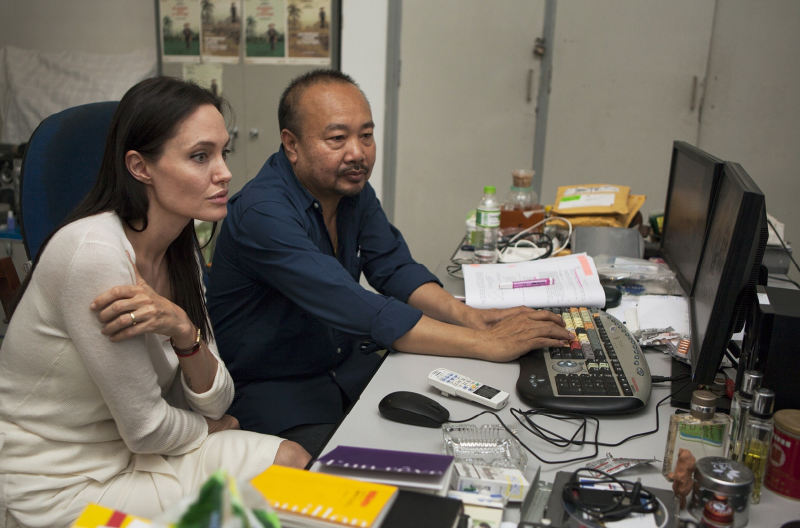


Play
Angelina Jolie lends her Hollywood clout to Cambodia's resurgent film industry
When Angelina Jolie first came to Cambodia in 2000 to make the action film “Lara Croft: Tomb Raider”, the country was just emerging as a democracy after decades of war and then foreign occupation
Land-mines remained in large swathes of the country, the last band of Khmer Rouge guerrillas had disarmed just a few years earlier, and poverty was endemic.
Despite the numerous problems faced by Cambodia then and now, Jolie fell in love, calling the Southeast Asian nation the “most beautiful country in the world” in December 2014.
In the years since “Tomb Raider”, Jolie, 40, has become Cambodia’s unofficial ambassador to Hollywood and the rest of the world.
She has also used her star power for good, returning to Cambodia numerous times on behalf of the UN High Commissioner for Refugees and adopting a Cambodian son, Maddox, in 2002. For creating a wildlife reserve in Cambodia in 2003, she was awarded citizenship by King Norodom Sihanomi two years later to set alongside her US citizenship.
Cambodians have in turn reciprocated the love. That heightens the sense of anticipation for her next project, an adaptation of “First They Killed My Father”, a memoir of the Khmer Rouge-era when the radical communist regime ruled the country from 1975 to 1979.
“A lot of Cambodians know her, a lot of youth know her, because she is in many films,” says Chea Sopheap, director of the Bophana Audiovisual Resource Centre in Phnom Penh. “She is the person who has done humanitarian things in Cambodia... Everybody knows her.”
Jolie attended the Cambodia International Film Festival, which was co-hosted in December by the Bophana Centre, joining a panel discussion with young Cambodian film directors before an audience of 700.
The Phnom Penh festival named her president of its honorary committee.
Her patronage brought much-needed attention to the event and the Cambodian film industry, says French-Khmer filmmaker Davy Chou.
Thanks to the media coverage of her attendance, the annual festival enjoyed the limelight after six years of efforts to provide the city with a fest of international quality, he added.
Cambodia’s film sector has been hit by challenges unlike any in the other countries in Southeast Asia. After a flowering of filmmaking in the 1960s, most of the country’s actors and directors were either killed or forced to flee when the Khmer Rouge came to power in 1975.
Any person with Western associations, or who spoke a foreign language, or even wore glasses was suspect. The radical Maoist regime often killed such people.
Rebuilding the film industry has taken time, as the country had to heal from its war wounds. But the return of exiled filmmakers and a new crop of young talent has helped it to recover.
One such director is Rithy Panh, who is co-producing “First They Killed My Father” with Jolie.
Panh has helped to lead the film industry since returning from France in the 1990s, and also brings his personal experience of living under the Khmer Rouge regime as a child to the project.
Having a Hollywood star champion the local industry has also helped to bring it renewed attention overseas.
Most Cambodian films are shown on the art-house and festival circuit, with big-name films shot in Cambodia directed by foreigners with foreign actors – such as “Tomb Raider” and 2002’s “City of Ghosts” starring Matt Dillon. “The Killing Fields” was shot in Thailand, although its story took place in Cambodia, and Cambodian star Haing S Ngor won an Oscar for his role.
“First They Killed My Father” will be filmed entirely in the Khmer language with local actors, and shot on location around the country. Jolie worked with the memoir’s author, Loung Ung, to write the script, and has cast her son Maddox, now 14, in the film.
While “First They Killed My Father” has some Hollywood flair, Jolie’s project is still “local” enough for Cambodians to fully appreciate.
“Cambodian people and Cambodian film makers are very excited and very proud of this [project],” says Chou.
