
Pursuit of the oblique line


Scenes of ethnic village life yield to more conceptual thinking in the art of Dinh Thi Tham Poong
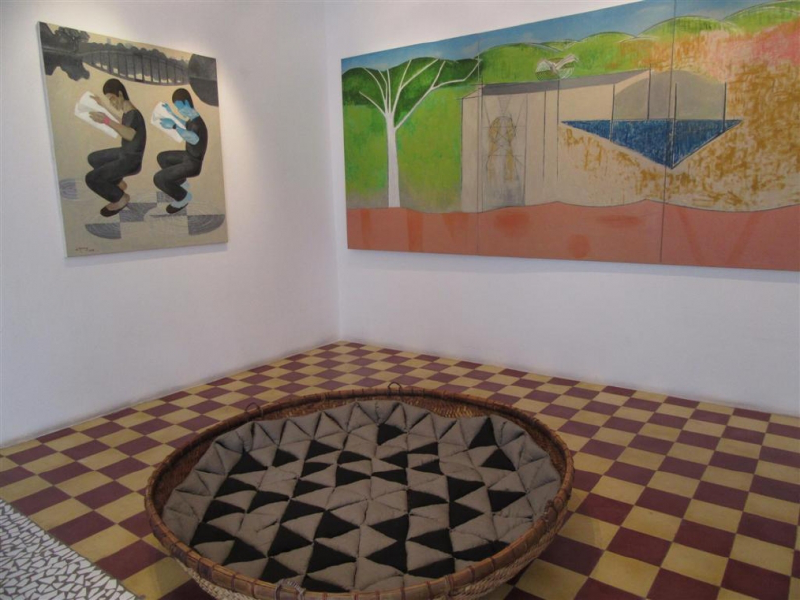
Dinh Thi Tham Poong has set aside the hand-made paper known as do, or sometimes poonah, on which she painted the scenes of ethnic life that made her famous. Her latest solo exhibition in Hanoi finds her exploring all sorts of materials – oil on canvas, ceramic fragments held together by embroidery, even bamboo baskets.
“Since 2008 I’ve been experimenting with new things, with oil and ceramics,” she says. And catchy titles: The exhibition is called “Destination Point of an Oblique Line”.
“When I look at something but don’t really concentrate on it, I get lost in my thoughts.” And, similarly, the new art represents fresh ways of seeing the world. “I perceive two ways of seeing. One is the real and the other is the imaginary – what one wants to see – the destination point. The two different points connect and disconnect, but should never be too far apart or too close,” says the 46-year-old.
The canvas of her oil paintings offers a completely different texture than the do paper, playing into the concept of altered perspectives and sensations.
“Like the Shadows on Water” has two figures sitting by Hanoi’s Hoan Kiem Lake absorbed in a newspaper, and the shadow they cast is embroidered and takes the form of a target, yet another point of concentration.
Portraits of ethnic women – and one of the artist – also appear in the show.
The small, golden ceramic pieces include a fingerprint held in place against canvas in much in the same way the artisans in her native village fix an object centrally in the loom around which they weave patterns.
Dominating the middle of the gallery is an enormous bamboo “nest” with triangular cushions arranged in a pattern. It’s a mandala of the universe, or perhaps a rendering of the sacred dance of Venus and Mars, the conjunction of the shapes suggesting the nature of the relationship.
“I want people to imagine entering the mandala basket and think about their interaction with the intersecting lines and shapes, exploring their own interconnectedness,” Poong says. “They’re all points of intersection – crossing, dividing and morphing into a new existence.”
Gallery director Suzanne Lecht suggests that Poong finds order in all aspects of life. Being “born of an ethnic Muong father and White Thi mother in the remote northern region of Lai Chu, her life began in nature, in close alignment with the seasons and the phases of the moon. Life was simple and free to align with the shifts in nature.
“Her new works are a departure in form, medium and presentation, but are once again a convergence of the intersection of the many paths or lines she’s crossed or encircled in her life.”
Born in 1970, Poong studied sculpture at the Hanoi Fine Arts College and has received several prizes for her work from the Ministry of Culture and Information. After graduating from the Vietnam Fine Arts University in Hanoi in 1993, she became quickly established as one of Vietnam’s leading female painters.
Yet Poong remembers clearly what it was like leaving her parents’ house to study in Hanoi. “I was 18 when I came to study art,” she says. “I cried a lot during those three years because I missed my family, but I finally understood that I’d grown up and had to become independent.
“Now I feel very lucky for having so many good friends and devoted teachers who helped me a lot during my difficult moments.”
The memories of Lai Chu have never faded. Her watercolours on do paper reveal that strong connection with trees and plants. Interestingly, though, her greatest artistic influence comes not from the real but the surreal. She admires the Belgian surrealist Rene Magritte above all others.
Like him, she often uses metaphysical devices to convey messages. There can be a challenging ambiguity in her images, but it’s clear enough what she sees with her vivid imagination.
Poong has often exhibited overseas and her works are in the permanent collections of museums in Singapore, Switzerland, Fukuoka in Japan, Illinois in the US and Salzburg, Austria.
BOX
“Destination Point of an Oblique Line” continues at the Art Vietnam Gallery on Ly Quoc Su in Hanoi until March 26.
