
A tale of two countries


Play
Traditional arts and crafts from South Korea and Thailand share space at the Korean Cultural Centre in Bangkok
Art lovers look on in silent wonder as Korean carpenter Sim Yong-sik painstakingly assembles the wooden sticks of a window partition. An expert in somok, as the Korean traditional joinery of doors and windows is known, he carefully puts the pieces together, knocks tiny triangular woodpins into the holes, then cuts their tails, sharpening the surfaces with his personal plane. He coats the window with a glue made from rice, places it in the frame, then slowly places saa paper on the motifs. The process ends with a light spray of water and the smoothing of the paper.
Sim Yong-sik smiles up at his audience as he shows them the miniature wooden window he has delicately crafted without a single nail.
“I’d like to preserve the Korean treasures for the next generation,” says the 64-year-old artist who has almost five decades of experience to his credit and is responsible for much of the wooden preservation work at South Korea’s temples and palaces including popular Seoul tourist attractions Gyong Bok Gung and Chang Deok Gung palaces.
The master carpenter is in town as part of the “Korean Treasures from Seoul: The New Path of Korean-Thai Arts and Crafts Destination” exhibition, which opened on Thursday evening at the Korean Cultural Centre on Sukhumvit Road.
Sim Yong-sik’s door and window partitions are on display along with another 150 handicrafts created by 23 masters from Society of Seoul Intangible Asset of Seoul Metropolitan. Alongside are more than 60 crafts by nine artisans from the Support Arts and Crafts International Centre of Thailand (Sacict), which serve to underline the common culture of traditional craftsmanship between the two countries.
“While we are delighted that K-pop and hit TV series like ‘Descendants of the Sun’ are very popular in Thailand, we would like to present Korean history, traditional culture and our excellent craftsmanship through ‘Korean Treasures from Seoul’. We hope this exhibition will be the first step in our collaboration to exchange knowledge on traditional crafts,” South Korea’s ambassador Noh Kwang-il, said at the opening.
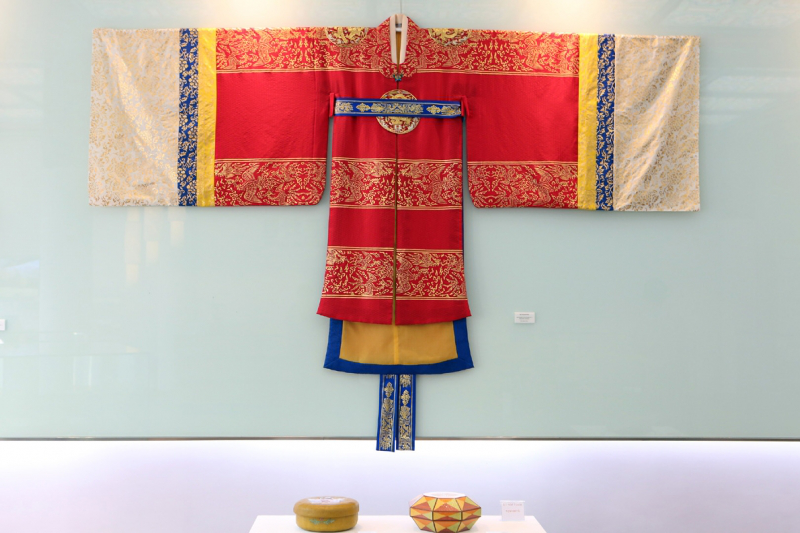
Those traditional crafts include Korea’s royal hanbok (the Korean traditional costume for the Queen) and Thailand’s phan waen fah (a wooden pedestal tray used in the royal court) along with everyday life household items like lacquered wooden lunch boxes, baskets and matches. The pieces are cleverly arranged, with similar items displayed next to each other while more distinct works are showcased in separate corners.
The highlights of the exhibition are the treasures from Korea, 23 of which feature on the Seoul Intangible Cultural Heritage lists. In addition to Sim Yong-sik’s somok (doors and window), visitors can admire Park Kwang-hoon’s delicate needlework (chimseon) in the hanbok hanging on the wall. Chimseon refers to the needlework produced by the seamstress – a chimseonjang. The specific technique and delicate patterns she used reflect the class and usage in the hanbok for the queen.
Kim Eun-young turns the Korean tradition of decorative knots into an art form. A craft that dates back to the Joseon Dynasty, knot production was originally divided into three processes: dyeing, weaving and applying tassels. Today, they are all handled by one master, of which Kim is among the best known.
Another highlight is Jung Myung-chae’s lacquered mother-of-pearl plate inlaid with clouds and cranes. During the Goryeo and Joseon periods, the art was shared between two craftsmen with the najeonjang responsible for the pearl decoration and the chiljang for the lacquer finishing. However, the demand for lacquered works decreased after the Korean War, and the work of the najeonjang was absorbed into the work of the chiljang.
“The exhibition reflects the common culture of craftsmanship that uses natural material like wood, rattan, straw and lacquer while also preserving traditional techniques,” explained Amparwan Pichalai, Sacict director.
Alongside Jung Myung-chae’s magnificent piece is a beautiful lacquer work decorated with mother-of-pearl by Sanae Jamjirarak, named Master of the Arts of the Kingdom by Sacict in 2009.
Once used at the court but now a collector’s item, his phan waen fah has two tiers made from crafted rattan that are coated with chad (red-coloured wood) and covered with another coat of rak (lacquer). Sanae spent five months completing masterpiece.
“The most difficult process is in fitting the 16-angledcorners together,” Sanae told XP.
Other Thai treasures include silver nielloware by Nikhom Nokauksorn and double ikat phrae wa silk by master Kamsorn Srathong from Kalasin while Korea offers musical instruments by Kim Bok-gon, bows by Kwon Mu-seok, Kim Man-hee’s folk paintings and Eom Ik-pyeong’s jade.
Hanging together on the wall are mattresses by both Korean and Thai artisans: Choi Hun-yul’s rush deung-me and Jurairat Sappasook’s Chanthaboon reed mat. While the natural materials used are similar, the finished products are very different with Jurairat’s work depicting a unique Thai motif and Choi Hun-yul’ covered in Korean calligraphy.
In a video presentation screened at Thursday night’s opening, Seoul’s mayor, Park Won-soon, said that the show not only aims to promote the rich craftsmanship of both countries but tourism too.
“More than 1.5 millions tourists from Thailand and Korea visit each other’s country every year. We are confident that this kind of cultural cooperation will see an increase on both sides.”
Amparwan echoed his hopes, saying that she believes that this international arts and crafts network will be another important factor in encouraging artistic exchanges and will lead to sustainable joint development in the near future.
“Coincidentally, Sacict is planing to invite Korea’s silversmiths to join the workshop in Thailand this June. I think we will learn more about the uniqueness of each countries while reinforcing what we have in common,” she said.
Soul of Seoul
