
‘Ziarah Tambora’: Moving festival across Indonesia's Sumbawa Island


Play
SUMBAWA ISLAND - If you attend a Western music concert it will probably be in one of the most exclusive venues of Jakarta. Similarly, if you listen to African music, it might be among the world-music lovers of Kemang in Jakarta or Ubud in Bali - not in on
This elitism is changing however. Following a “crazy” idea, which a famous Indonesian cultural activist, Taufik Rahzen, recently managed to “sell” to the Indonesian Institute of the Arts (ISI) Art Institute of Surakarta, Central Java, as well as to the Tourism Ministry and other institutions, Western and African music are no longer the exclusive preserve of the rich, but can also be performed among and for ordinary villagers and fishermen.
When did this happen? On the occasion of a cultural “pilgrimage” organised on April 7-17 on the island of Sumbawa as a side-event to the recent Tambora Festival.
Tambora is the mountain whose 1815 eruption dwarfed the 1883 Krakatoa eruption and can only be compared to the Santorini (Cyclades islands in the Aegean Sea) eruption that destroyed the ancient Cretan civilisation.
The present government is using the 200th anniversary of this extraordinary eruption as a means to promote tourism in Sumbawa. Hence the Tambora Festival which is Taufik Rahzen’s idea of a moving festival, hence a “pilgrimage” to ensure its success.
Taufik set up the Ziarah Tambora cultural “pilgrimage” as a multi-faceted event. For its foreign participants — British, Mexican, Sri Lankan, Mozambican, American, Polish — it was a discovery of wonderful Indonesia: as they hopped from island to island in the Saleh Gulf or trekked on the slopes of Tambora, they met smiling people everywhere and nature in all its wonders and diversity.
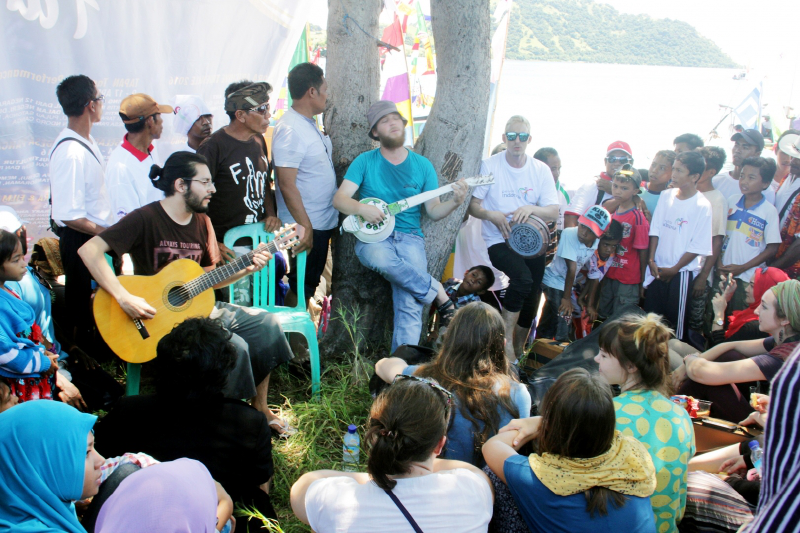
But it was also devised as a cultural encounter. They were welcomed by villagers with songs and flowers and repaid their hosts with music from the world over.
Westerners played violin; Arone, a young Mozambican, beat African percussions with a strange, gamelan-looking wooden instrument; Leon the Mexican sung Zapotek aubades, and Bilky mesmerised all with strange Sri Lankan laments.
In the first days, there was also Mustafa “Debu” the ex-American who played, to wild applause, Muslim gambus music to Sumbawan gambus lovers.
Not to forget, among the Indonesians, the mantra-like chanting and ululations that Bambang Besur (artist) addressed to the trees and gods.
All along the atmosphere was one of equality between the participants, as well as between the artists and their Sumbawan hosts. Seen from the latter’s point of view, it was a far cry from the too often alien foreign culture they watch on TV screens or on occasional visits to beach resorts.
On the whole the experience was indeed a fascinating “pilgrimage”, a friendly discovery of cultural “otherness”, with music as its medium.
The key to the success of this pilgrimage was in the selection of its participants. There was a small core of Indonesian artists and activists.
As for the foreigners, they were picked from among the holders of Indonesian scholarships found at the ISI Art Institute in Surakarta. Most were students of Javanese gamelan (traditional ensemble music of Java) or ethnomusicology, thus already open to diversity. Yet, they all had to descend from their ivory tower, which made it an experience they will probably recall for their whole life.
Of course the Ziarah Tambora program did not aim at being entirely idealistic. It was part of an endeavor to broaden the concept of cultural tourism by opening new areas to tourism and new modes of contact between foreign visitors and Indonesians.
It is in this context that the visits to islands and Tambora plantations were organised. It also comprised on-site evaluations of complementary activities and infrastructure such as village museums, libraries, contemporary art events etc.
Finally it aimed at identifying the type of visitors best suited to this new cultural approach to tourism.
Important lessons can be drawn from the program, the principal one being that the notion of cultural tourism must be broadened: It must become participative cultural tourism. With adaptations — having cultured tourists selected and paid in one way or another- this new concept has probably a bright future ahead.
