
A tactile tale


Play
His Majesty the King’s best-selling “Story of Mahajanaka” is retold through bas-relief sculptures and animations created especially for the visually impaired
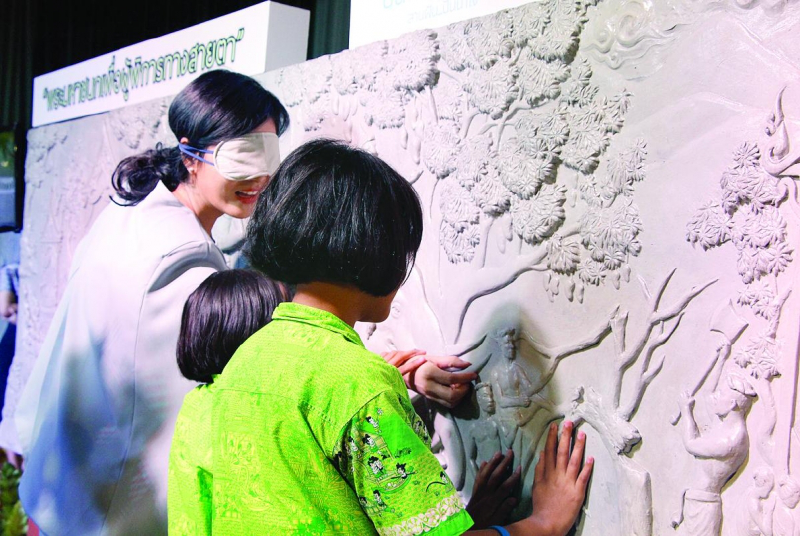
NET, WHO was born blind, gently touches a cement bas-relief sculpture depicting scenes from the story of Mahajanaka, which recounts the last incarnation of the Buddha before being born again as Prince Siddhartha. Next to the sculpture is a TV screen projecting the story in animated form complete with descriptive audio and sound effects to help visually impaired individuals like Net to synchronise the tale with what he is feeling through his hands.
The youngster slowly explores the entire sculpture as he listens to the animation. “I know this is an elephant,” the 17-year-old tells a sighted guide when the audio narrates the battlefield. “Can you guide me to the important scene of Mahajanaka swimming for seven days and seven nights in a stormy ocean?” he asks.
Net, a Prathom 6 student at the Bangkok School for the Blind, and his friends were among the first sight-impaired youngsters to test the “Bas-relief Sculpture and Animation of Mahajanaka for the Visually Impaired”, a pilot project initiated by Pun Fun Pun Yim, a non-profit organisation that focuses on the health of the underprivileged, and the Thai Health Promotion Foundation. The aim is to provide a barrier-free experience for the blind.
“I read the braille version of ‘Mahajanaka’, so I understand the story quite well. This is the first time I’ve felt connected with art. It’s very moving,” Net told The Sunday Nation.
On show recently for three days at TK Park at CentralWorld, the three bas-relief sculptures – each measuring four-by-one metres – have been created by instructors and students of Poh Chang College of Fine Art to match the three acts of animation produced by Vithita Animation. The tale is based on the “Story of Mahajanaka” (1996), the literary work penned by His Majesty King Bhumibol that demonstrates perseverance, wisdom and loving-kindness.
His Majesty brought a modern twist to his Mahajanaka, which is based on the story from the Tripitaka, after listening to a sermon about King Mahajanaka. He wanted this story to encourage everyone to face problems with courage and perseverance in all circumstances.
“In addition to the descriptive audio, giving blind and partially sighted persons the chance to touch the artworks helps them connect to the story while also enjoying the experience,” says Pun Fun Pun Yim director Nattapong Mokhaphan.
“The sighted are also encouraged to visit this event too but they’ll be given a blindfold to get an understanding of how the blind feel.”
Vithita Animation participated in the production of the 112-minute animated film “Mahajanaka”, which screened in theatres two years ago, so it was not new to the tale.
“The challenge was telling the complicated story in a nine-minute animation without distorting the version in the King’s book,” says Santi Laohaburanakit, Vithita’s deputy managing director.
“It took about six months for a team of designers to draw a new storyboard and complete the animated version. We obviously couldn’t use the one we created for the full-length film.”
The comic book, which was illustrated by cartoonist Chai Rachawat, was used as the reference to develop the storytelling and character design of the new 2-D animation.
“Actually it should be called ‘limited animation’,” adds Santi. “The emphasis is not on the moving picture, but on the subtitles for the hard of hearing and the sound effects such as the stormy ocean and the battlefield to help them follow the dialogue. We have worked with the staff of Poh Chang College to ensure that both the sculptures and animation follow exactly the same direction. We discussed which scenes should figure in the sculptures and then the artists carved the works based on the storyboard. The animation plays an important supporting actor role, but the prize for best actor has to go to the bas-relief sculptures.”
Divided into three acts each lasting three minutes, the first act “Birth” chronicles the life of Mahajanaka’s father Prince Aritthajanaka of the city of Mithila and his younger brother Prince Polajanaka, who fall out when a high-ranking minister drives a wedge between them. Polajanaka escapes but later returns to fight against Aritthajanaka, who is killed in the battle. Aritthajanaka’s pregnant wife has to flee to another city and it is here that Mahajanaka is born.
In the second act “Perseverance”, Mahajanaka is a grown man and wants to earn back the throne that rightfully belonged to his father. He sets sail for Mithila but is shipwrecked in a massive storm. He survives by swimming for seven days and seven nights and is finally rewarded for his perseverance by the goddess of the sea Manee Mekhala, who takes him to Mithila.
The last act “Wisdom” sees him married to King Polajanaka’s daughter Sivali Devi and becoming king. But after witnessing the ravaging of a mango tree by greedy citizens, he sees similarities with his position and is thus ordained so he can share his wisdom with others.
Actresses Nattarika Thamapreedanan and Panadda Wongphudee voice Manee Mekhala and Mahajanaka’s mother respectively while the comedian Yong Chernyim takes on the councillor.
Each of the three bas-relief sculptures is devoted to one act, which took six instructors and 60 students five months to complete. The sculptures are formed from clay and moulded with cement. Each weights about a ton.
“Bas-relief is more suitable for depicting complicated subjects with many figures and very active poses such as battles than free-standing sculpture. We chose cement because it is durable and has a much better tactile feel than resin. We have been careful not to underestimate the blind’s perception of forms. They make up for what they can’t see with a strong sense of touch,” Poh Chang’s instructor Chatmongkol Insawang, explains.
The relief sculptures, he adds, don’t require delicate details of figures but a sharp outline of each subject is crucial.
“The challenge was how to illustrate the important scenes in each act in one sculpture. The first sculpture focuses on the battle scene between the brothers Prince Aritthajanaka and Prince Polajanaka. The highlight of the second act is Mahajanaka swimming in violent ocean weaves, so the second sculpture doesn’t require many relief figures, just Mahajanaka swimming alone in the vast ocean and Manee Mekhala, who gently cradles him in her embrace as she takes him to Mithila.
“The last piece emphasises two mango trees – one is so heavy with fruit that the people vandalise it as they strive to pick the tasty mangoes while the other is a fruitless tree that has been abandoned. Mahajanaka realises that his throne is like the fruitful tree and menaced by greedy people, so he decides to be ordained and live peacefully like the fruitless tree,” Chatmongkol explains.
While the project did attract many visually impaired students during its recent showing, the organisers need to find a way to bring the story to a wider audience. Cement bas-relief sculptures might be perfect for exploring with the hands but their weight makes it difficult to hold an exhibition that can travel to schools for the blind.
“We’ve made DVD copies of the animation, but the bas-relief sculptures might have to be reproduced in resin to make them easy to transport if we have several expressions of interest for the travelling show,” says Nattapong. “We do invite interested schools or institutes to contact Pun Fun Pun Yim and we will try to meet their needs.”
HANDS-ON HELP
Pun Fun Pun Yim can be reached at (096) 889 5315. It also has a TV programme dealing with underprivileged children that airs every Monday at 1.10pm on Channel 5.
