
To die or not to die


Play
Thailand-based Japanese playwright and director Shogo Tanikawa delivers a unique view on living and dying
Earlier this year, members of the Thailand centre of the International Association of Theatre Critics (IATC) made note of a major trend in contemporary Thai theatre – the significant rise, in both quantity and quality, of English-language productions by local expat theatre troupes.
What we forgot was the fact that for almost a decade now we have been enjoying Thai-language plays, usually performed with both Japanese and English surtitles, by resident Japanese playwright and director Shogo Tanikawa.
His latest work “Like a Rat: I Want to Be Beautiful” finished its three-weekend run at Blue Box Theatre last night and, like his previous plays, drew the attention and attendance of both Japanese expats and Thai fans who adore his different look at life,
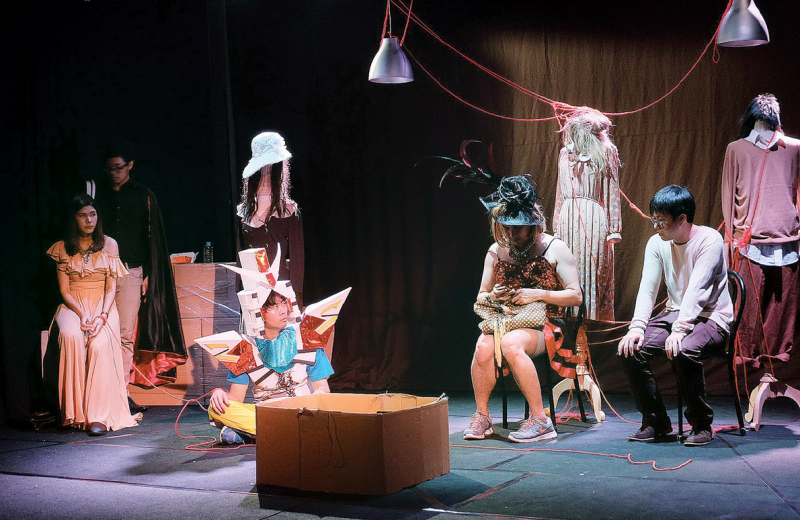
In this entertaining dark comedy, five strangers who met online decide to meet in person at a deserted warehouse full of mannequins. Despite the weird and wonderful costumes, the five are there to commit suicide together, albeit for different if valid reasons.
Tanikawa himself performed Sun, a “Hikikomori” who boxes himself in literally and figuratively, and as always his Japanese accent in delivering Thai dialogue was charming. Veteran actor Apirak Chaipanha portrays Gaga, a man married with children who realises that husband and father are not the roles he wants to play. Dressed as famous Japanese robot Gundam, Tewan Siripatanakulkajorn is Amuro, whose mother is against his fascination with Japanese manga. In the clothes of the knight in shining armour, Adidet Chaiwattanakul portrays another man who no longer wants to live and in those of the mermaid, Kanorkwan Intarapat is a professional singer whose recent surgery prevents her from singing again.
All is going to plan until – and this was more predictable than the twists in Tanikawa’s previous works – they realise they have nothing to light their charcoal with. None accepts other means of suicide, like strangling one another with the many red threads in the room.
While his commentary on the social media is commendable, it is amazing, even mind-numbing, how many different ways strangers can meet without ever coming face to face.
I do wish, though, that Tanikawa, as the director, had been able to find more time to hone the acting skills of his players. Adidet and Kanorkwan were realistic while the remainder were larger than life, and this led to a lack of balance when all five were on stage together. Of course, the play’s main theme, as suggested in the subtitle, “I want to be beautiful”, is pivotal in this day and age when many of us are not satisfied with what we have and each person spends more time, alone by himself online and yet feeling that he’s really connected to the whole world while in fact he’s living in an urban studio apartment by himself.
When Tanikawa was working as part of Life Theatre, whose other two core members are actress Sasithorn Panichnok and director Bhanbhassa Dhubthien, his works, like “Water Time” and “The Three Sisters”, were more refined. Theatre is a collaborative art after all, and one simply cannot do everything.
And so I wish to see the next work by Life Theatre soon: we have had enough of theatre troupes who come and go.
