
Loei is feeling spooked


Play
Bangkok gets to share in Isaan’s annual ghost fun this year as Ssean neighbours join in
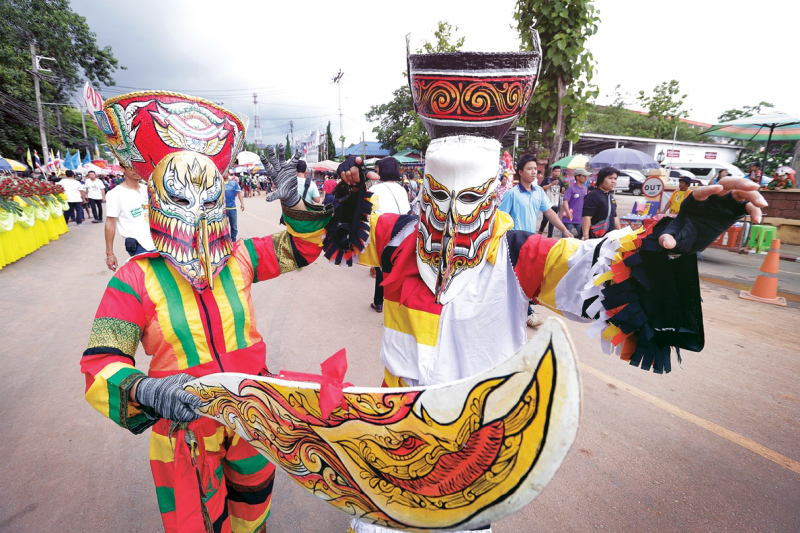
Loei's Dan Sai district is welcoming supernatural spirits from across Asia to its Phi Ta Khon Festival this week, the annual celebration of ghost lore that’s increasingly drawing global interest.
The event is, perhaps wisely, combined with the Bun Luang Festival, which involves making merit, in large part to appease spooks with evil intent.
And this year Bangkok gets a taste of the ghoulish goings-on, when the Asean+3 Mask Festival brings the walking dead to town on Saturday.
The Phi Ta Khon Festival, held during the seventh month of the lunar year, has its roots in the fable about Prince Vessandorn, the Buddha’s penultimate incarnation, who was escorted from his exile in the forest by the spirits of the woods.
It must have been a chilling sight for the inhabitants of the city to which the prince was returning to rule. And each year the festival organisers endeavour to evoke that horror with processions of people in frightful masks and costumes.
This week, as part of a Culture Ministry initiative, they’ll be joined by demonic spectres from Laos, Cambodia, Myanmar and South Korea for the inaugural Asean+3 Mask Festival.
“This year’s festival is bigger and more international, because we have our neighbouring spirits joining in,” says Samart Supama, who handles cultural events for Loei province.
The first scary sight that visitors are likely to encounter is the Phi Ta Khon Yai, a pair of ghost effigies – one male and one female. The people who make them say they have the permission of the spirits to do so for at least three years in a row.
Then there’s the Phi Ta Khon Lek, comprising groups of villagers dressed as ghosts, typically with long noses made from coconut husks and trailing streamers of woven bamboo. For two days these creatures are parading around, and then the costumes are ritually destroyed to guard the community from misfortune.
Loei and Andong in South Korea – twinned cities since 2007 – happen to share a tradition of masked dance and a widespread belief in the spiritual. Andong sent some of its performers again that year, returning the favour after Thais participated the Andong Mask Dance Festival, which draws more than a million visitors.
The Thai event will see the return of dancers from South Korea’s National Gugak Centre, who were well received at Chulalongkorn University in Bangkok in 2013 and 2014.
Their dances are registered as “intangible cultural assets” in their homeland, says the centre’s Kibok Jung.
“We want to show how we communicate with the audience through these two shows – ‘Bongsan Talchum’ and ‘Cheoyongmu’ – which are not often presented. The facial expressions and movements are unique to Korean masked dance, |and that’s all that’s needed to communicate. Plus, ‘Bongsan Talchum’ lets the audience become part of |the performance. Language is not a barrier.”
“Cheoyongmu” originates from the legend of Cheoyong, in the reign of King Heongang (815-886) and is performed entirely by male dancers. Each of the five dancers wears a different colour, and in energetic fashion depict the unification of the five elements to exorcise evil spirits.
“Bongsan Talchum” is a quintessentially Korean talchum (masked dance) originating in Hwanghae province. It’s a social comedy about a nobleman, monk and commoner.
Also coming to Thailand is the Kabong Lao Puppet Theatre, a hit at last year’s World Puppet Festival in Bangkok. The troupe will be deploying its “equipment puppets” fashioned from everyday objects, just like the Phi Ta Khon masks. The Lao also use items like pha khao maa (sarongs), coconut husks and woven bamboo in their costumes.
Kabong Lao’s five-part show begins with “The Journey of the People”, a very modern look at how migrants must have the proper documents. “The Little Coconut” considers the multitude of uses for a nut so common across Asia.
“Elephant the Imagination” similarly examines the animal’s importance, and also laments its decline in numbers in the region. “Arts Mask” is about dishonesty, whether to one’s nation, family or other people, and how it’s punished even in death through the tormenting of souls.
The finale is “Trashcan”, a stirring look at the conflict in the world that pits people against nature and each other.
As previewed at the Asean Plus Ramayana Festival in Bangkok in April, Cambodia and Myanmar are dispatching demons from the beloved Hindu poem.
The Cambodian Dance Troupe will stage “Lakhon Khol”, recounting the episode “Kumphakan Stopping the Water”, and a Myanmar troupe will present “Rama Pursuing the Enchanted Golden Deer”.
The Ramayana – called the Ramakien in Thailand – is known throughout the region, but each country, including India, where it originated, has it own way of retelling the tales.
Kibok Jung notes that South Korea hosted a workshop on Southeast Asian traditional dance in 2014 that had Phi Ta Khon dancers attending.
“The Phi Ta Khon dance is quite difficult in its movements because of the way the fingers are held,” he says. “But the music and dance are very enjoyable. Korean traditional dance tends to be very slow by comparison.”
Asked if he believes such cross-cultural exchanges do in fact bring countries closer together, Jung says it’s “the best way”.
“We need to organise many more workshops to share the dancing techniques. It’s through the specific movements found in different countries that you get to understand the cultural diversity.”
WHAT’S IN STORE
WEDNESDAY
9am: Procession from Chao Pho Kuan Shrine to Wat Phon Chai temple
10am: Bun Luang and Phi Ta Khon Festival Eve rites at Wat Phon Chai, with ML Sarali Kitiyakara presiding
10.30 and 7pm: Asean+3 Mask Festival performances
THURSDAY
9am: Phi Ta Khon Festival procession from Dan Sai district office to Wat Phon Chai
10am: Opening of Bun Luang and Phi Ta Khon festivals at Dan Sai district office with Deputy Prime Minister Tanasak Patimapragorn presiding
7pm: Asean+3 Mask Festival performances
SATURDAY
1.30 to 4pm: Asean+3 Mask Festival at the Asean Culture Centre in Bangkok, free admission
The centre is on the third floor of the Rajadamnoen Contemporary Art Centre on Rajdamnoen Klang Road. Call (092) 248 2429 or visit the “aseanculturalcenter” page on Facebook.
