
Wear the band and everyone feels better


Play
The Charge HR fitness tracker from Fitbit comes with a reminder of the hidden benefits
FITNESS-TRACKING devices such as the Fitbit Charge HR have become essential gadgets in the daily lives of anyone who wants to stay healthy. They’ve become so common, in fact, that AIA and other firms gear their healthcare insurance rates to using a fitness tracker wristband.
Provide the insurer with the data recorded on a fitness tracker to prove you’ve achieved a specific performance level and the cost of renewing your insurance policy comes down.
The insurance companies know that if their clients at least do a lot of walking, there’s less chance they’ll need costly medical attention. So there’s less risk of insuring them.
The bigger benefit is always to your health itself, of course. Wearing a fitness wristband means you’re constantly setting and upgrading goals, prodded along by its electronic alerts. I once lost my wristband and became less active without it. Along came the Charge HR from Fitbit, and I was back at it, power-walking and climbing stairs again.
Compact and comfortably lightweight, the Charge HR is barely noticeable even as you drift off to sleep. You get to find out just how deeply you snooze on top of the usual workout tracking, number of paces taken, average distance per step, stairs climbed and total time active.
Lacking a built-in GPS chip, it calculates distance from the number of steps while at the same time measuring calories burned.
The “HR” in the name stands for heart rate, and this is gauged with Fitbit’s proprietary PurePulse optical heart-rate technology – it’s continuous, automatic and all day and night.
Anyone with a heart problem can greatly benefit. The Annals of Emergency Medicine reported that the data tracked by a Charge HR helped doctors in the US save the life of a 42-year-old man who’d suffered a seizure. Seeing that their patient had shown an irregularly high and erratic heartbeat three hours prior to the seizure, they knew right away to use electric shock to stabilise his heart rate.
I strapped on a Charge HR and got a reading of 59 to 62 heartbeats per minute. While exercising that sometimes topped 100bpm.
So I felt secure being monitored, and found the device quite was comfortable to wear all day and while sleeping. You’re advised to take it off while showering, though – it resists sweat, rain and splashes, but doesn’t want to get soaked.
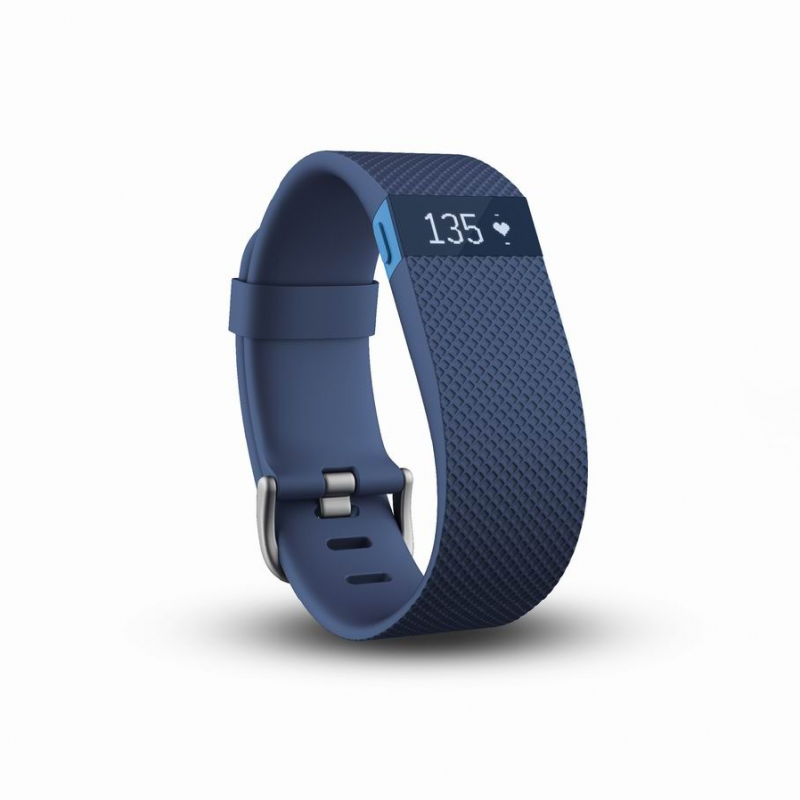
The wristband is less than an inch thick. In Thailand you can buy it in size small (5.4-6.2-inch circumference) or large (6.2-7.6 inch).
The single-line OLED displays the time, number of steps, number of floors climbed, current heart rate, distance travelled and calories burned, as well as the time at which the alarm is set. You press a button to cycle through that information, or just double-tap the band. By default you’re looking at the time of day, but that can be customised via an app or web page to show whatever you prefer to see.
When you raise your arm to look at the wristband, it displays the time by default. This too can be switched for something else, using the Fitbit app. It tells you to turn on your smartphone Bluetooth and press and hold the Charge HR button for three seconds.
Next you set up an account with Fitbit to store your fitness data, via a Facebook, Google Plus or email account. Input your birth date, height, weight and gender – all essential data to measuring your performance – and set a goal for losing weight.
The Charge HR will also handle your incoming phone, vibrating and displaying the name or number of the caller. Just switch this function off if you’re not interested.
Once you’re all set up, the band displays your first goal – 10,000 steps a day, the minimum for staying healthy. Boost the number if you’re feeling tough or lower it if you need a more modest start.
On a normal working day I take 13,000 steps, including a short walk from my bus stop to the front of my soi and my bicycle ride home. Fitbit reckons it’s equal to walking nine kilometres. As soon as I reached the agreed-upon goal, the Charge HR vibrated and displayed the magic number, and both my phone app and Web page displayed a “Sneakers badge” to congratulate me.
To begin with, the number of floors to be climbed each day is set at 10. My norm is 35 floors. (I’ve been doing this awhile.)
Steps, distance travelled and sleep quality are calculated using a MEMS (micro electro mechanical sensor) three-axis accelerometer, which measures your motion patterns. There’s an altimeter for the floors climbed.
Fitbit has recently improved the sleep-monitoring software. It works automatically, but you can also manually log when you go to sleep and get up, by using the app or by holding the button until it vibrates. One night, the device informed me later, I was in bed for five hours and 59 minutes, woke twice and became restless six times – a bumper crop of nice dreams, no doubt!
The Charge HR automatically recognises the type of activity you’re engaged in. Right off the bat, within 15 minutes it knows if you’re walking, running, riding a bike outdoors or doing an elliptical or aerobic workout. You can change the set times for auto-logging exercise or manually start and stop the tracking by holding the button until it vibrates.
If you’re exercising outdoors with a GPS-enabled phone, the Fitbit app also delivers summaries of your pace, heart-rate zones and route. While in exercise mode, it stores the heart-rate data at one-second intervals. Outside logging mode, it’s at five-second intervals.
And you can use the Fitbit app to record the food and water you have consumed during the day to better monitor your calorie intake and burn-off.
The built-in, rechargeable lithium-polymer battery lasts for about five days.
The internal memory holds detailed minute-by-minute information for the most recent seven days, along with daily summaries for 30 days. Thus you need to sync your tracker and Fitbit account at least once a week, and preferably every day.
The Charge HR can also sync directly to your computer using a provided wireless sync dongle. You need to install the Fitbit Connect application to use the dongle.
The Fitbit Charge HR has a suggested retail price of Bt6,250 and it is available in black, plum, blue or tangerine.
Key Specs
- Display: OLED
- Sensors, components: Optical heart rate monitor, three-axis accelerometer, altimeter, |vibration motor
- Memory: Tracks seven days of detailed motion data, daily totals for past 30 days
- Syncing range: 20 feet
- Call notifications: Via Bluetooth 4.0
- Syncing to computers: Internet connection and USB port required
- Syncing to mobile devices: Bluetooth and Internet connection required
- System requirements: Windows Vista or later, Mac OS X 10.6 or later, iPhone 4S or later, iPad 3 or later, leading Android and Windows devices
- Battery: Five days of use
- Included: Charging cable, |wireless sync dongle
