
Truly fit for a Queen


Play
Elegant outfits designed for Her Majesty by couturier Pierre Balmain go on show
WHEN THEIR Majesties the King and Queen embarked on a six-month state visit to 15 Western countries in 1960, the Queen was quick to recognise that the tour would offer an unprecedented opportunity to promote Thai textiles to the world.
She chose to do so through elegant Western-style attire, commissioning leading French couturier Pierre Balmain to design a regal wardrobe using mainly Thai silk. Balmain proved an excellent choice and Her Majesty garnered tremendous interest and acclaim, which contributed greatly to the tour’s success. Indeed, the trip established her as an international tastemaker and the era’s epitome of royal style with newspapers and magazines scrambling to publish photographs of the Royal couple.
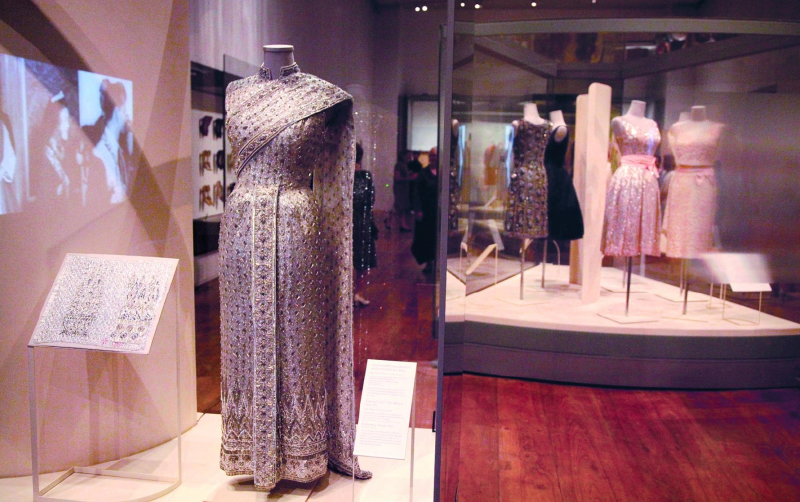
Some of those elegant outfits are now on show in a new exhibition at the Queen Sirikit Museum of Textiles titled “Fit for a Queen: Her Majesty Queen Sirikit’s Creations by Balmain”, which celebrates the auspicious occasion of Queen Sirikit’s seventh-cycle birthday.
“Fit for a Queen” focuses on the 22-year working relationship between Her Majesty and Balmain and showcases more than 30 of Her Majesty’s most stylish daytime, cocktail, and evening dresses, plus related accessories. Also on display are several pieces of the luggage custom-made by Louis Vuitton for Their Majesties along with nine design sketches and embroidery swatches on loan from Balmain SA and the House of Lesage in Paris to help illuminate the design and creation processes. Period footage and photographs further enrich the show.
“Balmain had to design all the dresses as well as the Queen’s hats and furs. It was cold in Europe and he made them in-house. He contracted well-known shoemaker Rene Mancini, who made a lot of shoes for couture houses including Maison Balmain and the footwear he designed is also on show here,” explains the museum’s consultant Melissa Leventon.
“Balmain went to Louis Vuitton for the trunks that would be required to transport the dresses and ensure they looked just like they had come fresh from the couturier. They are 24 in all, each with Her Majesty’s cipher and numbered so that her two wardrobe attendants could make sure that all the dresses were ready upon notice.”
Balmain chose to make Her Majesty visible to the crowd by using bright colours – Queen Elizabeth II’s couturier’s use the same technique.
“When Her Majesty arrived in a new city, she would disembark from the plane or car attired in a Thai silk suit in what we call jewel colours like emerald, ruby and garnet. These Balmain contrasted with patterned blouses and customised with a little bow that washis signature. He coordinated the whole outfit very neatly,” Leventon continues, adding that she thinks both Balmain and Her Majesty loved black-and-white polka dots because the Queen bought several polka-dots outfits over the next couple of years.
Balmain, along with Francois Lesage, who provided the embroidery for Her Majesty’s formal clothes, remained closely involved with the development of the Queen’s style.
As Her Majesty felt very comfortable with Balmain, she decided to continue to use him as her couturier. In 1963 Balmain and Lesage started to make the Thai national dress in eight styles and from the early 1970s their |work was further extended to developing strategies to transform Thai village silks into fashionable Western attire, which were |worn by Her Majesty to promote the work of the Support Foundation.
For an official visit to Iran in 1967, Her Majesty wore an evening dress in the Thai national style. The dress made from European silk and metal brocade connected beneath a layer of Lesage’s lavish and complex embroidery.
Also on show is an evening dress that Leventon says meets the European and American notion of a dress fit for a queen.
“This, for the West, is the quintessential royal gown,” she says, gesturing towards a dress made of silk satin with metal and iridescent-thread and crystal embroidery by House of Lesage.
The dress is one of the most formal Her Majesty owned and clearly shows Balmain’s love of 18th-century European style.
Silk by Design
“Fit for a Queen: Her Majesty Queen Sirikit’s Creations by Balmain” remains on display through June 2018 in Galleries 1-2.
A second exhibition “Dressing Gods and Demons: Costume for Khon”, (see sidebar) is on display until May 2017 in Galleries 3-4.
The Queen Sirikit Museum of Textiles is inside the Grand Palace and open daily from 9am to 4.30pm. Ticket sales close at 3.30pm.
