
Getting a feel for medicine


Play
Adapted to help the visually and hearing impaired learn and enjoy, Siriraj Bimuksthan Museum draws lots of young visitors
THIS IS AMNAT Srisung’s third visit to the Siriraj Bimuksthan museum and he is quite sure it won’t be the last.
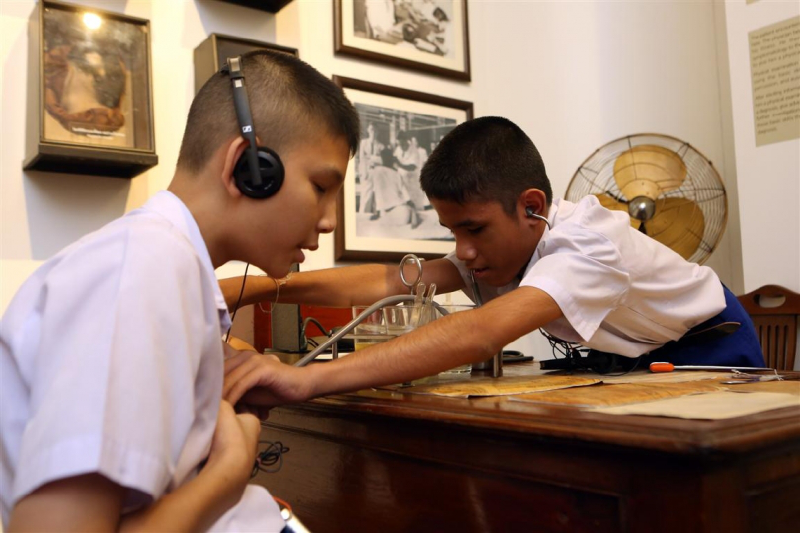
Amnat, who is visually impaired, first came to the museum on an outing with other School for the Blind students, then with his family. This time he’s with friends from school.
His mates are blind and so Amnat, who can see a little, is serving as tour guide. The collective lack of vision does nothing to dampen their enthusiasm.
Thanks to the efforts made by the museum in expanding access and learning bases for the vision and hearing impaired, both blind and deaf students can now explore the museum whenever they feel like it and mix freely with other members of the public.
“They don't want to be alienated, they are happy to enjoy the museum with other visitors,” says Assoc Prof Dr Tumtip Sangruchi who oversees the Siriraj Bimuksthan Museum.
Dr Tumtip, whose position as head of the medical faculty’s pathology department allows her to access the specimens used in training medical students, has put a great deal of thought and effort into setting up the museum in such a way as to allow the blind and deaf to be able to learn without their impairments being a barrier.
Audio guides are provided for the blind and staff members are on hand to take them from one area to another. The audio guide has been especially designed to provide as much detail as possible while the visitors handle the various exhibits.
For the hearing impaired, the museum has developed a video that takes them to different areas of the exhibition. They watch on a tablet and what they are seeing is also explained in sign language. There’s interactive learning too and Amnat took his friends to stand in front the TV monitor, explaining to them that thanks to cameras, they would be dressed in surgical gowns, masks and hats all ready to perform their first operation. Even though his two friends couldn't see for themselves, Amnat’s cheerful narrative had them smiling the whole way through.
The three boys then moved to the diagnosis room where on an old wooden table reminiscent of doctor’s surgeries in days of old, they picked up the stethoscope. Seeing their uncertainty, other visitors stepped in to help, explaining how the stethoscope works and placing it against their chests so they could hear their hearts beating.
“This is what I hoped to see – able-bodied visitors helping the blind and deaf to enjoy the exhibition together,” says Tumtip.
Surprisingly, the most popular base among the visually and hearing impaired is the anatomy display, where a real cadaver lies on a table underneath a sheet. Visitors can only touch the hands and are instructed to clean their own hands before and after touching the body with the hand soap gel provided at the area. The hands are well preserved and so the skin has a resin-like texture but the visitors were thrilled by this first encounter with a real dead body.
“I was terrified at first but it's okay when I tried touching. It’s a really exciting experience,” says a young blind student.
Most of the exhibits were created a few years back and have not been changed, although the museum has added a new exhibition on ophthalmology, where hundreds of cataracts removed from patients are stored in two glass jars. Used for teaching medical students, the cataracts are rarely seen today as removal is done by laser and not through surgery as in the last.
Dr Tumtip explains the ophthalmology exhibit was created to respond to the increase in eye disease, which she says is all too often ignored and because it is not treated leads to blindness.
Other new exhibitions will be created occasionally, she adds, and she will be asking different department in the faculty to showcase their items and ideas.
As not all the exhibits can be enjoyed by the non-sighted, Dr Tumthip has turned to the display of ancient weapons inherited by the Seniwongse royal family, descendants of Krom Phra Rajawang Bovorn Sthanbimuk. The real weapons have been removed and replaced with replicas, their edges left blunt so that they are safe for the blind to touch and feel.
Three years ago, Siriraj hospital held an exhibition for the blind and then took it on tour to several places around the country. That exhibition is now permanently set up at the School for the Blind.
“We don’t have many museums that give the blind and the deaf the chance to learn and enjoy themselves,” she says.
“I want to do a Siamese twins exhibition as we have a lot of materials we use for teaching medical students both in their medical and psychological studies. It would be perfect if we could work with the Chang and Eng twins museums in the States and borrow something belonging to the first Siamese Twins to exhibit in Thailand,” she says.
The newest of the hospital’s five museums, Siriraj Bimuksthan Museum is located on part of the land that was once Bangkok Noi train station. The plot is also home Sayamindradhiraj Medical Institute and the private Siriraj Piyamahakarun Hospital. The museum is named after Krom Phrarajawang Bovorn Sthanbimuk who was appointed Deputy Viceroy in the early Rattanakosin period. The common name of the prince was Prince of Wang Lang (The Rear Palace) as his palace was located in this area.
“My small project was among the more than 100 projects proposed for this land,” Dr Tumthip says with a smile.
SEEING IS BELIEVING
- The Siriraj Bimuksthan Museum is open daily from 10am to 5pm except Tuesday and official holidays.
- Admission is Bt200 for adults and Bt25 for children. Children not measuring more than 120 cm get in for free.
- For more information, visit Facebook.com/siriraj.museum or call (02) 4192618-9.
