
Discovering classic colonial bungalows in Malaysia


Play
When friends or relatives from the city visit Zulinawati Mohammed at her home, they usually mistake the light cloak of mist suspended over the oil palm trees for haze.
Such is the refreshing morning landscape and atmosphere when one lives amidst hectares of plantation land, away from busy rush hour traffic noise and city pollution.
Zulinawati, 38, is the wife of Sime Darby Plantation’s Bukit Paloh Estate manager Nor Yazid Kanapi, who has been in the role since January 2013.
Together with their four boys, aged five to 15, they currently live in the estate manager’s bungalow, which was built way back in the 1930s.
Bukit Paloh Estate is a 2,700-hectare oil palm plantation located in the Kluang district in Johor, about 25km from Yong Peng, Batu Pahat.
According to the book The Planter’s Bungalow: A Journey Down the Malay Peninsula by Peter & Waveney Jenkins (EDM Books, 2007), the Bukit Paloh Estate was formerly part of the Straits Rubber Co Ltd and later Kempas Sime Darby, before becoming part of the Sime Darby Plantation. The first occupant of the bungalow was manager John Hedley.
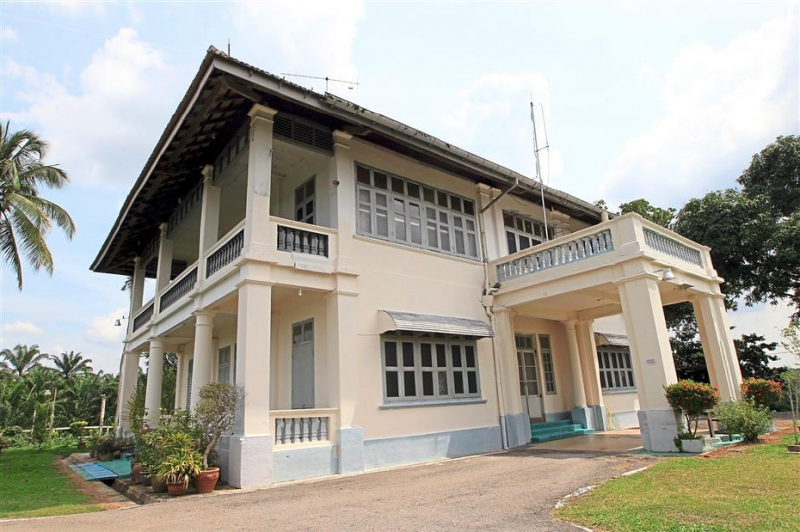
Located on a small hill, the two-storey masonry building bears hints of Scottish baronial architecture — a style that spread well beyond its Scottish borders and into the British colonies (victorianweb.org) — in the two small angle-walled turrets at the back of the house. Behind these angled walls are spacious living room and kitchen areas.
A porte cochère (porch) that shelters estate and guest cars forms part of the bungalow’s design in front, with a sturdy balcony resting above it.
Near the porch are windows with rounded tops that complement the building’s design. Some of the original paned windows on the upper floor have since been replaced with louvered glass and aluminium panel windows.
Walking inside the house, one of the first things we notice is the staircase with a wooden balustrade that penetrates the exposed beam ceiling to lead up to the second floor.
The wooden-floored upper level consists of four spacious bedrooms, bathrooms, and a small landing area that leads out to the balcony above the porte cochere.
“Back in those days, when general managers visited the plantation, they would stay at the manager’s bungalow, where a room would have been set aside as the guest room,” says Yazid, 47.
“But sometimes, with the manager’s family living in the house, it may not be conducive, especially when there are kids running around. Coupled with the availability of modern hotels, this practice has stopped.”
The master bedroom is connected to the children’s room, reflecting the Western practice of having kids sleep in an adjoining room.
Today, most of the furniture in the house has been largely replaced with modern pieces.
Yazid and his family also keep many pets —1a Boer goat, a mynah and seven cats that include a Persian and two Bengals. Some minor extension work has been done to the back of the house between the turrets to accommodate the cats.
Surrounding the property are fruit trees such as durian, pulasan, mango, mangosteen and kuinin, while (a currently unused) swimming pool is located at the back of the house.
Reflection of a Rich Heritage
About 20km away is the Yong Peng Estate, which spreads over 2,600 hectares. The first manager recorded at the estate office was R.H.V. Reed, who served from 1948 to 1950. In the years since then, there were 21 other managers before current manager Syed Akhmal Syed Isa took over in June 2015.
The manager’s bungalow is also located on a steep hill and was built in 1935. Also featuring a porte cochère and a balcony above, this handsome house features rounded and square pillars on its left side, forming part of the verandas on both the lower and upper floors.
Patterned concrete balustrades are seen all around the bungalow, as are grey wooden window panes with frosted glass and louvered wooden window panels.
Inside, 90cm-high dividers made of wood and concrete functionally separate the living room space, which features sand-coloured marble.
Arched entrance ways are seen around the white walled interiors, which still houses dark, solid wood furniture and an old Singer sewing machine, a gentle throwback to the old days.
The upper floor is designed with wooden flooring and has four bedrooms, each with a bathroom and a veranda. The main balcony offers a sprawling view of the plantation. All around the house are sapota, mango and coconut trees as well as a swimming pool (currently not in use).
Sime Darby Plantation special projects manager Ezzaruddin Abdul Rapar explains how these old estate bungalows are managed: “Most of the heritage buildings within Sime Darby Plantation’s operations are maintained by the respective home estates except for those on Carey Island (which come under Sime Darby Plantation HQ). The (preservation of the) roof structure is the common issue for all heritage buildings.
“Most of the heritage bungalows are of great significance and we value the rich history of these buildings that reflect the rich heritage of the company itself,” he says.
