
So what do you believe?


Play
A Thai fashion designer uses art as a synonym for his new collection
THAI FASHION designer Ek Thongprasert of Curated isn’t taking any chances in introducing his new collection. It’s his 13th and while he isn’t superstitious, he’s warding off suggestions of bad luck by swapping the traditional catwalk show for an art exhibition based on the concept of belief and decision.
Titled “Exhibition 13 ‘Believe?’” and continuing until November 13 on the second floor of vegan restaurant Broccoli Revolution on Sukhumvit Soi 49, the show displays a selection of Ek’s latest daywear and jewellery pieces along with sculptures and video art by three female artists, whose creations deal with similar issues.
“A fashion show on a catwalk is no longer the right tool to communicate my ideas,” Ek explains. “Mixing fine arts, fashion, food and more is essential to being precise in the message I want to convey,” continues the designer who graduated in architecture from Chulalongkorn University and went on to study fashion design at the Royal Academy of Fine Arts Antwerp in Belgium.
Ek is an art lover and frequently visits galleries at home and abroad to find inspiration. He set up Curated in 2009 to translate his favourite artists’ dialogues into fashion statements. For this new collection, he drew inspiration from two art exhibitions – “Where and When? Berck/Lourdes” by Sophie Calle and “Decision” by Carsten Holler.
“French artist Sophie Calle asked a fortune teller to dictate her actions for a certain period of time. She followed itineraries prescribed by the tarot cards and they led her to the town of Berck in northern France then to Lourdes. The exhibition put together texts detailing card reading sessions and accounts of the journey.
“Meanwhile, German-Belgian Carsten Holler’s exhibition at the Southbank Centre in London invited viewers to make decisions from the moment they stepped into the gallery’s foyer. They had to choose between entrance A or B to get into the show. Filled with uncertainty and doubt, visitors had a different experience regardless of which they picked. These two exhibitions offer an interesting view on human perception, leading to the notion of belief that makes people decide to do or not do a certain thing at each step of their lives,” says Ek.
In a nod to Calle’s artistic approach that hands over decision-making to a third party, Ek asked a tarot reader to foretell the future of his Curated brand, representing it as a seven-year-old boy and girl. Reading the tarot card according to the birthdate of the brand, the fortuneteller predicted that the girl would grow up as a single and lonely lady while the boy’s life would be frequently associated with bad luck and accidents.
The prediction inspired him to take two approaches in his designs for men and women.
“I’m interested in the way someone allows a stranger, in this case a fortune-teller, to decide his or her fate. A man who believes in the warning of bad luck will start wearing Buddha amulets or other talismans, hoping they will protect him.
That’s why graphics inspired by Thai talismans can be found in the menswear and jewellery pieces. The other response to the prophecy is choosing not to believe it, but he still needs to be careful. Other warning signs such as ‘fragile’ and ‘handle with care’ play out on the clothing.
“A woman who is predicted to remain single will perhaps pray to a sacred icon or do something to overturn the prediction. I thus apply the idea of the knot- tying ritual involving the fastening of a couple’s hands together with ribbon, cord or twine to my womenswear by incorporating knots and bowls on the clothes.”
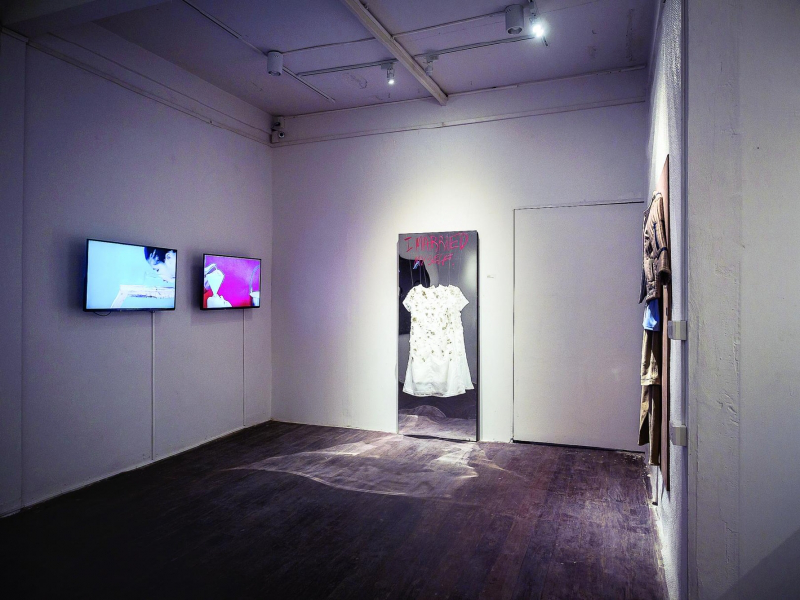
For a woman who is independent and doesn’t believe in the prediction, Ek applies details found on wedding gowns such as lace, chiffon, veiling and flower embellishments all on a white palette. In the exhibition, the white daywear is also attached to a mirror with a note reading “I married myself”.
Adjacent is Kawita Vatanajyankur’s video art titled “Tools”, in which she presents herself as various household objects such as a broom, an ice shaver, a scale, and a cone cup to question the social ideologies related to the repetitive tasks of a woman’s mundane labour.
She uses her own body as the household tools and performs repetitive actions. For the ice shaver, for example, she uses her chin and cheek to propel a block of ice back and forth across the blade. To act like a broom, her body is suspended and she sweeps her hair across floor until its touches the dustpan.
“I want to talk about inequality, feminism and women’s rights by using my body as the art objects,” says Kawita.
“Most women feel they need to get married or at least that they are expected to get married. That’s why we have a word ‘kuen kaan’ in Thai, which refers to a spinster. In our society it’s accepted that women should live their lives according to expectations and the many rules imposed on them,” Ek adds.
In Thailand, it’s common to see spirit houses that are built in such a way that they will appeal to celestial beings. People place offerings – bottles of a red soft drink, food, fruits and flowers – to the spirits who are believed to reside within. In the exhibition, a life-size spirit house, complete with soft drink bottles and a larger-than-life chicken – all made out of red fabrics – form Watanya Siriwan’s soft sculptures titled “Object” to illustrate beliefs that meld aspects of Buddhism, Brahmanism and animism
“Some people question whether this is a sacrilegious act. To me, the spirit house is just an object but people believe that the guardian of the houses watches over and protects the home. It’s one of the most fundamental features of Thai life that we follow even when we’re full of doubt,” says Watanya, whose family runs a textile company in Chiang Mai.
A selection of sculptures inspired by the form of the distinctive prang (spires) of Wat Arun originally showcased in architect/artist Sanitas Pradittasnee’s solo exhibition “Capturing the Intangible” at the Art Centre of Chulalongkorn University last year, is also on display here.
“I’m interested in the identity of belief that’s embedded in our daily life, such as in the statues and architecture to which we pay respect,” says Sanitas, who graduated in architecture from Chulalongkorn University before going on to study fine arts at Chelsea College of Arts and Design.
“Most Thais wai every time they pass temples and sacred monuments. This raises the question of what we’re actually worshipping. If we know something by theory but without practice, how can we truly understand it? My work also questions the outside and the inside.”
The three chedi-like sculptures are made of clear resin, glass and a pile of old dharma and science textbooks that reveal the emptiness inside and question the core of belief. Long-accumulated values have turned into beliefs that are coded into symbols, behaviours and rituals and man-made objects such as statues and architecture. The object of worship is then the appearance, not the essence.
Apart from art and fashion, Naya Ehrlich-Adam, the owner of Broccoli Revolution, also offers four five-course sets of vegan cuisine based on four elements. Each set comes in vivid shade: yellow-brown for earth, blue for water, green for wind and red for fire.
The earth element features corn chowder, tapenade (black olives blended with spices), onion confiture with bread stick, zaru soba (cold noodle), organic black sesame ice cream and a pumpkin, celery and mango smoothie.
Choose the water element and you’ll be served a vivid blue cashew cauliflower soup, hummus with pita bread, daikon blue pasta and miso soup, banana in coconut milk and butterfly pea iced tea.
The wind element is represented by broccoli soup, fresh celery with sour cream, edamame spaghetti with green pea and avocado, frozen mint panna cotta with kiwi juice, and a mix of broccoli, orange and green apple as a drink.
The fire element comes in a brilliant red palette and boasts Moroccan lentil soup, pumpkin hummus with carrot stick, stuffed tomato with cashew-cheese couscous and strawberry sorbet washed down with blended beetroot, carrot, green apple and lemon.
Some of the dishes are available a la carte. To order an entire set, place your order several days in advance. A set costs Bt500.
DO YOU BELIEVE?
“Exhibition 13 ‘Believe?’” continues until November 13 at Broccoli Revolution restaurant.
The show is open daily (except Monday) from 11am to 7pm.
Call (02) 196 2113 or visit “CuratedbyEk” page on Facebook.
Broccoli Revolution restaurant at the mouth of Sukhumvit Soi 49 is open daily from 7am to 10pm. Call (02) 662 5002. Visit “Broccoli Revolution” page on Facebook.
