
Nurturing Nan’an


Play
How an historical icon is keeping alive ties within Singapore’s Hokkien community
After climbing all the steps of the Hong San See temple, it was once possible to see the bustling Singapore River.
“About 30 years ago, we could see into the distance, as the buildings in front weren’t so tall,” muses temple secretary Lim Liong Kee, 60. “The area behind used to be nothing but forest.”
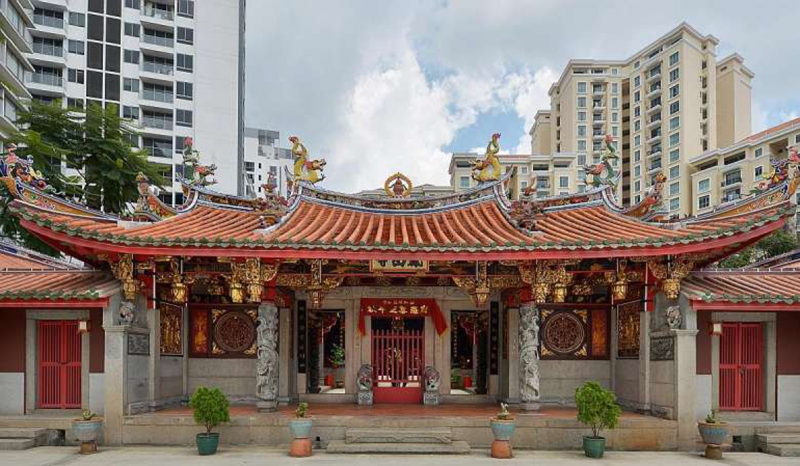
That view is now blocked, as the Chinese temple on the Mohamed Sultan Road is dwarfed by posh condominiums and surrounded by stylish bistros and hipster pubs.
Hong San See, which means “phoenix hill temple” in Hokkien, was founded in 1836 by migrants from Nan’an, a county in China’s Fujian Province. The temple building was originally located on Tras Street |in Tanjong Pagar, where 31 tombs bearing the names of people from Nan’an were sited, says Tan Aik Hock, 47, chairman of the Singapore Lam Ann Association that maintains the temple. The association was formed|in 1926. Lam Ann is Hokkien for Nan’an.
Migrants who had cleared quarantine after arrival would go straight to the temple to meet relatives who were living here, Tan says. The temple also provided an avenue for them to interact, celebrate joyous occasions, such as weddings, or get assistance for their problems.
“They returned to the temple when they needed medical help or when they were homesick and wanted to return to China,” Tan says, adding, “the temple also helped when they passed away and the bodies had to be sent back to China,”
Hong San See was moved to its current location in 1913 after it vacated its Tras Street premises to make way for road widening in 1907.
The new temple covers an area of more than 4,600 square metres, including the adjacent Singapore Lam Ann Association building. The construction cost was funded by architect Lim Loh, whose son Lim Bo Seng was Singapore’s war hero during World War II.
Two teams of carpenters worked on the building at the same time.. “They drew a line down the middle, so you can see the left and right sides of |this building are very different, in terms of crafting and structure,” Tan explains..
According to the National Heritage Board’s heritage website, the lanterns hanging on one side are decorated with chrysanthemum flowers carved into their bases, while those on the other side have lotus motifs.
Hong San See was gazetted as a national monument in 1978.
From 2006 to 2009, the temple underwent major restoration works. Based on conditions set by the Preservation of Sites and Monuments, about 90 per cent of the building is original.
“For example, the pillars that were corroded, instead of replacing them, we actually dug into them and treated them instead,” Tan says.
Other artefacts include a 120-year-old brass urn on the altar and an intricately carved lantern dating back to the 19th century.
The temple won an Award of Excellence from the UN Educational, Scientific and Cultural Organisation in 2010 and the Architectural Heritage Award from Singapore’s Urban Redevelopment Authority in 2013.
Hong San See was built in the traditional Hokkien architectural style. A courtyard separates its entrance and main halls, and it is aligned along the north-south axis, with the entrance facing south.
Exposed structural elements are also richly decorated. For example, on the entrance hall’s roof ridge, two dragons flank a hulu, or bottle gourd, which supposedly wards off evil spirits.
While the courtyard catches rainwater and drains it away, it also serves a more divine purpose.
“It is where deities descend during our temple celebrations,” Lim says.
The temple’s patron deity is Guang Ze Zun Wang, who was a filial son. Thus, filial piety – and loyalty to the country – are values that Hong San See embraces.
During the second and eighth months of the lunar calendar, the temple holds week-long events that include prayer ceremonies and dinner banquets to celebrate the birth and death of Guang Ze Zun Wang.
Apart from worshippers, 300 to 400 people – tourists as well as locals – visit the temple each month to sightsee.
While the temple played a big role in uniting and helping the early Hokkien community here, it also focuses on promoting family ties.
“We have a lot of youngsters. About 20 to 30 per cent of our members are in their 30s to 40s,” says Tan, adding that the older members are in their 80s.
“When we hold dinners, families attend together for a multi-generational celebration. This is good,” he said.
Among the younger members is polytechnic student Tan Ker Vin, 19. “It feels really nostalgic being in this temple, knowing that it is the same thing that my ancestors experienced,” he says.
