
Views from the top


Play
For spectacular scenery and plenty of adventure, it's hard to beat the Bernese Oberland
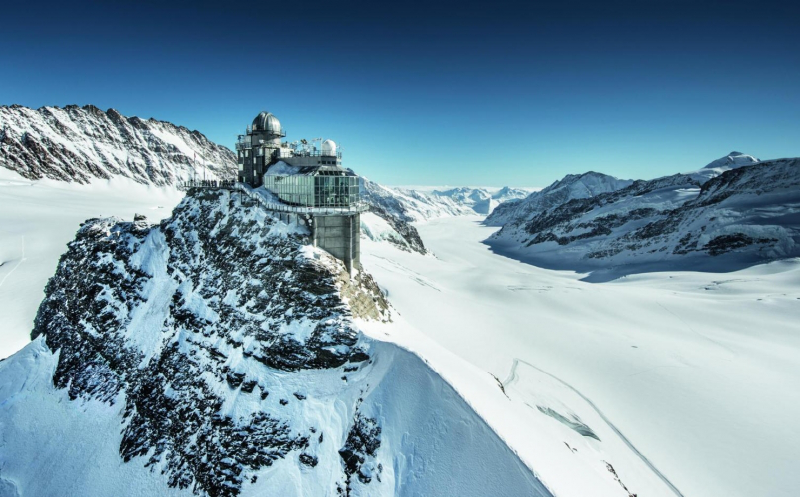
PERCHED AT an altitude of almost 3,500 metres, the Jungfraujoch, as the col or saddle that lies between Switzerland’s Jungfrau and Monch summits is known, huddles under a snowy blanket even at the height of summer. It’s home to the Sphinx Observatory, one of the highest astronomical observatories in the world, as well as several restaurants and a post office, as well as the terminus of a state-of-the-art Swiss railway that transports some one million visitors to the glacier every year.
The railway, which seems like an impossible feat of engineering, is a poster child for Swiss efficiency and planning. As our plane descends towards Zurich airport, a look out of the window reveals the care this small alpine country has given to ensure that people and nature live together in harmony.
That sense of care is reinforced during the two-hour drive from Zurich to the heart of the Bernese Oberland, where villages in the valley are still surrounded by open pasture and verdant pine forests.
Famous for hiking trails, alpine glaciers and winter activities, the Jungfrau region lies at the foot of the Eiger, Monch and Jungfrau and in 2001 was designated as the first Alpine Unesco World Natural Heritage Site.
The Jungfrau Railway is the brainchild of Swiss industrialist Adolf Guyer-Zeller, who wanted to give everyone a chance to conquer the peaks of the Swiss Alps. Construction began in 1896 with an investment of 16 million Swiss francs – a fortune in those days – for the 1,400-metre track from Kleine Scheidegg station to the col.
Explosions were used to blast a long tunnel through the Eiger and Monch mountains.
“Guyer-Zeller died three years after construction started and his family continued his project. The construction period doubled from seven to 16 years because of weather conditions and there were strikes as well as an accident that took the lives of 30 Italian labourers,” explains Pen Tiyawarakul, the Thai representative of Jungfrau Railway.
“Seven of the nine kilometres of railway are in the tunnel and the train stops for five minutes at each of the two intermediate stations, the Eigerwand and the Eismeer, where passengers can disembark to observe the mountains through windows built into the mountainside,” Pen explains.
“Our cog railway is powered by electricity. It might appear vintage in design but it is safe. We recently launched a series of new bogies with a modern design and better capacity.”
The 50-minute trip to Jungfraujoch was officially opened in 1912 and today visitors can enjoy a wide range of fun activities such as snow tubing, zip line, skiing, snowboarding and sledding in the snowy alpine playground.
The property is divided into 10 zones. We start our journey with a four-minute screening of “Jungfrau Panorama”, which offers a 360-degree perspective of the station before riding in an elevator that whisks us up to the glass Sphinx Observatory in just 25 seconds.
The building was opened in 1931 to undertake climate and environmental research, meteorology and glaciology and the alfresco terrace was added in 1996 to provide a panoramic view of the Aletsch Glacier and the frontiers of France, Germany and Italy.
Next door is the light-and-sound Alpine Sensation tour, which was launched in 2012 to celebrate the Jungfrau Railway’s 100th anniversary. Focusing on the development of tourism in the Swiss Alps and the history of Jungfrau Railway, a giant snow globe at the entrance mimics everything about Swiss culture and the vibes of snow resort town.
The walls are painted by local artists to demonstrate how much the Mount Jungfrau has changed and honour the mountaineers who scaled the Alps more than a century ago. There is also a rare collection of old black-and-white photographs taken during the construction of the railway and several metal altars engraved the names of Italian workers who died in accidents in the tribute gallery.
Our adventure continues in the 1,000 square-metre Ice Palace, which lies 20 metres beneath the alpine glacier. It’s a splendid creation from the 1930s, originally built, the story goes, to give the tourists something to do when the viewpoint was closed. It’s home to crystal-like sculptures of penguins, eagles and dogs, while an ice maze makes a perfect backdrop for photos.
Our visit coincides with a special basketball match between NBA superstar Tony Parker and top Swiss players, sponsored by Tissot, one of Jungfrau Railway’s partners. A standard-size basketball court is built on snow for the match and the players apparently have no trouble adjusting to an ambient temperatures of just minus 1 degree Celsius.
“We’ve hosted many sports event on the top of the Jungfrau. We’ve had tennis, running and boxing matches and this year we selected basketball,” says Urs Kessler, chief executive of Jungfrau Railway.
Back down in Grindelwald, a picture-perfect resort that’s the kick off point for several hiking trails and adventure activities, we make our way to the six-seat aerial cableway and ride to First station at 2,168 above sea level, where we tackle the First Cliff Walk by Tissot. A 40-metre-long one-rope suspension bridge, not recommended for anyone scared of heights or vertigo sufferers, leads us to the west side of the First summit and the sun terrace of the Berggasthaus First.
“Most local residents in this area are dairy farmers and produce fresh milk for Swiss cheese factories. They often build a big barn on a hill and share the space. Cows wear a large bell to signify that they have won many awards,” says Pen.
The wonderful backdrop of 4,000-metre-high snow-capped mountains on the opposite side of valley makes the three-kilometre hike to Lake Bachalpsee worthwhile. Known as the pearl of the Alps, the lake reflects the majestic Schreckhon and Bernese Alps on its surface and just demands to be photographed.
Adrenaline junkies can ride the First Flyer from First to Schrechfeld station, which involves sitting in a specially designed harness and travelling at speeds of up to 84 kph then ride a Trottibike down the hill.
The small resort town of Interlaken is a great place to enjoy the slow life. It has two old cathedrals and a Japanese garden in the heart of city for the shoppers, the Kirchofer community mall, which is home to the flagship stores of many leading Swiss watchmakers as well as several top fashion brands.
Best of all, it’s just eight minutes away from Harder Kulm, a popular spot for its romantic sunset view over the lakes of Thun and Brienz and the imposing Eiger, Monch and Jungfrau.
MOUNTAIN HIGH
>> For more information on the railway and attractions, visit www.Jungfrau.ch.
