
As ever, Paris sets the pace


Play
Androgyny and see-through tops are among the five top trends this fashion week
WOMEN’S FASHION WEEK in Paris heading to a climax of frills and feathers this weekend, five big trends have already emerged among the spring-summer 2017 collections.
No Bras
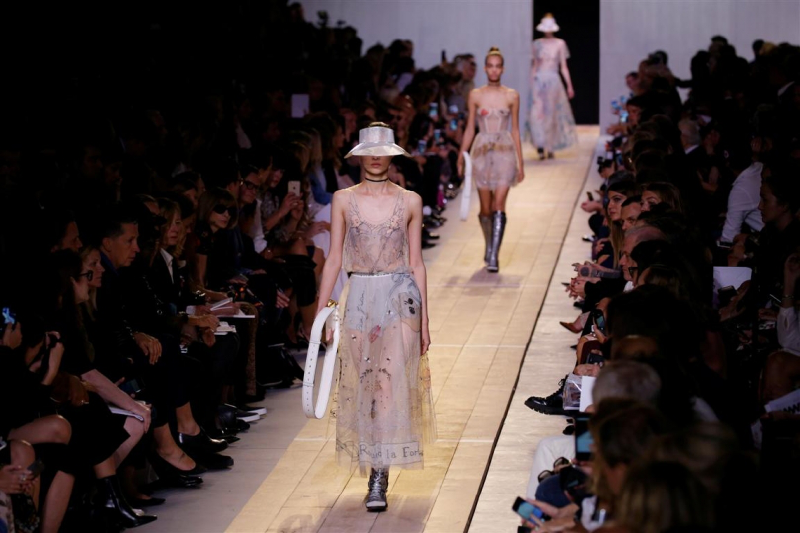
We demand transparency of our leaders and institutions and now it’s coming to your wardrobe. See-through is one of the big looks of the season, dominating the past week’s three big, headline-grabbing shows.
Almost every dress in Maria Grazia Chiuri’s debut at Dior was of gossamer lingerie tulle, while Anthony Vaccarello, toying with bad taste in his first show for Saint Laurent, sent out a line of bra-less sheer tops and a mono-boob dress that exposed one breast.
Chiuri dressed her female models as if preparing mediaeval knights for a joust with destiny. A short-haired waif in a white fencing suit, a “beating heart” sown on her chest, led the procession of bare black-and-white pieces that looked like armoured underwear.
As her debut show went on, the looks became more elaborate, with Chiuri layering embroidered tarot symbols, star signs and protective talismans onto transparent lingerie dresses.
Bouchra Jarrar was more restrained and elegant in her debut for Lanvin. Even so, at least two of her lingerie dresses would work as well in the bedroom as at a ball.
All the Lanvin signatures of feathers and slightly bohemian narrow jackets were there, with pyjama-stripe coats, embroidered flowers and silk trousers cut to fall perfectly over beaded flat sandals.
Newbie Neith Nyer and older stagers Carven, Rochas, Y Project, Vionnet and John Galliano at Maison Margiela all got in on the act too, while Rihanna and ID made underwear outwear.
While some of Galliano’s combinations might look improbably futuristic, there was plenty of individual pieces that had critics swooning, not to mention the 1940s-style suits and trench coats worn with scuba boots.
Gender Flux
Androgynous, gender-less fashion has been in the ascendant for some time, with transgender models more present on the runways as designers blur boundaries. This week Brazilian creator Francisco Terra used four trans models in his Neith Nyer show, while others turned up across the catwalks from Y Project to Koche.
Julien Dossena at Paco Rabanne evoked gender flux in a show inspired by 1960s sexual liberation, which seemed partly to have also sprung from the loins of Woody Allen’s 1972 film “Everything You Always Wanted to Know about Sex”.
Off the shoulder
Despite last season’s 1980s retro revival, designers are far from finished with resurrecting looks from the decade of big belts, big shoulders and even bigger hair.
This time it is off-the-shoulder tops and dresses, not quite “Flashdance”, but close, often pulled tight across the chest. The “one bare shoulder” look ran from floating bohemian Chloe to Barbara Bui’s shiny vinyl with variants turning up in Mugler, Wanda Nylon, Vionnet, Isabel Marant and Yohji Yamamoto shows.
It seems to be all Hedi Slimane’s fault. He started the ball rolling with his final show for Saint Laurent, the now notorious love-it-or-hate-it 1980s super-bling “bat-wing” shoulders collection.
Instead of turning on such excess, his successor Vaccarello has embraced the look – or the off-the-shoulder part, at least.
The sublime Haider Ackermann show on Saturday was all shoulders too, bringing the focus to the hard work his models |had done in the gym and pool.
Frills are fun
Despite being the frivolity that dare not speak its name to fashion’s dominant minimalist brigade, frills are back with a flourish.
Prada lovers should look away now, but frills are breaking out all over the catwalk, from Anne Sofie Madsen to Andrew GN, Alexis Mabille and Lanvin, to name but a few.
Even rappers’ favourite label Off White went all frilly.
The young Ukrainian brand Paskal used them ingeniously to punctuate its otherwise minimalist collection, making a summer bikini type top from one single frill. Japanese street avant-gardist Junya Watanabe was also swept up by the trend, folding them into his jagged geometrical origami creations.
Sun rises again
Japanese designers are a major part of Paris fashion week, with pioneers Kenzo, Yohji Yamamoto and Commes des Garcons now the godfathers of an ever-expanding brood that includes Undercover, Junya Watanabe and Anrealage.
And beyond the global brands like Issey Miyake, the country’s influence on foreign designers has rarely been as strong. Japanese aesthetics and techniques are everywhere on the catwalk, with three of the most exciting young talents – Terra, Paule Ka’s Alithia Spuri-Zampetti and Liselore Frowijn – all citing trips to the country as the key to their collections.
Do you speak |fashion?
IF THE IDEA of an “It Girl influencer” sitting in a “frow” watching a “gender-fluid” collection available in “see now, buy now” has you scratching your head, you need our essential guide to fashion jargon.
Gender fluid
Which gender are you this season? The strongest meta-trend in contemporary fashion is towards a more and more androgynous look, demolishing the boundaries between men’s and women’s styles.
Uber-cool French label Vetements, which puts men and women in thigh-high boots, dresses and bomber jackets, has brought the look to the street with a bang.
“There is no gender anymore,” says its commercial boss, Guram Gvasalia. “Men and women can now choose what they want to be.”
With former Kardashian consort Caitlyn Jenner now the face of H&M Sport, transgender models are ever-present in Paris. Men and women now walk together on the catwalk for Gucci and Burberry as well as for Koche, Vivienne Westwood and Andrea Crews.
In the frow
This is the front row, the place where you’ll find Kim Kardashian at Balmain, Salma Hayek at Saint Laurent and Rihanna at Dior.
It’s also where you will find “It girls” and boys, Vogue editor Anna Wintour, top buyers and the brand’s most in-favour celebrity fans and bloggers, who now like to be known as “influencers”.
‘See now, buy now’
Oddly, for a fashion term, this means exactly what it says. You see a fashion show and you can buy the clothes straight away, not having to wait six months for them to appear in the shops, as has traditionally been the case.
Big high-street brands like Tommy Hilfiger, Tom Ford and Burberry are adopting the practice, but most of Europe’s younger and innovative creators regard it as the work of the devil.
They argue that it favours brands with their own stores, narrows choice and will be hugely wasteful, with pre-made clothes the public doesn’t like heading straight for landfill.
Capsule collection
This is a one-off collection made between seasons or to sate fans clamouring to buy something after a fashion show. It’s not to be confused with a “resort collection” comprised of clothes you take with you when you winter in Monte Carlo, Dubai or Palm Springs.
