
Voyages to the unfamiliar


Play
How several communities in Thailand’s south are attracting foreign visitors just by being themselves
Wedged between Trang, Nakhon Si Thammarat, Songkhla and Satun, the southern province of Phatthalung has tended to attract only a modest number of tourists, most of them local. Yet foreign visitors are now being spotted regularly in a small village close enough to the provincial capital as to be part of Muang district. The tourists, many of them British, come to Ban Prang Mu to indulge in the local way of life.
There’s a strong sense of authenticity in Ban Prang Mu. Residents are welcoming but make no effort to create new activities to entertain their visitors. In fact, they live their lives pretty much as they always have. Makers of a local type of drum, the phon, continue to practise their trade. When tourists drop by, they are happy to let them observe and even try their hand at drum-making too.
“We are selling our culture to tourists,” explains Nithi Subhongsang, managing director of Nutty Adventures.
Since starting his venture nearly two years ago, Nithi has designed many of his tour programmes based on available research. The Thailand Research Fund (TRF), for example, has looked closely at the potential for tourism development in the Songkhla Lake Basin in Phatthalung and Nakhon Si Thammarat. Asst Prof Dr Chairat Jussapalo of the Hat Yai University is planning director for the project and works closely with his colleague Dr Prachyakorn Chaiyakot.
Nithi has been selling his tour products to a tour agency in Britain by presenting the TRF’s findings. Next month, Nithi will be heading to the UK to take part in the World Travel Market to promote his culture-themed tour programmes. The event will be held in London from November 7 to 9.
“Our in-depth interviews and meetings with many people during our field trips to the Songkhla Lake Basin, have shown that the area boasts a broad natural and cultural diversity. It has rich resources for tourism but they have hardly been exploited to generate income for the locals,” Chairat says.
He adds that he and his team are keen to see more efficient use of these resources through research that would highlight the area’s strengths.
“It’s possible to promote tourism in line with local culture. It’s possible to arrange nature and adventure tourism and so on. Tourists are out there and they have different tastes,” Nithi says.
Nutty Adventures has now prepared several new tour programmes in cooperation with the TRF and these include new destinations such as Ban Prang Mu.
Ban Prang Mu native Klom Chukaeo, 68, has been making phon drums for decades. He is also a veteran musician, taking part in phon drumming contests and winning twice, the first time in 1970 and the second time in 1971.
Today, Klom’s 29-year-old son Sakda is following in his footsteps. A bachelor’s degree in his pocket, he’s come home to make phon, enter drumming contests, and teach the art to interested children. Tourists who drop by his yard can observe how a piece of buffalo skin is stretched and dried for days before being fitted on the drum’s frame.
In another village in Phatthalung, Im Chanchum is ensuring that the traditional art of shadow-play puppets will not die out. A master engraver, he has passed on his skills to more than 1,000 craftsmen already in the hope of keeping talung, Thailand’s shadow play, alive.
He laughs as he recalls how a foreigner once offered him Bt5million to move to Germany and demonstrate his amazing skills there. Im refused, preferring to stay in his home and pass his craftsmanship down through the generations.
“I have produced puppets for nearly six decades already. Shadow-play theatres in the South order their pup
pets from me,” says Im, who is in his late 80s.
Phatthalung, as a tour programme prepared by Nutty Adventures reveals, also has a stunning natural landscape. Combined with the local way of life, its appeal is hard to resist.
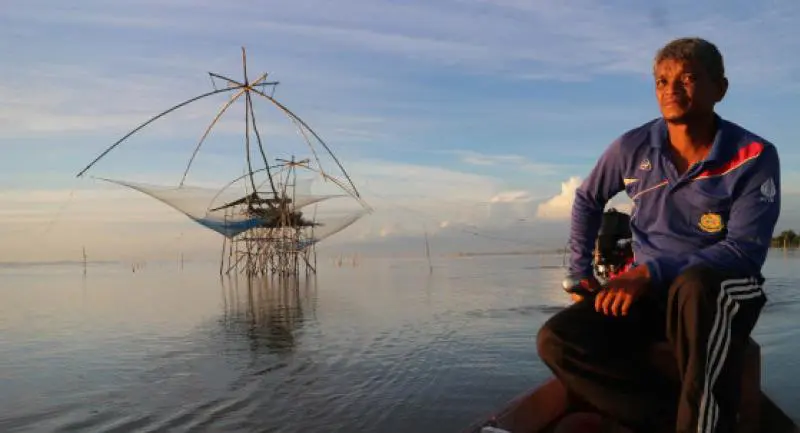
In the early morning, Chat takes tourists out in his boat so that they can see the sun rising over the pole-linked fishing nets – yor yak – as they are known here.
“I used to be a fisherman. But I switched to taking tourists out in my boat. It earns me more money,” says the 47-year-old resident.
Chat says he can earn up to Bt900 from just two hours of work, leaving him plenty of time free to do other chores.
Backed by TRF research, several southern villages now set to transform into new destinations for tourists who want unusual experiences. Visitors can, for example, drop by the Node Nalay Way of Life Centre in Songkhla’s Sathing Phra district and observe how locally-grown sugar palms can be turned into desserts, sugar rings and soap.
“We welcome tourists without losing our identity,” says Puangsap Srichu, chair of a local community enterprise and the coordinator for local conservation tourism.
Local life, she adds, is still centred on local crops like rice, sugar palms and shrimps.
“We are placing more emphasis on our local culture, resources and identity. This way, we retain our traditions while standing out as a charming destination,” Puangsap says, adding that foreign visitors seem genuinely interested in the local way of life.
Sitting on the Songkhla–Nakhon Si Thammarat border, the Klong Daen Buddhist Community offers homestay services. The community sits at the confluence of three canals, and rows of wooden houses stretch along the waterways as far as the eye can see.
At the centre of the community is a temple built in 1887 and a gold Buddha statue.
“The locals here are good hosts. Your happiness is our happiness,” says Kriangkrai Anantapong, the chair of Klong Daen Buddhist Community.
Here tourists can buy a tour programme that takes them across the border to Perlis in Malaysia where they can try their hand- at growing rice, tapping rubber and cooking local food at Homestay Kampong Paya Guring.
HJ Romle B HJ Hassan, the chair of Paya Guring Homestay, says the homestay services attract mostly Western tourists.
“We can even arrange a local-style wedding ceremony for them,” he says.
Asst Prof Supawadee Photiyarach of the TRF says Thailand and Malaysia are working to develop joint tour routes.
“Tourists can travel a long way from Thailand to Malaysia, dropping by the Klong Daen Buddhist Community and the Homestay Kampong Paya Guring before travelling further to Penang and Kuala Lumpur,” she says.
Prachyakorn says his research will allow border communities to set the standards for joint tourism management. Malaysian communities have clearer management guidelines, he explains, because the Malaysian authorities have come up with clear criteria for the management structure, service standards and safety.
“Tourists in Malaysia have to buy insurance. Thailand, meanwhile, has not yet made travel insurance mandatory,” he points out.
“We are highlighting the good points of Malaysia’s tourism management so that Thailand can learn from them.”
