
King Bhumibol: The Supreme Artist
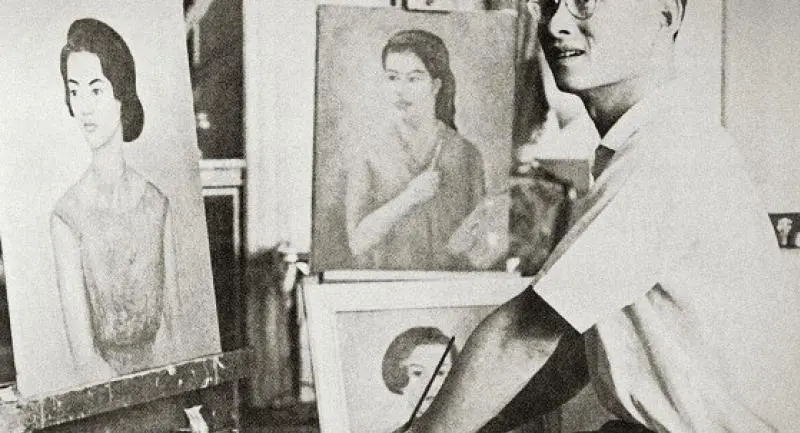


A self-taught painter, His Majesty had a true passion for the discipline
His Majasty the King Bhumibol Adulyadej is not just remembered as one of the great kings of Thailand, but also as the “Supreme Artist”. His Majesty, with the support of the late Princess Mother, developed a real love for art in his younger years.
He became interested in painting, photography, music and literature as a child, and began taking lessons while in Switzerland from 1937 to 1945. Between 1959 to 1967, he produced 107 pieces of art, all signed with his initials. Since royal duties forced him to give up painting in 1967, he began concentrating on photography, taking his cameras with him when travelling across the country.
His Majesty picked up techniques by studying art books and visiting artists’ studios during his childhood in Switzerland. He then tried to apply what he learned to canvas, and often returned to the artists until he fully understood their style. He then successfully applied their techniques to his work.
His Majesty’s most active period in painting began in 1959. He preferred to meet with Thai artists informally, inviting them over for discussions or the occasional painting contest.
Among them were late Hem Vejakorn, Kien Yimsiri, Chamras Kietkong, Fua Haripitak, Paitoon Muangsomboon, Chuladhat Bayakaranondha, Chalerm Nakhirak and Uab Sanasen as well as art historian Bhiriya Kririshka. These artists all say that His Majesty followed his own original concepts, only consulting them for technical advice and critical comment.
When not performing his duties, His Majesty was preoccupied by painting. In fact, when visiting HRH the Crown Prince at Kingsmead College in the United Kingdom in 1966, His Majesty spent his free time shopping for books and painting materials, the government-run |website www.Kanchanapisek.or.th said.
His Majesty’s paintings became publicly known from 1963, when he agreed to exhibit some of his pieces at the 14th and subsequent National Art Exhibitions held by Silpakorn University. In 1965, Silpakorn University presented the King with an Honorary Doctorate in Painting.
Then in April 1982, on the occasion of Bangkok’s Bicentennial Celebrations, the Fine Arts Department was allowed to organise a solo exhibition for His Majesty, exhibiting 47 of his paintings.
Different styles
His Majesty’s paintings may be categorised into three groups – realistic, expressionistic and abstract – but it would not be fair to say he consciously followed those stylistic trends. The classification is based on similarity in appearance only.
His Majesty once explained that he did not let other people’s work influence his own. He always took an amateur’s approach, giving run to his imagination and not getting restricted by theoretical principles and rules. This is why his works exhibit so much originality and personal identity.
The King’s subjects were usually Her Majesty and their children. The notable exceptions were a portrait of his father, HRH Prince Mahidol, which exuded a gentleness with highlights and shadows, and another of an old woman (Untitled, 11-6-07), painted with strong brush strokes. In a rare untitled work created in 1961, His Majesty painted a monk meditating under a tree in the moonlight, reflecting his deep interest in Buddhism.
In terms of expressionism, His Majesty’s deep thoughts and feelings were evident in bright creations created with strong, quick brushstrokes, such as the “Red Hand”, depicting a red hand contrasted against a yellow-green background.
Abstract paintings were a further development of his expressionistic works, in which emotion and thoughts were expressed freely without adhering to form or subject matter using strong brushwork with contrasting colours like orange and green.
Mom Chao Karawik Chakrabhandhu, a leading painter, made the following comment on His Majesty’s works:
“His Majesty the King first painted portraits which were realistic and finely executed. He then proceeded to modern expression and developed new techniques in order to express his thoughts without worrying about realism, which would restrict freedom of expression.
“His Majesty was a true artist in the sense that he enjoyed other people's works, yet was never satisfied with his own. He was always searching for new techniques, yet his paintings always exude a personal originality. While working on purely abstract subjects, he was still able to paint other aesthetically pleasing subjects. As an artist, he fully expressed his thoughts and feelings, which were sincere and forceful. He used bright colours and mainly strong curving lines, but did resort to straight and zigzag lines occasionally.”
Though his duties forced him to stop painting, the King remained interested in contemporary art. In 1996, he invited seven leading Thai artists to create illustrations for his literary work “The Story of Mahajanaka” about the perseverance of the King Mahajanaka. The artists included late national artist Prayad Pongdam, living national artists Pichai Nirun, Preecha Thaothong, Chalermchai Kositpipat and Panya Vijintanasan plus veteran painters Teerawat Kanama, Jitana Piamsiri and Netikorn Chinyo. Pisanu Supanimit helped design the book, while sculptor Nonthiwat Chantanapalin, also a national artist, created the coin depicting King Mahajanaka that accompanied the book.
To get the younger generation interested in the tale, in 1999, His Majesty assigned Thailand’s leading cartoonist Chai Rachwat to come up with a cartoon version.
The King was also a talented sculptor. Late sculptor, Paitun Muangsomboon, a former official of Division of Arts, Fine Arts Department, worked for His Majesty for a number of years.
His Majesty personally created two sculptures, both of which are in Chitrlada Mansion of the Dusit Palace.
His first sculpture was that of a kneeling woman, 9 inches high and modelled in plasticine, and the second, also in plasticine, was a 12-inch high rendering of Her Majesty. Paitun was later granted Royal permission to make a plaster cast of the second sculpture.
The King was also involved in the making of some important Buddha statues including the one in the Royal Cypher and popular amulets “Luang Pho Chitrlada” or “Phra Kamlang Phaendin”.
The King’s paintings comprised of 47 known and published pieces and 60 others that were never publicised, as well as the sculptures, which are being kept at the palace.
Visit the virtual Rama IX Art Museum at www.Rama9art.org or the Culture Ministry’s Supreme Artist Centre in Pathum Thani, where printed copies of the king’s paintings works and archives about the process of art makings have been put on permanent display.
The Rama IX Art Museum Foundation, which provided these photos to The Nation, was set up 20 years ago for the exhibition, “The Art of Rama IX Reign”, held to mark the Golden Jubilee of the King’s reign in 1996. The exhibition displayed more than 200 artworks by 150 artists including some of the King’s paintings.
This was considered one of the most important art exhibitions in the modern era, with the main objective being to dedicate a contemporary art museum to our “Supreme Artist”.
Though the King loved creating art and music, making his people happy soon became his priority and lifelong pursuit. But whether pursuing art or his love for the people, the beloved King always devoted himself totally and sincerely to the task at hand.
