
From barren to fertile
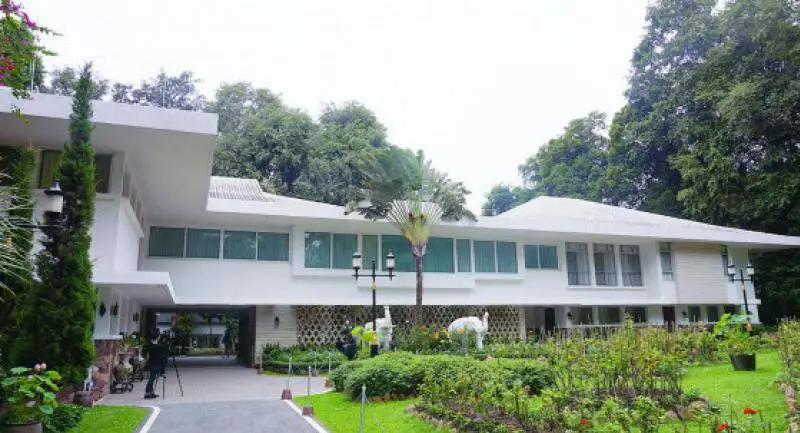


How His Majesty transformed the arid fields and forest of Isaan into productive agricultural land
BACK IN 1955, long before the advent of eight-lane highways and modern transportation, His Majesty the King Bhumibol Adulyadej travelled thousands of kilometres on his first journey to the Northeast region, a barren land with mountains scalped of trees and fields of arid soil.
He made his journey to remote and unmapped villages throughout 15 provinces by car, train, plane and boat to survey his homeland and learn how his people lived.
This trip formed the basis for what would become a series of royal development projects that have improved the quality of people’s lives, rehabilitated the forests and promoted the philosophy of the sufficiency economy throughout communities.
The King returned to Isaan, as Thailand’s Northeast is known, in 1975, two years after the October 14 uprising. Tensions were high both in the country and in the region, and the government was worried that the Northeast could become a hotspot for communism.
For his part, the Monarch saw only a pressing need for development and instead built Phu Phan Ratchaniwet Palace in Sakon Nakhon.
Located in the heart of the Phu Phan mountain range, the 2,000-rai Palace is home to several royal residences, most with a modern European design. The exception is Peek Mai, which is designed to look like a log cabin and is used as a guest house. The mansion complex is surrounded by large shady trees and shady botanical gardens.
“His Majesty the King Bhumibol set out on his first tour of Isaan after hearing that this land was barren and there were few water sources. He had also heard that Nakhon Ratchasima and Phu Kradueng National Park in Loei enjoyed cold weather similar to Switzerland, where the King used to live. During his visit he discovered an ecological diversity that would best be served by improving irrigation,” says Anantasit Samat, head of Phu Phan Ratchaniwet Palace.
“The King always held a map in his hands because he was born and raised in the West, where map reading was common. He wrote the details and coordinates of each place he visited.
“On return to Bangkok, he asked the Royal Thai Survey Department to correct their information and create a new and accurate map. The King Bhumibol was a genius and paid attention to even the smallest detail.”
The land on which the palace now stands was offered to His Majesty by the Royal Forest Department to serve as an experimental site for reforestation.
“The King Bhumibol started his experiment in 1974 by constructing a huge reservoir inside a palace, which became the prototype for the dams that would later be built.
He discovered eucalyptus grew very fast and could help absorb water and block sediment from the stone forest. After that, he cultivated assorted plants that have value to the economy such as makha, payung, teng and pradu,” Anantasit explains.
Her Majesty Queen Sirikit created a mock-up Isaan-style village inside the palace grounds to display the traditional architecture, culture and the rural life of the ethnic Phutai and Tai Yo. “Queen Sirikit once turned the Larn Kham Hom lawn into a catwalk for a silk fashion show, on which she collaborated with local artisans and villagers as part of the Support Foundation project,” Anantasit recalls.
A 16-kilometre drive from downtown Sakon Nakhon is home to Tao Ngoi village and the Third Royal Factory, which is operated by leading food supplier Doi Kham. Founded by His Majesty in 1982 following the other two manufacturing bases in Chiang Mai’s Mae Chan, this 38-rai factory produces a range of high-quality agricultural items such as ready-to-drink fruit juice, dehydrated fruits and tomato paste.
The four-storey building takes visitors back to its origins through a photo exhibition on the second floor. There are two zones, one that’s home to a rare collection of black-and-white photographs of His Majesty exploring Tao Ngoi village and the other an exhibition of images by professional photographers Noppadol Khaosamang and Chinnamit Bunnag of modern life in the area.
“His Majesty visited Tao Ngoi district in 1980 and saw first hand how poor and malnourished its residents were. He built this factory as a farming learning centre,” says Chotirose Supinya, production manager of Doi Kham 3.

An aerial view of the Third Factory that produces such quality agricultural food as dried fruits and tomato paste.
“We educate villagers how to plant tomato and corn. Today we have more than 4,000 farmer members and produce tomato paste, dehydrated fruits and herbs including aloe vera, tomato, mango, guava, passion fruit and roselle. We also have a rice mill.”
The factory is eco-friendly, equipped with a huge wastewater treatment pond that produces gas for cooking and a solar roof that generates electricity for its manufacturing line. The surplus power is sold to the Provincial Electricity Authority.
Last week, the factory hosted a three-day craft workshop for local youngsters, with specialists turning out to demonstrate ceramic-making and indigo-dyeing.
“We hold a free workshop for young villagers every year. We want them to follow in the footsteps of His Majesty the King Bhumibol and learn about irrigation, sustainable agriculture and the sufficiency economy. This year, we focused on frugality,” says Ramorn Thanasophon, a special representative of the Crown Property Bureau.
Kram (indigo-dye) expert Prach Niyomkar, owner of famous kram lifestyle brand Mann Craft, taught the youngsters to dye T-shirts and shawls using local plants, fruit juice and tomato paste from the factory.
“Naturally indigo-dyed techniques give a bright and long-lasting colour. Sakon is famous for kram and I want to educate the children about their roots,” Prach told The Sunday Nation.
Potter Walriya Pengsawang from Sakala ceramic club guided the youngsters in making ceramic tableware and home decor items from local clay while art lecturer Charyata In-Char from Roi Ed Rajabhat University demonstrated how to create colourful handprints from local leaves.
Arraya Wideesa, a 17-year-old student, was delighted with what she had learned from the workshop and happy to show off her indigo-dyed handmade notebook and scarf.
“It’s a great workshop and has taught me so much about my community and culture,” Arraya enthused. “Now I can adapt indigo-dyed techniques to create my own accessories.”
