
Memories of another day
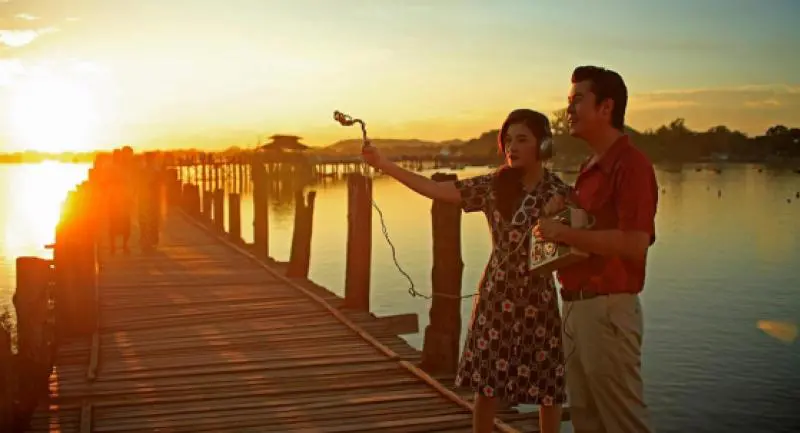


The first Thai-Myanmar co-production, "From Bangkok to Mandalay" shows that life can be fully lived even without love
THREE YEARS in the making, the first Thai-Myanmar co-production, “Thueng Khon...Mai Kidthueng” (“From Bangkok to Mandalay”), opened to packed theatres in Myanmar last week picking up Bt6 million in its first three days of screening and shooting straight to top position in box office rankings.
The film, which opens today in Thailand, is directed by Chartchai Ketnust, a man better known for his talents in post-production work, particularly editing, which earlier won him Thailand’s national film award – the Subhanahongsa – for his work on “Final Score”, a documentary that followed six students in the run-up to their university entrance exams. He also co-founded White Light Production along with another well-known editor-director, Lee Chatametikul, and respected cinematographer Sayombhu Mukdeeprom.
“From Bangkok To Mandalay” is his first feature film but comes on the heels of years of experience, including directing documentaries like “October_14 (Student Uprising 1973)”. Yet Chartchai says his friends and colleagues worried whether he was up to working on such a complex co-production with a relatively new Myanmar company.
“They felt it was a risk,” Chartchai says bluntly. “They pointed out that I’d be working with people who speak a different language and filming in a country that has only just opened up to the world. But I knew that the time had come to do something in Myanmar.”
He admits that his original plan was to make a low-budget film using funds promised by a friend. That idea fell through when his friend told him he was no longer interested in the project. Chartchai, however, persisted, using his Magenta Films Studio to seek funding and finally attracting cash from Tee Entertainment, which belongs to Somchai “Tee Matching” Cheevasuthanon, a company involved in the entertainment business in Myanmar, as well as the Audio Engineering Enterprise (AAE) from Myanmar.
The story came about both because of the director’s interest in history and his frequent visits to Myanmar. It eventually developed into a road movie about a young woman Pin (Philaiporn Supinchomphu), who has lost her boyfriend (Uttsada Panichkul) and is finding it difficult to move on with her life until she finds her grandmother Suda’s love letters. They come with an instruction from her late grandmother asking her to read them in chronological order and pay particular atten
tion to where they were posted – all in Myanmar. In fact her grandmother was originally called Thuzha (Wutt Hmone Shwe Yi) and moved to Thailand 50 years earlier. The letters tell of her love affair with Nanda (Nay Toe), a postman. Pin sets off to Myanmar with help from music instructor Moe Nai (Sai Sai Kham Leng) who takes her to all the places mentioned and translates the letters for her.
Pin’s journey runs in parallel with the story of her grandmother’s life back in the 1960s with the beautiful scenery
of Myanmar as the backdrop. “Movies and TV dramas often portray love as the best thing there is. But I disagree. I don’t think love is the best answer to everything.Without love, our life can move on,” says the director.
“The character is trapped in her love, but her grandmother handed over the letters in the hope that she would understand that in life and love we can start over and move on without love,” he says.
Chartchai is grateful to his friend, veteran musician Anant Nakkhong, who took him to visit the Gitameit non-profit community centre and music school in Yangon, which grants scholarships to talented musicians nationwide to study music.
But the original inspiration, says the director, is based on his own family history. His parents were the product of an arranged marriage and while they were not in love, the family was happy. One day, two young women showed up at the door and introduced themselves as the daughters of his father and his ex-lover.
“All the adults already knew. Only my sibling and I had been left in ignorance and we were shocked then surprised when my mother happily ushered them in,” he says.
Inspiration for the letters came from his own grandmother, who communicated with her ex-boyfriend by letter for several years. The couple eventually drifted apart and only met again after she was married.
In the film, he says, while Pin’s grandmother used her letters to communicate both her happiness and sadness to the one she loved, Pin wraps herself in isolation after losing her boyfriend.
The fact that the film was a co-production made filming a lot easier, Chartchai continues. “We were able to shoot in lots of different places in Myanmar including such tourist landmarks as Shwedagon pagoda in Yangon, the sea of pagodas in Bagan, the hill resort town of Pyin U Lwin, which is known for its British colonial architecture, and also Hsipaw in Shan State.”
As the project continued, sponsorship from major companies like Brand (Myanmar) pushed the budget up to Bt25 million, helping Chartchai and his partners shore up the storyline.
“At first the focus was just on Pin and Moe Nai, but the additional funding meant we could further elaborate on the story of Nanda and Thuza,” says the director.
The extra money also helped pay for A-list superstars like Nay To, Wutt Hmone Shwe Yi and Sai Sai. “Nay To is Myanmar’s answer to Thongchai ‘Byrd’ McIntrye and has acted in hundreds of movies. Wutt Hmone Shwe Yi has the superstar quality of Thailand’s Patcharapha ‘Um’ Chaichua while Sai Sai is a hip-hop singer and actor with millions of followers,” Chartchai explains.
And while he admits that the film crews in Myanmar are not up to the Thai standard, he says he would far rather work there than at home.
“The scenes in Myanmar are more powerful and have more impact than the scenes we shot in Thailand. Perhaps it’s because of the atmosphere or the locations, which are very different from what we are used to,” he says.
Chartchai hopes his movie will change the image of non-studio films, which often disappoint audiences.
“Limited budget or lack of promotion support are not good excuses when a film is criticised.
“For me, the ticket price is the same, so our task is to make the film the very best we can,” he says.
SHOWING NOW
- “From Bangkok to Mandalay” opens today at theatres nationwide.
- It’s in Thai, English and Myanmar with subtitles.
