
Taking a deep breath
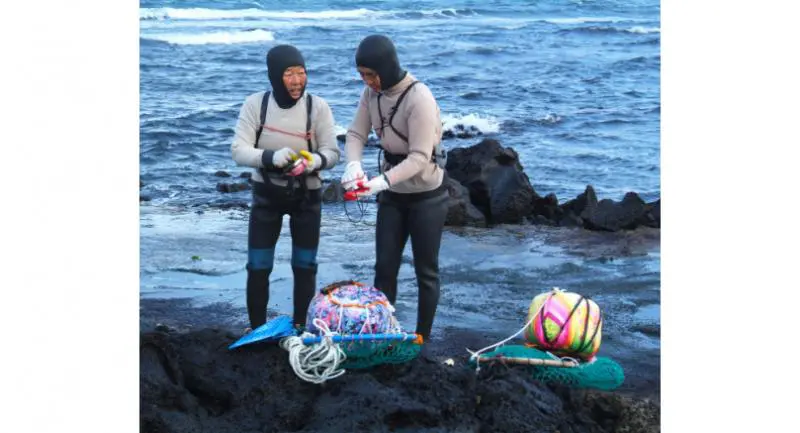


The “Haenyeo” culture is recognised by Unesco for empowering women, ecofriendly fishing and embodying regional identity
When the female divers of Jeju Island emerge from their minutes-long foray underwater, they let out a much-awaited sigh.
Called “sumbi”, the exhalation releases carbon dioxide from the lungs with a sound that is similar to whistling. When the divers pop up in groups, a chorus of singsong breathing echoes through the coast.
“Haenyeo”, as the women divers who have been diving in the waters off Jeju for centuries to gather seafood are known, were inscribed on the list of Intangible Cultural Heritage of Humanity by UNESCO on Wednesday during the 11th session of the Intergovernmental Committee for the Safeguarding of the Intangible Cultural Heritage in Addis Ababa, Ethiopia.
The inscribed haenyeo culture consists of “muljil”, free diving techniques that involve no oxygen gear; “jamsu-gut”, a pre-diving shaman ceremony praying for safe dives; and the “haenyeo norae,” songs that divers sing aboard boats heading out to the sea.
The committee said haenyeo culture deserved international recognition for preserving the region’s traditional rituals, passing down technical know-how for generations, following eco-friendly harvesting methods and empowering women.
“The breaths she held became rice, became her husband’s drink, and became her children’s books,” a voiceover says in “Breathing Underwater”, a documentary spotlighting haenyeo by Ko Hee-young, released in September.
Since the 17th century, female divers have been making ends meet by gathering marine products like shellfish, abalone, sea urchins, and seaweed from the sea bed, according to Choa Hye-kyung of the Jeju Development Institute.
“Back when there was no other industry on the island, and when women weren’t educated, it was the only way they could provide for their families,” she says. Both men and women engaged in diving for marine products back then, before the island developed a booming mandarin orange farming industry.
“The sea is our workplace,” 55-year-old haenyeo Kim Bok-hee said at the Korean Women’s International Network convention held on Jeju Island in August. “In some ways it’s much more comfortable than an office. You don’t have to tiptoe around others. What you earn is proportionate to your skills.”
“Don’t get greedy. Only harvest for as long as you can hold your breath,” an elderly haenyeo tells her daughter in “Breathing Underwater”.
“Your eyes are greed, which you must control.” Such wisdom, along with extensive knowledge of the seabed, are carried down orally, generation after generation.
Wearing only a black rubber wetsuit, haenyeo plunge into the water for up to 3 minutes at a time with no additional breathing apparatus and carrying only rudimentary fishing tools – a bowl for scooping and a net for storing the harvest. They gather seasonal products – sea cucumbers from January to June and August to December, and abalone from January to September.
“They take what’s available, but there’s no risk of overfishing,” says Choa. “They’ve learned to live alongside nature.”
Few younger women are joining the trade nowadays, however, due to the availability of other jobs and coastal pollution, which has led to lower yields from the sea.
According to the Ministry of Maritime Affairs and Fisheries, there were 4,415 active haenyeo as of 2015 and more than 98 per cent were over the age of 50. In 1965, there were as many as 23,810 haenyeo in Jeju, according to the Academy of Korean studies.
“The Unesco designation is significant, shedding light on the waning trade and letting haenyeo take pride in their work,” says Yoo Chul-in, a professor of anthropology at Jeju National University.
The Cultural Heritage Administration also hoped that the haenyeo culture, unique to Korea, would gain fresh attention around the world, it said in a statement.
Jeju Special Self-Governing Province will continue efforts to preserve the haenyeo culture through research projects and support for the haenyeo school, which was established last year. A celebratory event will take place on December 14 at the International Convention Centre Jeju.
A total of 19 Korean cultural assets are now included on the Unesco list of intangible cultural heritage, including the royal ancestral ritual and music of the Jongmyo shrine, the pansori (a Korean genre of musical storytelling) epic chant and Korea’s annual practice of making and preserving kimchi, called “kimjang”.
The haenyeo culture listing came almost three years after Korea applied for the listing in March 2014.
Present at the committee session Wednesday were officials from the Jeju Special Self-Governing Province, along with a delegation consisting of officials from the Ministry of Foreign Affairs, the Permanent Delegation |of the Republic of Korea to |Unesco and the Cultural Heritage Administration.
