
The true voice of country
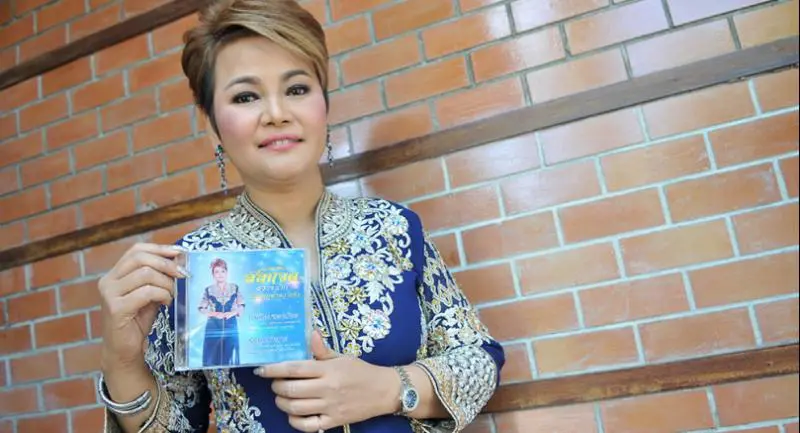


Salakjit Duangchan, sister of luk thung queen Poompuang, sets out to keep the traditions of the genre alive with a self-funded solo album
THIS YEAR marks the 25th anniversary of the death of Thailand’s much-loved luk thung (Thai country) queen Poompuang “Pueng” Duangchan and her younger sister, Salakjit or Ong, as she is known to friends and family, is marking the occasion by releasing a self-funded solo album that pays tribute to the original luk thung sound.
Salakjit, who bears a striking resemblance to Poompuang both in terms of looks and vocal tone, has made a career out of singing for the last 20 years and is often heard guesting on the albums released by other luk thung singers.

“I’m still singing but have never released a solo album,” says Salakjit, 46, one of the late luk thung queen’s three sisters.
“I often see contestants in TV singing competitions covering one of Phi Pueng songs and while it would have been nice to record an album of her tracks, I’m not allowed to sing her copyrighted songs in public. So I thought that it would be better to make my own album.”
Salakjit’s plans for a solo offering came as a surprise to national artists Wipoj Petchsupan and Chonlatee Thanthong as well as music master Rapee Ruanpetch.
“I didn’t want to write any songs after Poompuang’s tragic death. But Salakjit came to me and pointed out that it has been over 20 years since she died and in that time I haven’t written for a single artist. She wanted me to write songs for her. I asked her if she suddenly had the need to become popular as she grows older. She retorted that she wasn’t old yet,” says Wipoj.
“Anyway, when you’re a singer, it’s not age that matters but experience,” Salakjit told him.
“Salakjit’s voice tone is similar to Poompuang’s. I think that age has no effect over Salakjit’s singing. In that she’s like Wipoj. He is getting on but his voice can make even new songs become popular,” says Rapee, who was once a singer with Wipoj’s luk thung band.
The album, which is titled “Nong Poompuang Ma Laew” (“Poompuang’s Sister Is Back”), goes on sale Monday.
It features 14 songs – three penned by Wipoj, six by Chonlatee, three by Rapee, one by luk thung music enthusiast Jenphop Jobkrabuanwan plus “Paendin Namta”, a song recently written |by Rapee in memory of His |Majesty the late King Bhumibol Adulyadej.

“Dern Tam Roy Mae” (“Follow in Mother’s Steps”) features the voice of Salakjit’s nephew Pakawat “Nong Petch” Leelamekhin, Poompuang’s only son.
Salakjit worked hard on preparing the album, practising her vocal range with music master and veteran artist Seree “Tom” Rungsawang and projecting her own character through the songs.
“I have spent many years performing on stage but only covered songs by other luk thung artists’ songs including some by Phi Pueng. The practice sessions were arduous because Phi Tom is very strict and fierce. We would often argue because I couldn’t give him the sound of real luk thung music he wanted. For example, I needed to convey the real sense of a broken heart in Wipoj’s song ‘Rak Thook Thamlai’. That meant singing the words with the right emotions and increasing the highest pitch in my vocal range,” says Salakjit.
“My favourite song, I think, is Chonlatee’s ‘Silapin’ (‘Artist’), which is about a singer who is always cheerful and happy while on stage but knows that as he approaches the end of his life, he won’t be able to afford a coffin |for his burial. It is a very good |meaningful song.”
The title track is “Nong Poompuang” written by Rapee.
“This song is reminiscent of my childhood with Phi Pueng, who was 10 years older than me and helped our mother take care of the younger kids. She showered and powdered me and I was overwhelmed by her kindness. I would like to repay her kindness with this song even though she has gone. I could see her in my mind’s eye while we were recording the vocals of this song and I was in tears.”
Salakjit’s new album isn’t just announcing her comeback to the music scene but also aims to preserve the sound of real luk thung, which is very different from the modern country music sounds of today.
“Nowadays we have a mutation of real luk thung music into modernised luk thung. The music companies put out songs and call them luk thung but they have nothing to do with luk thung,” says Chonlatee. “They don’t talk about the paddy fields or buffaloes but sex. Real luk thung must reflect people’s lives especially those living upcountry. Modern luk thung destroys morals and culture. We are from upcountry, so the language of our songs is easy to listen to and draws a picture of the place. Listening to real luk thung, for instance Seree’s 1986 number ‘Thep Thida Pha Sin’, is like watching a drama within three minutes. They are timeless and the language is beautiful. Salakjit’s album will be part of the preservation of real luk thung. I believe that luk thung music will never die as long as Wipoj, Seree and I are still alive.”
Seree, who produced the album, agrees. “It’s important that we preserve real luk thung music,” he stresses. “I think that the previous generation, who include Kamron Sombunnanon, Suraphon Sombatcharoen and Wipoj, have laid the foundations of real luk thung music. The genre has been around for almost 100 years. All I can do is plead with the radio and TV stations who have turned the luk thung business into a multimillion baht industry, to support our efforts to sustain real luk thung music for the next 100 years.”
