
Memories of Montien


Jumpong Boonma honours his father, Thailand’s greatest installation artist, with an archive for the ages
MONTIEN BOONMA’S son Jumpong marked what would have been his father’s 64th birthday last week by reopening the family home as the Montien Atelier.
Jumpong was just 11 when his father succumbed to cancer in 2000. Now he’s giving the public a chance to see where the revered artist lived and worked, on Bangkok’s Ngamwongwan Soi 25.
The two-storey house, left abandoned for several years, was refurbished and opened to the public on February 25, Montien’s birthday.
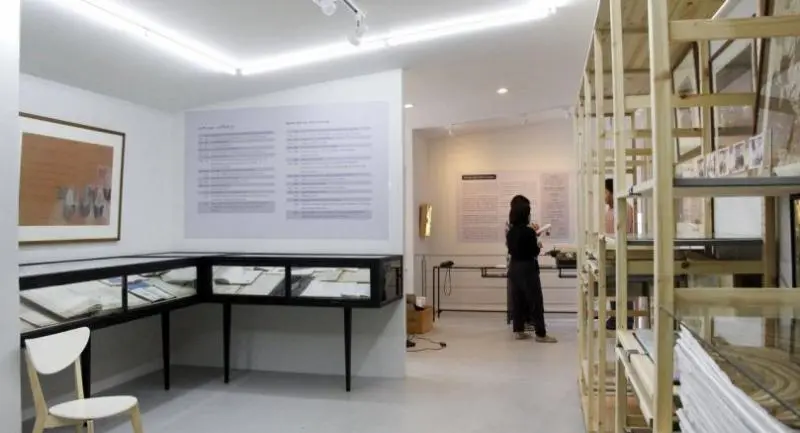
Operated by the artist’s estate, it’s now called 408 Art Space and has the Montien Atelier on the second floor, a place to appreciate Montien’s creative process through drawings, sketchbooks, letters, photographs, art objects and fragments of his famous installations.
Downstairs is a cafe called Early Bird Gets Coffee, and adjacent is a glass-wrapped building that will host workshops.

The Montien Atelier offers a comprehensive survey of the life of the late great installation artist Montien Boonma.
“My father kept so much art here that visitors are only seeing about 25 per cent of it on display,” says Jumpong, 27, an arts graduate of Silpakorn University, as was his father.
“I want people to see the sources of his inspiration. He always wrote his ideas in notebooks, did preliminary sketches and took pictures of whatever inspired him.”
Montien “never stopped working”, Jumpong says.
“Despite the brain tumour and the debilitating radiation and chemotherapy, he continued working until the very end.”

The late artist Montien Boonma
Montien is considered “the father of contemporary interactive art” in Thailand, a sub-genre that gets the viewer directly involved rather than merely standing back and admiring.
His installations entailed Buddhist teachings. He made clever use of herbal pigments. And he had a substantial following overseas, buyers of his work including museums in Japan, Australia, New York and Athens.
Before his death at 47, Montien acknowledged that the amount of art he’d amassed was vast, so much so that a third of his invariably fragile installations fell to ruin for lack of proper storage. Fortunately his preliminary sketches were carefully preserved to allow their restoration or re-assembly.
The limited space in the atelier prohibits the display of larger pieces anyway. Instead there are the characteristic components of those installations – bells, alms bowls, the herbal pigments. The work on view covers his entire career, right from his student days.
From the typewriter you see issued letters to family and friends. His collected news clippings are on view too, and you can watch a TV interview he did in the early 1990s. Most of these paper documents have been digitally scanned for a database that’s ready to be searched on the laptops made available.

The atelier offers access to a database of the artist’s work in digital format.
It took Jumpong nearly a year to get all the material in order, relying on the help of curator Somsuda Piamsumrit and his father’s loyal student and assistant Apisit Nongbua, as well as financial support from artist Rirkrit Tiravanija.
“Ajarn Montien was very disciplined,” Somsuda says. “He kept all of his important documents and other objects related to his work, and this now helps to explain his inspirations.
“There are 3,000 photo slides he made of various things that inspired him. His huge collection of sketchbooks and notebooks and the letters he sent to his wife while he was studying in France in 1986-88 offer a better understanding of his creative process. Many of the sketches are as copiously annotated as an engineer’s plans.”
One small notepad is filled with sketches of different kinds of herbs and their medicinal properties. A large book with saa-paper pages records Montien’s experiments with herbal pigments.

Montien’s sketchbooks and notebooks shed light the creative processes he employed.
When his wife died from breast cancer in 1994, Montien took solace in Buddhist teachings and his art began to reflect that. He also began incorporating herbal pigments after seeing traditional herbal remedies ease his dying wife’s suffering.
In the installation “House of Hope”, 1,500 dangling, beaded ropes dusted with coloured herbal powder conceal a platform of sitting stools. Surrounding walls suggest a smoke-tainted temple chamber.

Bells, alms bowls and aluminium “lungs” dusted with herbal pigments were commonly seen in his art.
Medical experts believe that, tragically, Montien’s use of herbal pigments might have activated an existing brain tumour and led to his own death.
“House of Hope” and another large acclaimed installation, “Melting Void”, are now stored at Apisit’s studio in Pathum Thani. The latter was an effort to replicate the “lost wax” process long used to cast large bronze Buddha statues. Montien’s busts of the Buddha stand on steel-pipe “legs” amid metal rods and casting tools. Inside you can see the red cinnabar and gold leaf he applied to evoke the peace of a temple chapel.

Bells, alms bowls and aluminium “lungs” dusted with herbal pigments were commonly seen in his art.
At the atelier, the archives are arranged in chronological order, running from Montiern’s student drawings through watercolours he did while teaching at the College of Fine Arts in the early ’80s to experiments with objects intended for installations, done as a teacher at Chiang Mai University into the ’90s.
Many earlier pieces address concerns about the rural poor and the environment. Montien was subtle yet effective in conveying his feelings about such causes, utilising such everyday items as bamboo chicken cages and feather dusters to clearly express his dismay.
“A Pair of Water Buffalo” comprised unhusked rice, sacks, straw and buffalo horns. You can see sickles and fragments of the sacks at the atelier, and papers on which he painted with a latex-dirt mixture for the 1991 installation “Manual Traces in the Paddy Field with Fish and Spade”.

The “Zodiac House” series, seen here in an exhibition at the Jim Thompson Art Centre in 2013, was an assembly of church chapels complete with peaceful interiors.
Montien’s sketch for “Zodiac House”, done while he was living in Germany in 1998, represents his worries over his own declining physical health. Six figures symbolise different aspects of a church chapel. Inside were the scent of herbs and a view of the “stars” rendered with pinprick holes in the ceiling.

Montien’s son Jumpong Boonma, left, tapped curator Somsuda Piamsumrit for ideas.
“Even when I was too young to understand his work, I always enjoyed interacting with it,” Jumpong says. “I remember tucking myself inside ‘Sala of Mind’, which was a stack of wooden boxes arranged in the shape of a stupa, with suspended flowerpots and the sound of chanting. I knew even then that I liked art that offered more than just the visual aesthetic and let me be part of it.”
Jumpong next plans to set up a website dedicated to his father’s life and work and offering access to the database. He’d appreciate any help with the financing.

Montien’s home and studio has been fully refurbished with the atelier above and cafe below.
A SON’S TRIBUTE
The Montien Aterlier is at 408 Ngamwongwan Soi 25, Sub-soi 3, next to Pantip Ngamwongwan. There is no admission charge.
It’s open Wednesday through Sunday from noon to 7.
Find out more at (081) 714 3075 and the “Montien Atelier” page on Facebook.
