
The long road to the stage


With a comedy, Tran Luc gets serious about theatre
Tran Luc returned to a very different Vietnam after studying in Bulgaria for seven years, but went on to make his mark as actor, TV-film producer and teacher. Then, 30 years into his career, he unleashed his deep-set passion for theatre with a trail-blazing, awarding-winning comedy.
Watching the audience as they viewed the first play he’s ever staged, Luc was delighted to see “excited youngsters tapping their toes and clapping their hands along with the lead actor’s rap performance on the Vietnam Youth Theatre stage”.
The “older spectators”, he noticed, were “quiet, not quite sure what is happening on the stage”. But the audience mainly comprised fourth-year students from the Hanoi Academy of Theatre and Cinema.
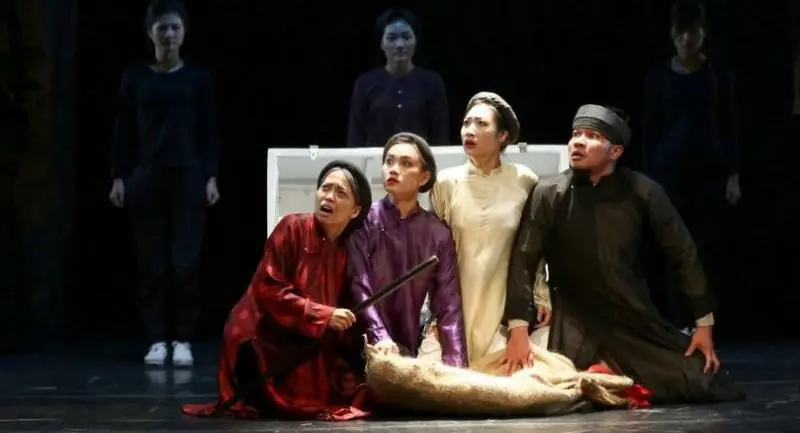
The comedy, “Quan” (“Stupefaction”), might be considered representative of modern Vietnamese theatre. “I set it up to give my students a chance to access expressionism on stage,” Luc says. “Comedy is my favourite style and I want them to learn about different theatrical styles.”
The comedy – written by late dramatist Long Chuong in 1960 – is about an upper-middle-class man, Dai Cat, and his family as they try and hide their wealth after being ordered to yield their property to a new government. Dai Cat’s daughter spoils the plans.
Luc adjusted the original script because he felt the author was mocking the upper-middle class, a sentiment that “no longer suits our time”.
“The playwright’s intention is to enlighten the upper middle class to follow the new government, but they’re human beings too. The comedy teaches people about the history of their country. The audience laughs at the infantile thoughts of the older generations and, when people laugh, that means there’s been development.”
“Quan” earned Luc the best-director award at the Hanoi Theatre Festival in December, the play won a gold medal and the cast claimed three silvers.
The actors performed in the expressionistic style called “epic theatre” devised by German dramatist Bertolt Brecht “to make the audience question and think about what they are watching”, Luc explains.
“Western theatre is much influenced by the theatre of Japan and China, and when I staged ‘Quan’ I wanted to take advantage of the Vietnamese traditional art genres of tuong [drama] and cheo [opera]. In tuong, just three actors performing with whips can express the image of thousands of troop riding horses to battle.”
But “Quan” broke with the predominant tradition established by the first Vietnamese spoken drama, Vu Dinh Long’s 1921 “Chen Thuoc Doc” (“A Cup of Poison”) and the Vietnam National Drama Theatre founded in 1952, which relied on Stanislavski’s “psychological realism”.
“‘Quan’ amazed me – I’m surprised that Tran Luc did this,” says People’s Artist Le Khanh of the Youth Theatre. “I always liked the comedy very much and had asked several famous directors to revive it, but they refused. They said it was outdated.”
Luc’s father, People’s Artist and former cheo star Tran Bang, got to see the show at his home. Too old to attend the theatre, he watched a video of the performance that his son made for him.
“Epic theatre is something that hasn’t received much attention from Vietnamese directors,” Bang said. “In the past only Nguyen Dinh Nghi and Doan Anh Thang used it, but they focused on stage design, not acting.”
Returning in 1991 from a five-year course in Bulgaria in theatre directing and acting, Luc missed the introduction of the national doi moi (renewal) process. Adjusting took some time as he concentrated on getting established in the industry first.
He played the lead in the movie “Chuyen Tinh Ben Dong Song” (“Love Story on the Riverbank”) and several others, won awards, and in 2001 was recognised as a Meritorious Artist. Still, he wasn’t satisfied being a successful actor.
In 2002 he ventured into television-film production with his own Dong A Studio. That too proved a success, but as a teacher at the Hanoi Academy, he seeks still more.
“The most valuable thing is that I do a comedy in my style and give my students a chance to practise. I want them to become skilful actors.”
