
A passion for porcelain
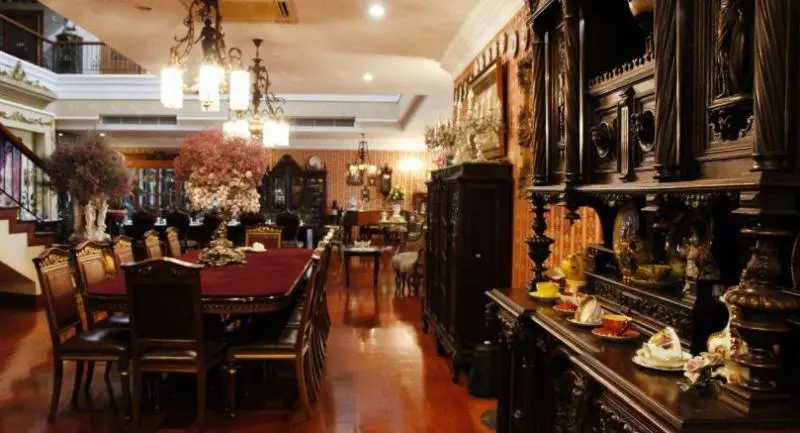


ML Boonyanuch Kashemsanta Dulyachinda opens her impressive collection of European artefacts and furniture to the public
WHEN ML Boonyanuch Kashemsanta Dulyachinda decided to move from her well-appointed residence in Huay Kwang to a large Colonial-style mansion in the Ram-Indra area two years ago, she wasn’t thinking of either convenience or location. She needed to find a permanent site for her collection of more than 10,000 pieces of European porcelain and pottery and the mansion provided both the space and layout to meet her requirements.

ML Boonyanuch Kashemsanta Dulyachinda's new mansion houses her collection of antique European porcelain and furniture and invites the public to learn about her treasures.
Taking up half of the four-rai plot on which it is located, the two-storey 17-room mansion will eventually be totally given over to the porcelain and antique furniture she has collected over the years while she and her family continue to occupy the small house within the same complex.
Chateau de la Porcelaine, as she has named the property, is, in her own words, an “authentic European ceramic mansion for Thai people to experience for free”. Five of the 17 rooms are now open to public and the remaining 12 should be ready by the end of this year.
“I started collecting European ceramics 30 years ago. These lovely pieces shouldn’t be hidden away for my personal enjoyment but shared with others, particularly students. I believe art can educate people and since I’m lucky to be able to afford these works of art, I think I should share them with the public,” says the 58 year-old.
Her collection includes rare and elaborately designed tableware, chandeliers, vases, clocks, candelabras, figurines, perfume bottles and jewellery cases crafted by Europe’s best known makers including Meissen from Germany, Limoges in France, Denmark’s Royal Copenhagen, England’s Royal Albert, Hammersley and Wedgwood as well as Russian manufacturers Faberge and Lomonosov. All are between 50 and 200 years old.

The mansion has 17 rooms, of which five are now open to the public.
Among the highlights is a vintage tea set made by a Limoges potter boasting a hand-painted image of the courting couple painted by French artist Jean-Honore Fragonard. In the familiar painting, a nattily dressed suitor stands serenading his love, who is seated, a flower basket in her lap.
Lomonosov’s hand-painted dinner service comes in the firm’s trademark cobalt net pattern trimmed with 22-karat gold. The original Lomonosov Factory logo is on the bottom of each piece.

Part of Royal Albert's Senorita Black Lace tea set
Next to it is Royal Albert’s Senorita Black Lace tea set made in England during the 1950s. The delicate pattern of black lace is embellished around each piece and a painted pink rose is placed at the centre. Crown Devon’s cheese dish produced in the early 1900s and decorated in the Etna pattern is also on show together with a tea set by Hammersley featuring floral patterns with gold trim.
“Both my husband, Suraspan, who is a retired official of the Office of the Civil Service Commission, and I are well aware of the importance of education so we decided to open this mansion for those who are interested in learning about product design, art and European history and culture,” Boonyanuch explains.

Viewing is by appointment and free of any charge. Right now, Boonyanuch is planning to accept only two groups of 30 to 50 persons every month. A European-style afternoon tea will be served and European culture experts are available on request to make the tour more interesting.
“I hope that students who learn about European culture, product designs and hospitality will want to explore these elements through my collection. For each visit, I will invite experts in the field that relates to the visitor’s interest to lead the tour.

“I will also work with the experts to provide as much descriptive information as possible. I’m planning to set up a multimedia room illustrating the craftsmanship behind the prominent products of the top five European porcelain companies. Afternoon tea will be served using my tea set collection so that visitors can experience this elegant and very European tradition,” she adds.
The opening event last month featured an auction of her 13 antique porcelain pieces to raise the funds. The Bt300,000 collected from the auction will be used to facilitate cultural activities for visitors.
Jarin Sumanont, Prateep and Yuwadee Liewpairat, Rakchana Apikasemsant, Warawuth Laohapongchana, Krongkarn Chamanant, Sumittra Kijkamjai and Rakchana Apikasemsant were among the guests.
“I’m delighted at what ML Boonyanuch is doing for society. The young generation is lucky to have a place like this, where they can explore precious European ceramics without travelling abroad,” says Suriyon Sri-orathaikul who auctioned her porcelain figurine for Bt50,000.

“I started collecting these porcelain pieces when I was 22. I used to scout them by myself every time I had a chance to travel to Europe but for the last decade, I have relied on trusted hunters to source the antique pieces that meet my preferences. I like delicate floral pattern and each piece must be at least 50 years old,” Boonyanuch says.
Valued for both its durability and its delicacy, porcelain was first developed in China. By the 17th century, oriental porcelain had become a valuable export commodity. Chinese porcelain represented wealth and refined taste in Europe. Apart from copying Chinese porcelain in faience (tin glazed earthenware), the soft-paste Medici porcelain in 16th-century Florence was the first real European attempt to reproduce it but met with little success.

Meissen porcelain in Germany was the first European hard-paste porcelain developed in 1708 by Ehrenfried Walther von Tschirnhaus. During the 1700s, porcelain production and decoration across Europe began to emulate that of China with its predominantly blue, hand-painted patterns. Early on in the history of Denmark’s Royal Copenhagen, a Chinese-influenced pattern was simplified and pared down to become the factory’s signature Blue Fluted Plain design. Porcelain became bourgeois, a status symbol for more than just the aristocrats.

According to Boonyanuch, although several rare porcelain sets have found their way to the market in the past decade, prices have doubled due to the interest by Asian collectors.
“Some young generation members of old European families have begun to sell their ancestors’ possessions. There are an increasing number of Asian collectors hunting for such treasures and this had led to high prices. It’s hard today to scout these pieces on your own.
“While a luxury Hermes handbag is a must-have item for many women, I’ve never wanted one. I have two Channel bags that I’ve owned for years and these are enough. I prefer to spend my money on vintage porcelain,” says Boonyanuch.
POTTERS’ PARADISE
To organise a visit, write to Baan Kashemsanta Dulyachinda, 247 Prasertmanukij 29, Jarakae Bua District, Lat Phrao, Bangkok 10230.
