
Luxury living on ‘Bangkok’s Fifth Avenue’
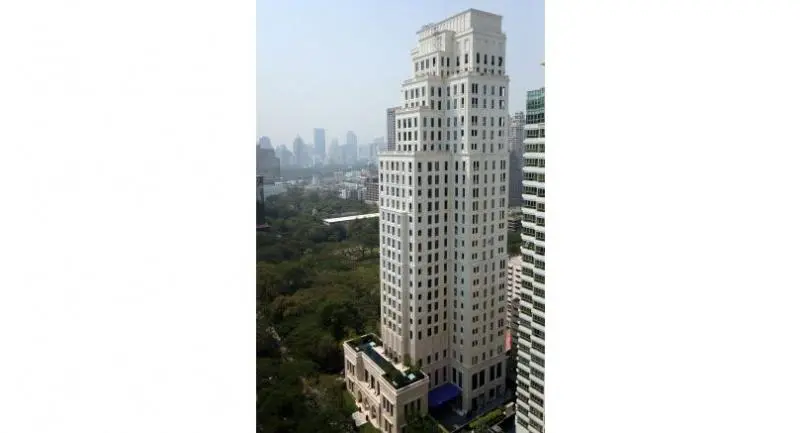


Sansiri's dazzling new residence '98 Wireless' blends modernity into classic French styling
EVEN A VETERAN New Yorker ought to feel at home on Bangkok’s Wireless Road with the addition of 98 Wireless to the skyline. The building’s architecture is reminiscent of the classic edifices of Fifth Avenue in the Big Apple.
Sansiri’s residential high-rise is the handiwork of Design Worldwide Partnership (DWP), an award-winning firm founded in Bangkok 20 years ago that’s hit its stride internationally.

In the Big Mango it conceived the lofty restaurants Sirocco, Mezzaluna, Distil and Breeze at the Dome in State Tower, and 87 Plus at the Conrad Hotel. It was showered with acclaim for the Earth Spa at Hua Hin’s Evason Hideaway.
Group executive director Scott Whittaker says taking on the prestigious, Beaux-Arts-style 98 Wireless project amounted to “pushing the envelope” in innovation. It entailed the finest materials and craftsmanship to create a structure that was as aesthetically pleasing as it was functionally liveable.
Whittaker, an Australian who’s called Thailand home for more than 20 years, got involved with 98 Wireless at the outset, about six years ago.
“We went for an ultra-luxury concept because Wireless Road looked to us like Bangkok’s Fifth Avenue,” he says. “Our vision is to create classic, timeless and traditional buildings, and for this one we researched projects around the world and settled on Beaux-Arts, the architectural school that was so influential in France at the turn of the 19th century.
“It’s a style and concept that was successfully transferred to America and especially New York, around Central Park, as well as to London. We thought it was particularly appropriate for the Bangkok project since there are a lot of embassies along Wireless.”
Whittaker points out that marble is a predominant material in the residence – pure white Statuario and beautifully veined Carrara and Calacatta from Italy.
“You see traditional architecture at the base, the middle and the top, giving the building a very strong podium that fits in with both the sky and the trees at street level.”
Also much in evidence are solid white oak in the herringbone floors, rare mahogany-crotch door panels from the United States and fine Portuguese Moleanos limestone.

Scott Whittaker: “In terms of contemporary architecture, Bangkok isn’t a leader – but that’s changing.”
“For ultra comfort, every car parking space is about 30 per cent larger than normal, and every residence has both a formal and private entrance for added privacy. The residents will be able to go about their private lives as they wish, but there are also a lot of public spaces – a drawing room, library, pools and a spa, all along the podium. The apartments at the top have their own private lifts, balconies and so on.”
Ultra-luxurious residences are quite similar everywhere in the world, says Whittaker, who recently completed other projects in Dubai and Shanghai.
“It comes down to very high-quality materials and attention to detail, as well as comfort and excellent service. There’s elegance and longevity to the designs, which typically have a European feel. It’s luxury that will pass the test of time.
“The global trend in ultra-luxury residences is towards conservative architecture. If you look at New York, the most expensive apartment buildings are still the traditional ones. Even in London and Paris, a lot of them are not in iconic buildings.
“There’s also the ‘starchitecture’ trend, but that’s not real super-premium. Ultimate luxury is about timelessness and less about unusual forms.”
Whittaker notes that Chinese, Singaporeans and Malaysians have begun travelling more in the last 10 years and are being exposed more to true luxury. “The buyers of these places are very sophisticated and well educated.
“Maybe for the mid-to-luxury market there’s a trend for way-out designs and unusual shapes, but working with Sansiri is very different. They don’t put the budget foremost. They just said, ‘Let’s build a quality project.’
“So we spent years just selecting the stones, for example, not only for their appearance but also their longevity. Then we built a full-scale mock-up of the fa็ade and tested it in a tropical environment to make sure the materials would last. So there was a lot of research and experimentation – testing shapes and forms, proportions and so on, and for the interior as well.”
Beyond the classic exterior, the interior is full of contemporary decor and smart technology. Beaux-Arts aesthetics reappear in the opulent staircases, chandeliers, delicate finishes on the walls and ceilings and cascading water fountains.
Whittaker’s firm turned the task over to Anne Carson Interiors, which tapped Ralph Lauren Home and Inverse Lighting, and, for the landscaping, Thai design company TROP.
Whittaker loves his “vibrant” adopted hometown.
“It’s the most popular tourist destination in the world!” he says. “It’s got character. It’s alive, and has a wonderful downtown, and it evolves rather than being planned. It’s a fascinating city.
“As an architect, I appreciate Ratchadamnoen Avenue and the buildings around the Grand Palace, which have a very strong Thai style and European influences and form a consistent part of Bangkok.
“There are lots of elegant buildings that have stood the test of time, although, in terms of contemporary architecture, Bangkok isn’t a leader – but that’s changing.”
