
A scan in your pocket
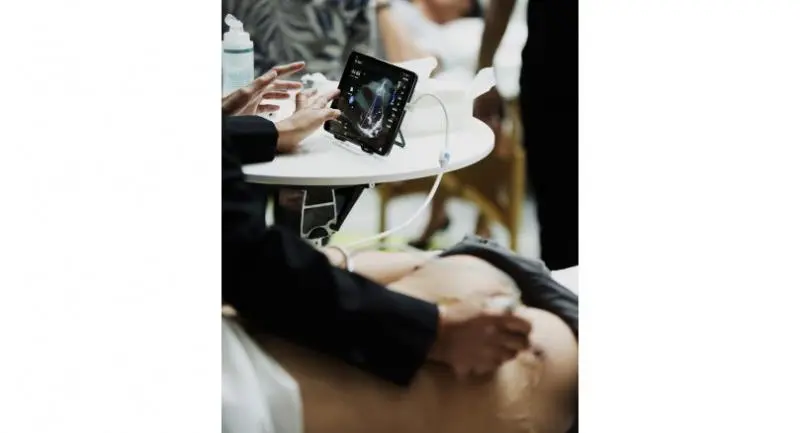


Philips launches the Lumify, a new handheld portable ultrasound device that runs off a smartphone
Healthcare professionals in Thailand now have a new tool at their disposal thanks to the recent Southeast Asia release of the Lumify, Philips app-based ultrasound.
The handheld ultrasound had its Asia launch last week at the Philips Asia Pacific Centre in Singapore with the city state and Thailand named the first countries to get use of this breakthrough product.
The size of a smartphone and using a smartphone or tablet app, Lumify has been used in North America for more than a year and the feedback has been sound.
Randy Hamlin, who heads up the Point-of-Care business for Philips, says the concept was first conceived six years ago.. At that time he was the head of R&D for protocol ultrasound and he, along with his clinical scientist, integrated circuit designer and assistant engineer, successfully came up with a real-time 3-D ultrasound imaging transducer. That led to the development of a 2D transducer, which in turn went on to become the Lumify, a device that puts the entire ultrasound process in the palm of your hand.
A regular ultrasound machine is about the size of a laptop, has a monitor and a control panel, and uses a transducer to view images of a patient’s body. A smaller and portable ultrasound is also available in a smaller size but the Lumify takes miniaturisation a step further by shrinking the entire processing system into a transducer that can be connected to a tablet, a smartphone or a TV monitor to view the pictures.
Not only does the Lumify help healthcare professionals make fast, informed decisions, it also allows physicians in multiple care situations to take advantage of every crucial moment without the time and mobility restrictions of locating a cart-based ultrasound.
Several ultrasound machines exist on the market offering different levels of image quality in 2D, 3D and 4D imaging. In Thailand the cost of such machines ranges from a few hundred thousand baht to more than a million. The Lumify price is around Bt500,000 per transducer.
Hamlin is quick to stress that the Lumify is not a replacement for more bulky ultrasound machines but designed to bring unprecedented convenience to physicians through a smartphone app.
“I've had a lot of conversations with customers who use the Lumify regularly. Emergency room physicians tell me that they can do 80 per cent of ultrasound exams in the emergency department with Lumify. The other 20 per cent need a more sophisticated system for deeper diagnosis. That’s a strong statement especially when we look at the affordability of the Lumify,” says Hamlin, adding that internal medicine physicians are using the device to do 2D imaging rather than borrowing an ultrasound cart from the radiology department.
The military has also adopted the Lumify, taking the transducer with them on deployment and giving positive feedback on the image quality.
Lumify is suitable for use in hospitals, clinics, mobile and paramedic units and also for health care professionals working in remote areas.
The Lumify doesn’t have a battery but uses the power from a smatphone or tablet once it is connected.
The Lumify App is free and can be downloaded from the Google Play Store but is not yet compatible with Apple devices.
Hamlin explains that his lack of compatibility stems from the requirement for the transducerpower to come from the device. Apple’s lightning port puts out only about a seventh of the power of the Android standard.
Dr Suthaporn Lumlertgul of Chulalongkorn Hospital has tried out the Lumify and says it’s ideal for use in the emergency unit where medical personnel are constantly on the move.
Medical students are also using it for puncture practice.
Three different types of Lumify transducers are available and each comes with a five-year warranty.
The Lumify S4-1 transducer assists in examining cardiac function or quickly performing FAST exams (Focused assessment with sonography for trauma). It is also suitable for lung, abdomen and OB/Gyn exams.
The L12-4 transducer supports up to 5 exam types, from looking for foreign objects to giving vascular, joint and soft tissue injections
The C5-2 transducer, which is the first to be introduced in Thailand, is suited to scans of the lungs, abdomen, gallbladder and OB/Gyn.
