
How blind students can "see" art


Sanchai Santiwes has devised better methods of art education for the visually impaired
STUDENTS WHO are blind and visually impaired aren’t going to understand or appreciate art through rote learning and other conventional means.
That finding recently earned Associate Professor Sanchai Santiwes of Khon Kaen University’s Faculty of Architecture the esteem of the Program on the Community and Social Development Division of the Thailand Research Fund (TRF).
Dr Sanchai’s research project, “Media Design for Art Education (Visual Arts) Learning Management for the Blind Upper-Secondary-School Students”, determined that using conventional methods to teach theoretical art to visually impaired students in the classroom leaves them feeling “disconnected”.

They continue having issues perceiving art, he found.
To overcome those issues, more efficient teaching materials are needed to “fill in” what’s visually missing. In his project, he sought to give students “equal opportunity” to learn about art by introducing different media and equipment.
“Art is unlike any other subject – it’s not science or mathematics,” Sanchai points out. “It aims to fulfil the mind. Art education for the blind can’t be about simply evaluating visually beautiful paintings. It has to let them express their feeling and emotions.”
The associate professor did his initial research while pursuing his doctorate at Silpakorn University’s Faculty of Decorative Art that included developing a computer program to help visually impaired students draw and colour. The resulting thesis earned him honours with distinction in 2014.
“I created a method using a touch screen where colours were applied with music notes. The 12 music notes matched 12 beautiful colours.

“My program didn’t become |popular because the technology advanced so fast that it was soon |outdated. But what was more |important was discovering that blind students can create really pure art.
“Even though these children can’t see and often don’t really comprehend what the colour is, they don’t paint without making a plan first,” Sanchai says. “They usually wanted to use red for a heart, green for a leaf and blue for the sky. I asked one student, though, why he used grey to paint a tree, and he said sometimes an artist has different ways of creating art.
“And that’s true enough. That’s the impression art provides, just as it does for anyone with full sight. So I was very impressed and really inspired to continue working on this issue. The more I learn about art education for the blind, though, the more I see what’s lacking.”
According to his interviews with blind students and their teachers, art class is typically regarded as a leisure activity. These are regular schools where the impaired students learn alongside hundreds of sighted peers, and it’s impossible for art teachers to pay special attention to the blind youngsters.
Leisure time or not, the visually impaired kids can’t help but feel left out, and it becomes an extra burden on them. They get discouraged and shun activities. They lose interest in developing art skills and in learning about aesthetics.
What Sanchai has done is create a simple instructional manual for teachers, currently a prototype. It outlines seven types of “properly” designed learning methods in art, including Visual Art Theory, Art History, Aesthetics and Art Critique.
The idea is to enable blind students to learn both theoretical and practical art without forgetting that art is often an abstract representation of actual visual impressions.
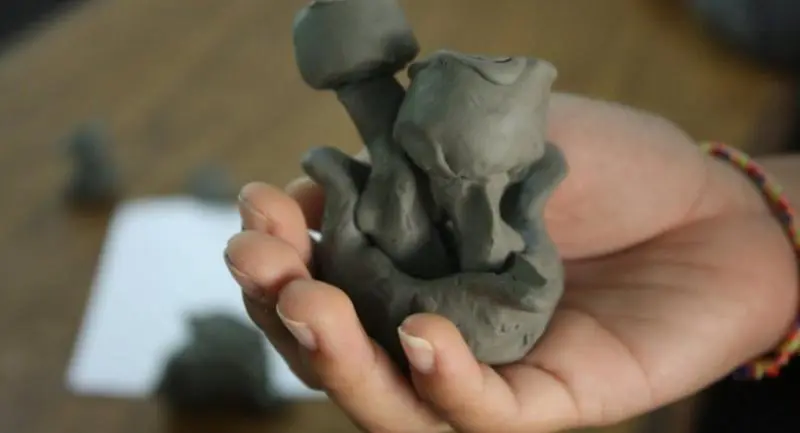
It’s obvious enough to anyone that impaired students can learn about sculpture more easily than other art forms. They can feel the shape of the sculpture and in fact might have superior tactile skills.
Similarly, architecture is quickly understood if paper models of buildings can be supplied. And there are such models available of famous structures, from the Pyramids of Giza to Paris’ Notre Dame Cathedral.
But learning about the two-dimensional arts – drawing and painting – poses difficulties. For the students to properly understand a painting, a low-relief rendering of it can be an effective tool.
When they can touch the prominent ridges and furrows of the surface, they can experience many famous artworks. The roughly applied pigment of a Van Gogh masterpiece is relatively easy to appreciate, for example.
Associate Professor Pattamawadee Pochanukul, deputy director for strategic research at the TRF, says Sanchai’s research offers guidance in ensuring that blind students have equal opportunity to learn about the visual arts.
He has helped create a standard management plan for art learning in every school, she says.
“The practical component includes painting, colouring using sound levels on a computer, dough sculpture and various activities for all students, mixed instead of separated, to learn together in the classroom,” Dr Pattamawadee says.
“Qualitative research with case studies and adaptation can be conducted with this new learning model. Importantly, the design of the learning media is based on affordable materials available in local stationery stores.
“The production process is easy – these items can be made and reproduced by staff or regular students. The art media can also be shared with other schools to build a sustainable network.”
Sanchai encourages art teachers and students at colleges and universities to create more such materials to share with schools for the blind around the country.
“These learning media help students with all types of visual impairment to learn art at a very high level,” he says. “The results with my sample group were extremely positive and the participants were very satisfied with the activities. They felt acknowledged by their experience with educational equality.
“Most importantly, they became excited and happy to learn art.”
