
Tummies never far from home


Ho Chi Minh City has an abundance of flavours from across Southeast Asia
HO CHI MINH CITY’S emergence as a melting pot has added immense diversity to its culinary scene, and nowhere is this more apparent than in the number of eateries serving food from other countries in Southeast Asia.
Many of the foreigners in the city hail from Thailand, Laos, Cambodia and Singapore. They’ve brought along expertise in making meals favoured not only by their compatriots but also by Vietnamese.
THAI EXPRESS
On placards and on menus, the word “Thai” always evokes scrumptious fare. From specialities like tom yum and pad thai to curries and hotpots, Thai dishes have universal appeal.
Restaurant chain Thai Express offers traditional dishes made by both Thai and Vietnamese chefs, at reasonable prices.
At the branch in Takashimaya, one of the city’s biggest shopping malls, kids can play dominoes, chess or Lego in a big entertainment area with comfortable seats.
The menu offers dishes suited to both children and adults, with more than 30 options to choose among. Two of the most popular are tom yum fried noodles and kuluay kang tod (banana fritters with coconut ice cream and sesame seeds).
The tom yum fried noodles are served with colourful array of red, green and white vegetables. The dish is cooked with chicken filets in addition to lemongrass, kaffir leaves, carrots, fish cake, tofu and bunga kantan (torch ginger flowers).
“We welcome both locals and foreigners, including Thais who visit or work in the city,” says waitress Le Thi Lan Anh. “Our dishes are colourful and not too hot and spicy, which caters to the local taste.”
Kuluay Kang Tod is four sweet and salty fritters served with two scoops of ice cream. While the fritters are hot, the ice cream is cold, a delicious combination.
Although it is a chain, Thai Express has a great reputation, receiving the honorary title “Thai Select” awarded by the Thai government to restaurants overseas that serve authentic Thai dishes.

ANGKOR ENCORE PLUS
Cambodian cuisine is familiar to most city residents, particularly people from the Mekong River Delta provinces, home to nearly 1.3 million ethnic Khmer.
Similar to Vietnamese, Khmer dishes are based on rice and pork as well as fish, shrimp, frogs and snails, with additions of coconut, banana, mango, lemongrass, chilli and palm sugar.
Khmer food is available widely at restaurants or street stalls. But for those who want to dine at a more refined place, Angkor Encore Plus in District 1, offers well-known Cambodian dishes made with traditional cooking techniques.
One of its famous dishes is amok – fish steamed and served in a banana leaf with coconut cream on top.
The classic dish adds kroeung, a type of curry paste made from lemongrass, turmeric root, garlic, shallots, galangal, finger root or ginger. Here it’s served with brown or white rice, julienned red bell pepper and lime leaf ribbons.
Angkor’s beef red curry, another favourite, is less spicy than those of Thailand and India, and features beef, eggplant, green beans, potatoes, fresh coconut milk, lemongrass and kroeung.
Baguettes, a remnant of the French influence on Cambodia, are served alongside the dish.
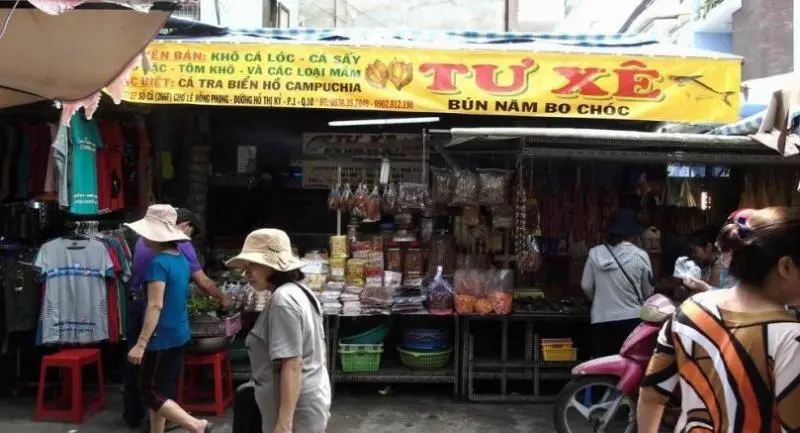
Locals often also visit Le Hong Phong Market, popularly known as the Cambodian Market, in District 10 to buy specialities and goods from there. The market has nearly 200 sellers, with 70 per cent of them Cambodian-Vietnamese or Cambodians who moved to HCM City in the 1970s and set up business.
Many popular products, such as salted fish paste and fish caught in Tonle Sap Lake, and Cambodian sausage made of pork with chilli are offered. Clothing, jewellery and meditation oils are also sold.
Sweet Cambodian porridge with coconut sugar and flavoured durian is a popular choice for labourers. For a hearty breakfast or dinner, there are noodle soups.
“I import the fish paste and other ingredients to make my dish authentic,” says Tu Xe, owner of a shop selling her homeland’s signature dish, nubuchok – a noodle soup with broth cooked from Cambodian salted and fermented fish paste.
“We offer not only goods but also a traditional slice of Cambodian culture and lifestyle,” said Xe, adding that most of |her customers are homesick Cambodian-Vietnamese.
THE SINGAPORE HOP
Frog porridge, a Singapore speciality, with its unusual taste and cheap price, is a favourite dish among younger residents of HCM City who often visit Singapore to shop or enjoy a holiday.
Chef Ho Ly Sau of Sentosa Food, a restaurant in District 10, cooks frog porridge Singaporean style, peppery and sweet.
Sau cooks the frog gently in oyster sauce, transfers it to a clay pot on high heat, adds chilli, and then stirs well until the meat is cooked and fragrant, topping the mix with spring onions and sliced finger chilli.
Other Singaporean specialities are found at restaurants downtown, such as Geylang Lor 9 on Dong Du Street and Lion City on Le Anh Xuan Street, both in District 1.
And for frog lovers of any cuisine, look no further than Ech Xanh Restaurant in District 3’s Ly Chinh Thang Street, whose a menu has more than 100 frog dishes.
