
For love not money
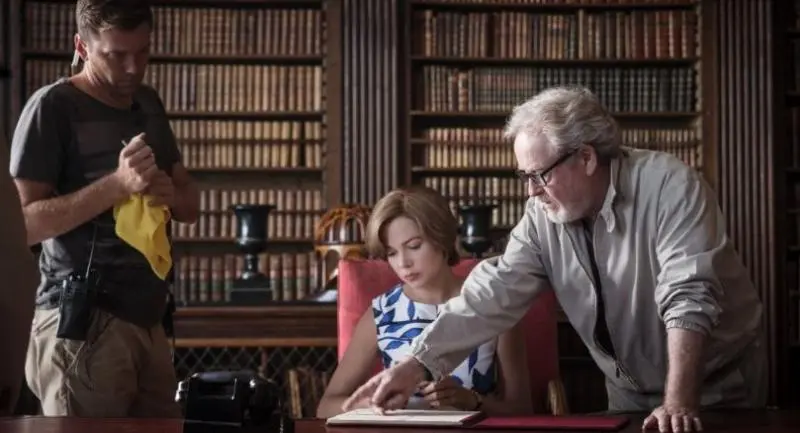


For 37-year-old, four-time Oscar nominee Michelle Williams, being cast by director Ridley Scott for his intense drama “All the Money in the World” was a dream come true.
n the film, which based on an infamous true-life crime, Williams portrays Gail Harris Getty, whose 16-year-old son John Paul Getty III – grandson of the oil tycoon J Paul Getty, then the world’s richest person – was kidnapped in July 1973 while he, his mother, and his younger siblings were living in Rome. The criminals’ $17 million ransom demand went unmet by the boy’s miserly 81-year-old grandfather, who suggested that if he met this demand, his other grandchildren might be kidnapped, and he’d have to pay those as well, leaving the divorced Gail as the clear-eyed force trying desperately to rescue her son.
The petite, Montana-raised actress made her breakthrough with TV’s “Dawson’s Creek” and went on to star in “The Station Agent”(2003), “Wonderstruck” and “The Greatest Showman”. In her Oscar-nominated performances – “Brokeback Mountain” (2005), “Blue Valentine” (2010), “My Week with Marilyn” (2011), and last year’s “Manchester by the Sea” – Williams has displayed diamond-like facets, pivoting from heartbreaking to haunting to an earthy grace that could cut glass.
Off-screen, Williams is a devoted mom to 12-year-old Matilda, her daughter with the late Heath Ledger. Sitting in a suite at New York City’s 1Hotel, in the shadow of the Brooklyn Bridge, Williams talks about the movie and her co-star as well as director Ridley Scott.
As you researched Abigail (Gail) Harris Getty, what struck you about her?
As soon as I got the offer to join the film, I set out to research her, looking at everything I could. In the clips of her from the time, there’s something about her directness, and the precision of her language, that I found intriguing. She had a very forward quality that helped me get a handle on her. She really held herself together. She exhibited a tremendous amount of strength. In the situation she found herself in, if she lost her wits or got too emotional, then she wouldn’t have become any closer to her goal, which was getting her son back alive. Flailing about wouldn’t bring him home, but staying clear on her objectives and then acting on those would hopefully save him. Abigail seemed to me like someone who very much was about progress and doing things, rather than feeling and emoting.
The film shows how the press implied Gail wasn’t a good mother because she wasn’t emotional.
I think she might have been given to that kind of response, but being emotional wasn’t going to serve the situation she found herself in. I think she believed that by making an impassioned, reasonable argument to these unknown kidnappers – if they could just hear her, if she could just reach them – then there could be some hope. She tried to keep herself together, and that, to her shock, backfired on her in the press.
She didn’t want to get “personal.” She was trying to say something that would work, that would reach these criminals, to say something persuasive. To do the right thing. And that’s not what the media at the time wanted from her. They wanted a kind of soap opera, and she was too accomplished and experienced to fall into that. She wanted to have authority in the situation, and be taken as seriously as any man would be. She wanted to be a real operative in the fight.
Something that linked Gail to the Getty family was fear, wasn’t it? Her fear of losing her son, and J Paul Getty’s fear of appearing weak.
That’s true – both Gail and J Paul Getty have a fear of being taken advantage of. It’s a struggle between something emotional and something practical, between thinking with your head and thinking with your heart. Most of us, especially if you’re a parent, would make a decision with their heart. But with her father-in-law, Gail was dealing with somebody with whom it would be of no use to plea. For J Paul Getty, only the numbers mattered. He was about financials, not emotions. That was the territory that family played in. They’re both trying to protect something they hold dear.
As you’ve played a mother more often in recent years, how has being a parent effected your portrayals of motherhood?
You learn so much about love being a mother, and a major part of movies are the connections between two people, two characters, which often involves love. And as an actor, you’re considering your character from that point of view: How many ways can I understand this person? How many ways can I put myself into this person’s shoes? And I think that’s intrinsically tied to parenting. When you become a parent, your heart suddenly feels like it lives outside of your body, and it’s susceptible and it’s open.
What was it like acting in a Ridley Scott film? Probably no time to slow down.
There isn’t! Sometimes, making movies can be boring, because you sit around a lot. But not on Ridley’s movies – you basically have to come to his films with a packed lunch, because you don’t take breaks. You have to make sure you always have enough food with you! Nobody on the set was on their phones, nobody had time to get bored or gossip or do anything but their job.
Performance-wise, Ridley was definitely only interested in things that were real and that were happening authentically in the moment. In the mornings, as we arrived on set, he would very often say something like, “Alright, welcome to work – the cameras are hidden all over the apartment, you can start over here if you want and you can end up there, and what do you say we rehearse on film?” And if he liked it, he’d say, “Okay, where are we going next?” One or two takes and then we were on to the next thing!
I was in heaven. I had the greatest time of my life. I thought, “I want to make this movie forever! Where’s the next one Ridley, I’m ready!” It was like doing a play, like every scene was a stage play. It was a great and satisfying way to work. And then you go home feeling like you know what you did today: You started something and you finished something, and you felt it all flow.
