
Missionary who left his mark on Siam
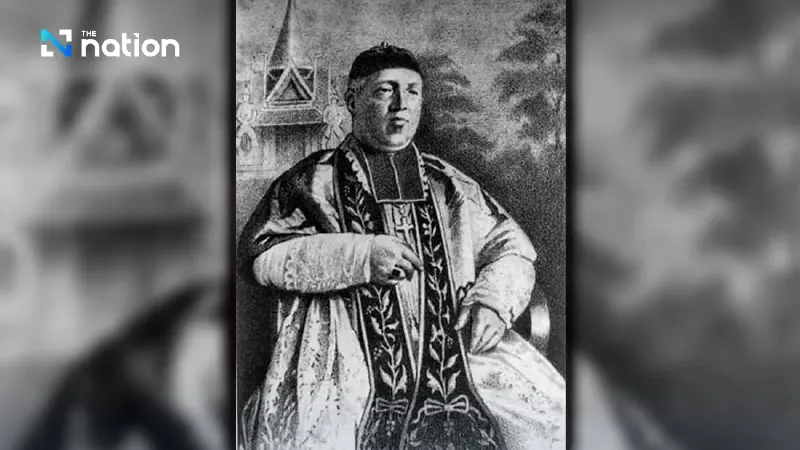


When Jean-Baptiste Pallegoix left a quiet village of France in 1830, he could hardly have imagined that his life’s work would be remembered in Siam nearly two centuries later
The young French priest, ordained just two years earlier, joined the Paris Foreign Missions Society with little more than conviction and curiosity. His journey east would shape not only his own life, but also the way Siam was seen abroad.
Bangkok at the time was a city of waterways and wooden houses, with a Catholic community numbering only a few thousand.
Pallegoix arrived with energy and resolve, rebuilding neglected churches in Bangkok and Ayutthaya while tending to the everyday needs of his flock.
By 1838 he had been named coadjutor bishop, and three years later he became Vicar Apostolic of Eastern Siam.
Pallegoix was also a man of letters. He immersed himself in Thai, Lao, Khmer and Pali, earning a reputation as one of the finest linguists of his generation.
His two-volume Description du Royaume Thai ou Siam, published in 1854, offered Europe its first detailed glimpse into Siam’s geography, laws, literature and daily life. For scholars and diplomats alike, it became a touchstone.
Equally important was his Thai–Latin–French–English dictionary, a practical yet groundbreaking work.
More than a tool for missionaries, it opened Siamese language and culture to outsiders in a way that was accessible and respectful, smoothing communication between two very different worlds.

Pallegoix’s influence stretched beyond the church.
He urged closer ties between France and Siam, and his efforts helped lay the groundwork for the 1856 treaty that formalised relations.
In many ways he acted as an unofficial envoy, a man trusted to interpret both words and intentions across cultures.
Contemporaries described him as humble and approachable. He moved easily between local communities and Siamese officials, treating villagers with the same respect he showed scholars. In an era when foreign influence was often viewed with suspicion, Pallegoix’s openness and patience earned him a rare trust.
He remained in Siam until his death in 1862, never returning to his native France. His funeral in Bangkok was marked with honours few foreigners received, a testament to the place he had won in the hearts of those he served.
