
Thailand’s PM who penned novels and stepped onto the big screen
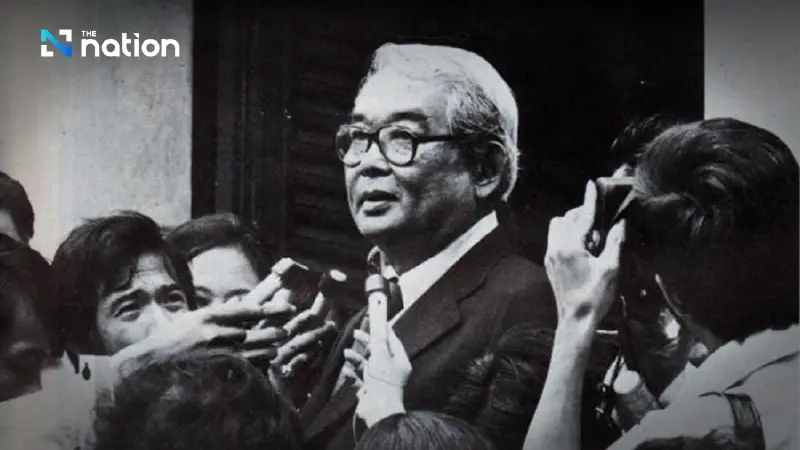


Kukrit Pramoj was more than a politician as he is also a literary voice, cultural force and even a Hollywood actor in his time
When Mom Rajawongse Kukrit Pramoj assumed the premiership in 1975, he brought more than political ambition. He carried with him the weight of history, the pen of a novelist, and the poise of a man who once shared a screen with Marlon Brando.
Kukrit Pramoj was born on April 20, 1911, in Sing Buri. He was educated in England, attending Trent College and later reading Philosophy, Politics and Economics at The Queen’s College, Oxford. After returning to Siam, his path wove seamlessly among banking, journalism and politics.
By the 1950s, Kukrit was already making his mark in literature and journalism. He founded the newspaper Siam Rath, where many of his essays, serials and commentaries appeared.
His best-known novel Four Reigns (Si Phaendin) is a sweeping chronicle of Thai society under four monarchs, told through the life of Mae Ploy, a court attendant.
He also published Many Lives (Lai Chiwit), Red Bamboo (Phai Daeng), and an array of short stories, essays and cultural critiques. His writing was underpinned by reflections on morality, impermanence, and social change, expressed with humour, sharpness and a humanist lens.

Kukrit’s literary fame was matched by a surprising foray into international cinema. In 1963, he appeared in The Ugly American, starring Marlon Brando, playing the fictional prime minister of the country “Sarkhan,” speaking both Thai and English. Originally brought on as cultural advisor to ensure authenticity in portraying monarchy and Buddhist society, he was later cast in the role because the director felt none could play it better.
In the following decades, Kukrit’s political life took centre stage. He founded the Social Action Party, served as Speaker of the House (1973-1974), and later became the 13th Prime Minister of Thailand.
During his administration, he re-established diplomatic relations with China and managed the withdrawal of US military forces from Thailand amid the shifting Southeast Asian order. His government, however, was short-lived and confronted sharp political pressures, including internal dissent and complex coalition dynamics.

Even after leaving active politics, Kukrit remained a public intellectual and cultural icon. In 1985 he was recognised as a National Artist in Literature. In 1990 he earned the Special Commemorative Prize of the Fukuoka Asian Culture Prizes for his broad contributions to arts and letters.
His Bangkok home has been preserved as a museum, a living archive of his life, filled with books, artefacts and reminders of his many roles.
Kukrit Pramoj died on 9 October 1995 in Bangkok, after a lifetime of bridging realms of power and creativity.

