
Formal Thai national costume: Her Majesty Queen Sirikit The Queen Mother’s vision for national identity and cultural legacy
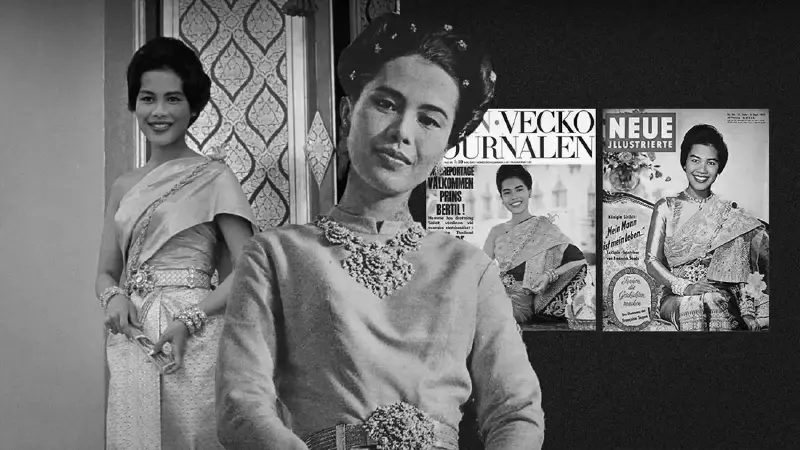


Her Majesty Queen Sirikit The Queen Mother designed the "Chut Thai" attire to showcase national identity and preserve Thai culture, blending tradition with Western formalities.
The formal Thai national costume, known in Thai as "Chut Thai Phra Ratcha Niyom", literally 'Thai dress of royal endorsement', was designed by Her Majesty Queen Sirikit The Queen Mother under her royal initiative in 1960 while she was known as Her Majesty Queen Sirikit.
In that year, the Queen and King Bhumibol Adulyadej were set to visit the United States and 15 European countries to strengthen diplomatic ties and introduce Thailand to the world after the Second World War. At that time, Thailand had no established guidelines for formal attire for women. Most women wore European-style dresses, such as suits, jackets, and hats.

Dr Surath Jongda, Assistant Rector of Bunditpatanasilpa Institute of Fine Arts, explained in a seminar titled “Promoting and Preserving Thai Costume for Sustainable Development” on August 5, 2025 that Her Majesty realised that many countries, such as Japan with its kimono, South Korea with its hanbok, and India with its sari, had distinct traditional outfits that reflected their national identity.
Her Majesty was determined to present herself in a way that would represent Thai women on the world stage. She prepared meticulously, especially in choosing Thai attire to showcase Thailand’s cultural identity and Western-style formal wear for official ceremonies abroad, taking into account various events, climates, and diplomatic settings.

To realise this vision, she instructed scholars to research historical Thai women’s dress, and with the help of royal attendants, the designs for Thai national costumes and accessories were created to reflect Thai traditions for international occasions.
Since Thai tailors at the time lacked expertise in Western-style fashion, Her Majesty sought the assistance of Pierre Balmain, a renowned French designer, to oversee the designs and provide guidance on attire for diplomatic occasions. Francois Lesage, a famous French embroidery artisan, was chosen to handle the intricate embroidery work on the royal costumes, with Her Majesty using her personal funds to finance the project.

The costumes designed by Pierre Balmain and his team for Her Majesty’s visit to the United States and Europe were both elegant and highly dignified.
The media and international audiences were highly impressed and admired the beauty of Her Majesty, and fashion experts from around the world praised her as one of the most beautifully dressed women of her time. Notably, she was recognised in several prestigious listings:
- International Best Dressed List Hall of Fame in 1960
- The 1964 list of the world’s best-dressed
- The 12 Best-Dressed Women Hall of Fame in 1965 in New York


Her Majesty Queen Sirikit recommended the enhancement and refinement of various Thai royal costumes worn during her official state visits, which became the prototypes of Thai national costumes for women, later known as formal Thai national costumes. There were eight main designs developed over time.
She wore these costumes on various occasions, both in Thailand and during official duties abroad, and they became widely admired both domestically and internationally.
The 8 designs of the formal Thai national costume have unique names that reflect the essence of Thai culture and its identity:
- Thai Ruean Ton
- Thai Chakri
- Thai Chakraphat
- Thai Amarin
- Thai Siwalai
- Thai Borompiman
- Thai Chitlada
- Thai Dusit


Her Majesty was inspired by the royal pavilions in the Grand Palace and Dusit Palace, which became the foundation for designing these costumes. Dr Surath explained further:
Thai Ruean Ton: This design is inspired by Ruen Ton Pavilion, a traditional wooden Thai-style house. It reflects the identity of the Thai rural dress, making it both practical and symbolic of Thai culture.
Thai Chakri: Inspired by the Chakri Mahaprasat in the Grand Palace, this costume blends Western-style tailoring with traditional Thai elegance.
Thai Dusit: Based on the design of the Dusit Mahaprasat, this costume features an elegant fitted bodice and embroidered patterns, mirroring the grandeur of royal ceremonies.
Thai Chitlada: Designed with the Chitlada Pavilion in mind, this costume represents a blend of rural Thai style and formal wear, appropriate for both official and formal occasions.
Dr Surath added:
“The formal Thai national costume designed by Her Majesty Queen Sirikit The Queen Mother is the prototype for the Thai attire we use today. It has evolved in many forms through performing arts, the entertainment industry, and beauty pageants both domestically and internationally. While the costume may not strictly follow the original pattern as designed by Her Majesty, with modifications made over time, the basis of all designs comes from the formal Thai national costume.”
“One key aspect of the formal Thai national costume is the tailoring for modern wearability. If people are unfamiliar, they cannot simply gather pleats and tie them around the waist as was done in ancient times. Her Majesty designed it so that hooks could be used for convenience, while still maintaining the signature pleats,” Dr Surath continued.

Meanwhile, Sawitree Suwansathit, an expert on the Cultural Heritage Preservation and Promotion Committee, and a speaker at the seminar, shared insights into the beauty and identity of the formal Thai national costume, which was born from Her Majesty Queen Sirikit The Queen Mother’s exceptional talent. She said:
“Her Majesty had excellent taste and was the daughter of the ambassador to the St. James Court in London, England, and France. What’s important is that she did not work alone. She had a team of historians, ladies, and scholars advising her on how the royal attire was worn in the past, which she then adapted into patterns for the costumes. This made the formal Thai national costume elegant and suitable for various occasions, while also flattering the Thai body shape.”
She also added:
“Creating the right taste—knowing which outfit suits which body shape and occasion—is a very delicate matter. For international events, there are dress codes to ensure people dress appropriately for the occasion. This is something we must encourage and teach, especially regarding how the eight styles of the formal Thai national costume should be worn.”
Even as she grew older, Her Majesty Queen Sirikit The Queen Mother continued to develop the Thai costume. For example, she graciously instructed the use of Batik fabric to be tailored into Thai costumes, which were paired with lace fabrics.
Each piece of her attire, beautiful at every stage of her life, was designed with the hope that all Thai people could wear diverse Thai costumes while also preserving Thai weaving craftsmanship for future generations.
