
Culture Ministry accelerates restoration of ‘Ta Kwai’ temple
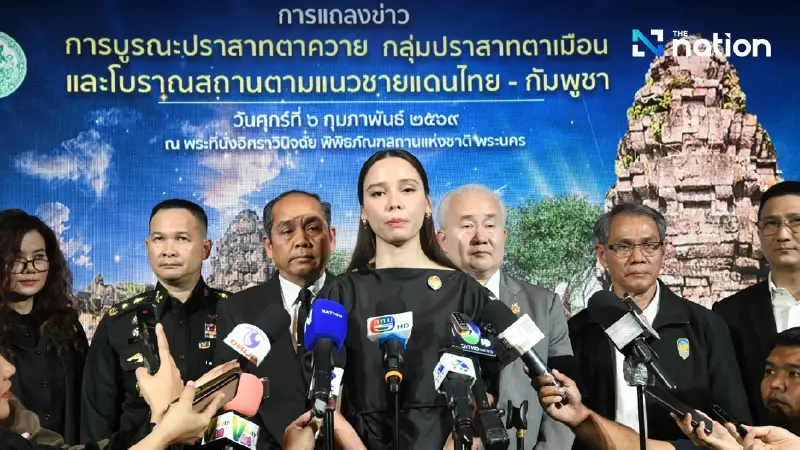


The Culture Ministry moves forward with restoring ‘Ta Kwai’ temple and registering all border temples, asserting their status as Thai heritage
The Ministry of Culture is speeding up the restoration of the ‘Ta Kwai’ temple and pushing forward with the registration of all temples along the Thai-Cambodian border. Sabida Thaiseth, the Minister of Culture, affirmed that Ta Kwai Temple and the Ta Muen temple complex are Thai heritage sites.

On February 7, 2026, following a protest letter from Cambodia in January, requesting that Thailand’s Ministry of Culture cease its restoration of Ta Kwai and the Ta Muen temple complex, which Cambodia claims as their own, the Ministry of Culture held a press conference. The department confirmed that it will continue its efforts to restore and preserve these temples, asserting their status as Thai heritage.
At the press conference, Sabida explained that, in response to Cambodia’s protest, the Ministry of Culture clarifies that Ta Kwai Temple and the Ta Muen temples are Thai heritage sites. The Ta Muen Thom and Ta Muen Toad temples were declared heritage sites in the Royal Gazette in 1935, and the Thai government approved funding for restoration between 1990 and 1996, during which the main temple restoration was completed without any objections from Cambodia.
Ta Kwai Temple is a heritage site located in Phanom Dong Rak district, Surin province. The Fine Arts Department, in collaboration with the Thai Border Patrol Police, conducted a survey of the site between 2001 and 2002, and a report was prepared as archaeological evidence.

During the survey, Fine Arts officers confirmed that no Cambodian military personnel were present in the area, as it was part of Thai territory. At the time, Ta Kwai Temple was in relatively good condition, and the Fine Arts Department did not allocate funds for restoration but added the site to the list of heritage sites that had yet to be officially registered.
Recent clashes between Thai and Cambodian troops have resulted in Cambodia using Ta Kwai Temple as a military base, causing extensive damage to the site. This action is in violation of international principles that prohibit the use of heritage sites as military bases. After the ceasefire, Thailand managed to reassert control over the area surrounding Ta Kwai and the Ta Muen temples. The damage to Ta Kwai Temple and the Ta Muen temple complex is significant, and the Fine Arts Department has been instructed to begin restoration immediately.
The Ministry of Culture has worked with the 2nd Army Area to survey and restore the temples, but Cambodian forces had previously laid numerous landmines within the temple and surrounding areas, presenting a significant obstacle to the restoration work.
The surveys revealed that Ta Kwai Temple urgently needs restoration due to severe structural damage, which resulted from Cambodia’s use of the site as a military base, disregarding internationally accepted principles, leading to the destruction of this important cultural heritage.
The Thai government continues to affirm its justification and necessity for the restoration of Ta Kwai Temple, the Ta Muen temples, and other heritage sites along the border, as they are clearly part of Thai territory and cultural heritage.
Regarding questions about the number of temples along the Thai-Cambodian border that have not yet been officially registered as heritage sites, there is no clear number from the official press conference. However, the Fine Arts Department has previously surveyed these sites, even navigating through landmine fields. Earlier reports confirm that there are approximately 30 temples along the border that Thailand intends to register as heritage sites.
