
One of a kind tradition: Mon Songkran rite bathes monks through bamboo channels
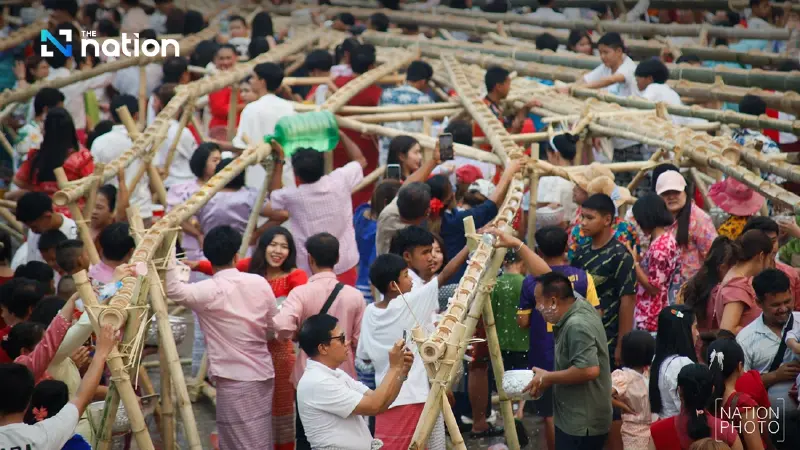


Sangkhla Buri’s Mon community keeps a rare Songkran tradition alive, bathing monks through bamboo channels at Wat Wang Wiwekaram in Kanchanaburi
A rare Songkran tradition unique to Sangkhlaburi drew Mon worshippers, local residents and tourists to Wat Wang Wiwekaram in Kanchanaburi on April 17, despite stifling heat and a lingering haze of dust and smoke.
The ceremony took place at the Bodhgaya Chedi in Ban Wangka, where devotees gathered to take part in the annual ritual of bathing monks with scented water flowing through a handmade network of bamboo channels.

Held every Songkran at Wat Wang Wiwekaram, also known as Luang Por Uttama Temple, the event is regarded as one of the most important annual merit-making occasions for the Mon community in Sangkhlaburi. The temple remains a spiritual centre for Thai people of Mon descent in the district.

At the heart of the ritual is a belief in the purity of the monkhood. Villagers believe monks should not step directly on the ground during the ceremony or come into contact with the earth. In a striking act of devotion, young Mon men lie shoulder to shoulder in a long line, allowing the monks to walk across their backs. The act is believed to help ward off illness and misfortune.

Meanwhile, villagers bring fragrant water from home, infused with scented water and floating flowers, and pour it into bamboo troughs split lengthwise. The sections are tied together into a connected waterway, with smaller branches extending from each channel so the water can flow widely and evenly during the bathing rite.

All of the water from the bamboo channels eventually converges at a single point. A bamboo screen decorated with flowers is set up as a partition, behind which the monks sit to receive the ritual bathing in privacy.
Once the bathing ceremony is over, the remaining water takes on a more festive role. Members of the Mon community use it to splash one another in cheerful celebration, bringing a joyful close to one of Sangkhlaburi’s most distinctive Songkran customs.


Photo: Kobphak Promrekha
