
Royal Vision: How Thailand Became a Caviar Producer in the Tropics
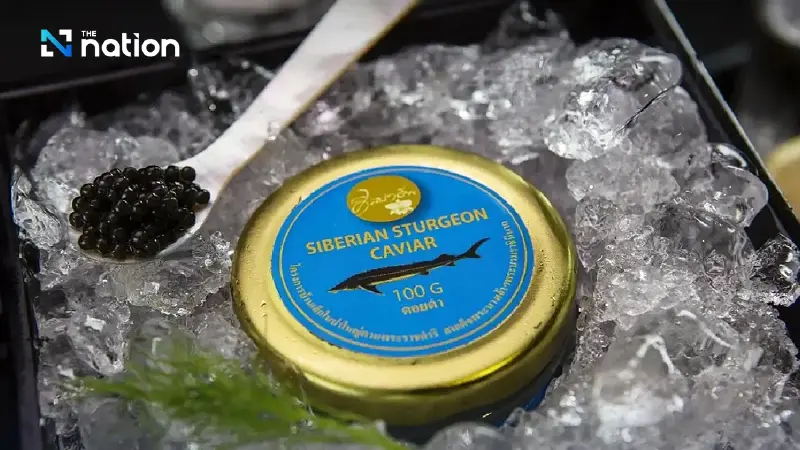


Queen Mother’s foresight transforms highland poverty into sustainable income stream; homegrown 'Silapacheep Caviar' now rivals global luxury brands
- A royal initiative by Queen Sirikit, The Queen Mother, established sturgeon farming in Thailand's highlands to create a sustainable income for impoverished communities and reduce caviar imports.
- The project succeeded in a tropical climate by leveraging the cool conditions of a Royal Project in Chiang Mai and obtaining Siberian sturgeon and expert assistance from Russia.
- The resulting homegrown 'Silapacheep Caviar' has gained national recognition for its quality and was featured at the APEC 2022 Leaders' Summit banquet.
Queen Mother’s foresight transforms highland poverty into sustainable income stream; homegrown 'Silapacheep Caviar' now rivals global luxury brands.
The delicate, high-value roe of the sturgeon—caviar—was once a costly import to the Kingdom of Thailand.
Yet, a decades-long royal initiative has turned this dependency on its head, establishing Thailand as an unlikely producer of the luxury foodstuff, all thanks to the far-sighted vision of Her Majesty Queen Sirikit, The Queen Mother.
Her Majesty’s royal initiative to successfully breed sturgeon and produce caviar has created a sustainable new career and a valuable source of income for impoverished highlanders in Chiang Mai province.
The breakthrough came under the "Baan Lek Nai Pa Yai (Small House in the Big Forest), Doi Kham" Royal Project, with critical species and expert assistance supplied by Russia.
Today, the resulting product, dubbed ‘Silapacheep Caviar’, has achieved national recognition for its quality, famously being chosen as an ingredient for the welcoming banquet menu at the APEC 2022 Leaders’ Summit in Bangkok.

From Trout to Sturgeon
The foundation for this success was laid much earlier. The Inthanon Royal Agricultural Station, established on Doi Inthanon under the initiative of His Majesty King Bhumibol Adulyadej The Great, had already been successfully breeding the cold-water Rainbow Trout since 2002, providing local villagers with a livelihood.
Building on this success, in 2016, the Support Foundation of Her Majesty Queen Sirikit announced the first successful production of caviar in Thailand, directly resulting from the Queen Mother's guidance.
Lady Jarungjit Teekhara, who served as Her Majesty's Royal Private Secretary, explained that while the Queen is often associated with cultural arts like silk and the Khon masked dance, "This work... intends to show that Her Majesty has worked extensively in many areas, particularly in agriculture."

The core drive behind all the Queen Mother’s projects was Her desire to transform the lives of poor and remote citizens.
Lady Jarungjit recalled Her Majesty’s method during royal visits: always asking villagers about their water sources and whether they contained fish.
"Her Majesty had the royal thought that if they lacked protein, how would the children grow up? Would they have the intelligence to study?" she noted.
This concern quickly expanded into a mission to combat deforestation, leading to the creation of the agricultural stations on degraded forest land.

An Unlikely Tropical Harvest
The specific location for the caviar breakthrough was the Baan Lek Nai Pa Yai, Doi Dam Project in Wiang Haeng District, Chiang Mai.
The area’s cool climate and good water quality, though initially too cold for local small fish, proved ideal for imported cold-water species.
The idea for sturgeon was planted by Her Majesty towards the end of 1997.

Charantada Kannasoot, former Director-General of the Fisheries Department and now a Privy Councillor, recounted Her Majesty's request: "If the Rainbow Trout farming is successful, I would like you to try raising sturgeon... [to] help reduce the import of foreign caviar."
The challenge was immense. Sturgeons require very cold water, and the most suitable species identified, the Siberian sturgeon, takes eight years to mature and produce eggs.

After an initial setback—a batch of imported German sturgeon eggs turned out to be all male—the project obtained new species from Russia following a royal visit that strengthened bilateral relations in 2007.
Success finally arrived in the eighth year of the second attempt. Russian experts were brought in to train the team on caviar production techniques.
When the first successful batch was presented to Her Majesty The Queen Mother and HRH Princess Maha Chakri Sirindhorn, the comment was simple: "It's similar [to the imported one], it's acceptable."

A World-Class Delicacy
At its 2016 launch, French Chef Hervé Ferard praised the locally produced caviar, noting that it possessed all the necessary qualities: firmness, resilience, a satisfying 'pop,' and a milder saltiness compared to the renowned Beluga variety.
Crucially, Silapacheep Caviar is unpasteurised, which, while limiting its shelf life, preserves the full flavour and nutritional profile.
The Support Foundation produces the roe only during the cold season, from November to February, and has successfully become the first entity in Southeast Asia to breed sturgeon in a tropical climate.

The project requires continuous, multi-year planning, as Charantada noted: “Since the fish must grow for eight years to produce eggs, we have to try to produce new fish every year so we can continuously produce caviar.”
The quality achievement was cemented when the product, marketed under the brand Silapacheep (symbolised by an orchid), was featured as the starter at the APEC 2022 Gala Dinner: Kratong Tong with Cream Sauce and Royal Project Doi Inthanon Sturgeon Caviar—a true testament to a royal dream come true.
