
Better care of our resources
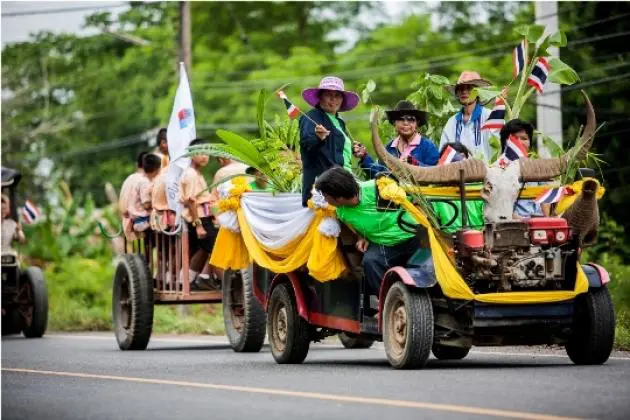


Thousands of volunteers take part in a nine-day project to learn about and practice self-sufficiency
THOUSANDS OF community volunteers joined forces for the recent nine -day activity “Power of Human Energy: A Journey Inspired by the King”, travelling from Bangkok to Saraburi to learn about His Majesty the King’s ideas for protecting and solving the country’s critical water problems.
Those volunteers, who walked, ran and cycled 170 kilometres with stops at several destinations inspired by the King’s sufficiency economy philosophy, included members of Chevron Thailand Exploration and Production, Riverpro Pulp and Paper, the Institute of Sufficiency Economy, the Agri-Nature Foundation, JSL Global Media’s “Joh Jai” programme. Also taking part were the cavalry squadron based Adisorn Camp in Saraburi, the Nong No community, the Highway Amateur Radio Club, students from Valaya Alongkorn Rajabhat University, Ban Pong Ket School, and an Institution of Universal Learning.
Crowds of volunteers started the journey from Thammasat University’s Rangsit campus to Wat Chujit Dhammaram in Phra Nakhon Sri Ayuthaya, which served as an aid centre for more than 2,000 flood victims in 2011.
Arriving in Saraburi province, they learnt about the forest and manufacturing without chemicals at Riverpro before visiting the sufficiency economy learning centre at Ban Nong No. Here, they split into small groups to take part in agricultural activities and planted trees in line with the King’s concept of “Three Forests, Four Benefits.”
The concept focuses on the growing mixed forests and combines agro-forestry and socio-economic considerations into a comprehensive approach to afforestation. In other words, forests should be divided into three parts to grow timber, fruits and firewood. These are the forests, which also offer great three benefits to the people. The fourth benefit is a by-product of the first three and ensures the conservation of soil and watersheds.
The groups then moved to Adisorn camp to learn how the army prepares to help people suffering from natural disaster before joining up with local volunteers and young people in making the Pasak River clean by dropping bio micro-organisms in it.
Later in the day, participants visited the experimental field at Wat Mongkol Chaipattana, the project that served as the first model for the King’s new theory.
Ban Pong Ket was the group’s last destination and here they learned about the several ways of building water supply.
Throughout the 9-day journey, participants learned a great deal about the King’s projects, helping each other to build ecofriendly water supply schemes and understand the self-sufficiency philosophy.
“I would like do more for the King,” said Suthichai Susansanee, a 65-year-old biker. “We are like his children. We would like to lighten his load. Thanks to this project, we have learned about water management and the importance of planting trees.”
