
Dancing through time
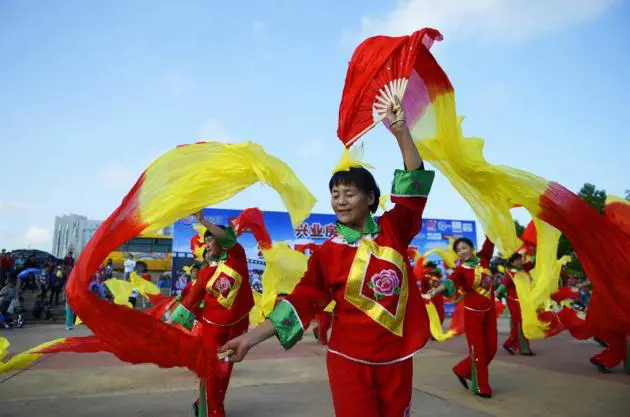


China's ethnic groups bring their traditional square dances to a competition honouring community art
Holding a rattlesnake whip in one hand, use the other to give yourself a tap on the shoulder, then your elbow, wrist, waist, kneecap and instep until you have tapped each joint in your body.
It sounds like the perfect stretching exercise and it’s fun too that to the whip, which is decorated with six little coins that give a jaunty jingle with each “swish”.
Practised daily at the People's Park in Dali, Yunnan province, the routine is not solely for exercise. The rattlesnake dance, a signature dance of the Bai ethnic group in the area, is an emotional expression of culture.
“Listen to the coins, it’s how we welcome wealth and happiness. It’s our tradition to dance the rattlesnake dance at major festivals and celebrations,” explains Yang Zhenyi, 36, who in October led her group of amateur dancers from Yunnan to Qingdao, Shandong province to participate in the Galaxy Awards competition that honours community art.
“The dance at the square we practice daily is easier than the original ones, but it’s the same free-spirited and engaging dance that just makes you happier and happier when you tap to the tune,” says Yang. “I’ve only seen the full set of dances in the village where my grandparents lived, but I love it.”
Yang was raised in the city and is a clerk at the local art museum.
Dancing in the square is best accompanied by impromptu Bai ethnic tunes sung a cappella. “Listen to it, we dance to say how lovely we Yunnan ‘golden flower’ girls are,” Yang says.
Just like the whip dance, the Kazakh traditional dance Karajurha tells the story of how men ride horses and wrestle and how women sew and children play. This traditional dance has also evolved into an engaging square dance and a morning exercise at schools.
“We’re used to dancing it whenever there is a wedding or happy get-together,” says Ersen Heyzat, from the Altay prefecture of the Xinjiang Uygur autonomous region.
He led his group of dance enthusiasts to the Galaxy Awards. He has also designed a set of school exercises based on Karajurha. “When the tribe still lived on the grassland, it was danced while on a horse. Therefore it’s the same tempo as the horses prance,” he says.
“It’s easy as long as you know how to shrug, as most moves are in the upper body,” says Heyzat. “For the Karajurha square dance, there is nothing you can't learn in a minute and no standard you can’t match.”
In Usu in Xinjiang, young and old participate in ethnic square dancing every evening in the summer in several plazas around the city. “We don’t wear an owl's feather or ultra-long sleeves (the traditional dance clothes) for daily square dancing,” Heyzat says. “But the movements still reflect our moods, that we are very happy with our lives.”
Square dancing can be witnessed across the country in the morning and early evening in warm weather, and is worthy of public appreciation.
“It dates back to the traditional folk dances, it’s a natural invention,” says Ming Wenjun, vice-president of Beijing Dance Academy. Ming is a specialist in folk dance research and was on the judging panel of the Galaxy Awards.
“They start as a ceremony related to the group’s belief, cultural lore, and are part of educating the group on manners and behaviour,” Ming says.
“These functions of the dances weaken with urbanisation, but the dances remain a very important part of our culture.” Square dancing cannot be properly categorised because it is a mixture of styles and themes. It’s engaging, entertaining and distinctly characteristic of one’s cultural upbringing.
“(In the Galaxy Awards) the square dances are representative of a group's cultural identity,” Ming says. “You see a soft whip, or a longevity drum, or an umbrella prop, you immediately know the dancer’s hometown.”
“The square dance is fun and easy for the dancers themselves. People become very invested in it,” Ming says.
And most importantly, the dance brings the dancers knowledge of themselves. “The moves are the ritual that gives us Chinese the sense of order and human relations,” Ming says. “Questions of who we are, and why we Chinese cling to our home, are answered here.”
