
Here comes the sun


Play
Solar panels not only make economic sense, they also look good
With energy prices continuing to rise, it makes sense for anyone building or renovating a home to take a close look at how they can reduce their electricity consumption by opting for energy-saving materials. An obvious choice is rooftop solar panels, as this not only adequately meet a homeowner’s energy needs for also benefit the environment.
Yet the choice of solar panels comes with several concerns: for example, will they make the roof and thus the house ugly? Will they cause problems in the future? And last but not least, is the initial investment worth the outlay?
“Eco-friendly living is gaining traction as evidenced by the increased use of rooftop solar panels by modern homeowners,” says Tossatan Boonsorn, Roofing Solution manager for SCG HousingTECH, which offers a SolarEco system that can be tidily configured to all shapes of roof.
“It is however important that homeowners do careful research before jumping on the solar bandwagon because the roof, an integral part of house, has an aspect of permanency and is a statement of homeowners’ tastes and styles. In addition, it is important to choose a solar panel mounting system that will not cause leakage. We also have an innovative SolarFIX system that secures solar panels without drilling or levering the roof tiles, which effectively prevents leakage and is compatible with all styles of roof,” he says.
Tossatan recently provided XP with a list of guidelines for homeowners to consider before deciding to install rooftop solar panels.
nQuality: Solar panels are intended for long-term installation, so the chosen producer should be highly reliable to ensure lifetime maintenance support.
nPropriety: The panels should face south or southwest and be installed on faces of the roof that have no obstruction of sunlight.
nLeakage: Installing solar panels can cause leakage because roof tiles may need to be force-levered or drilled. Therefore, the chosen solar system should feature a mounting technology that secures the panels without posing risk of leakage.
nReturn saving: The amount of energy saved should be calculated to estimate money saving. Homeowners should also find out if their home-generated solar energy can be sold to relevant authorities.
nAesthetic harmony: Roof is a permanently installed part of the house. Amendments made to it at a later time can be costly and involve disassembly and rebuilding of the entire roof structure.
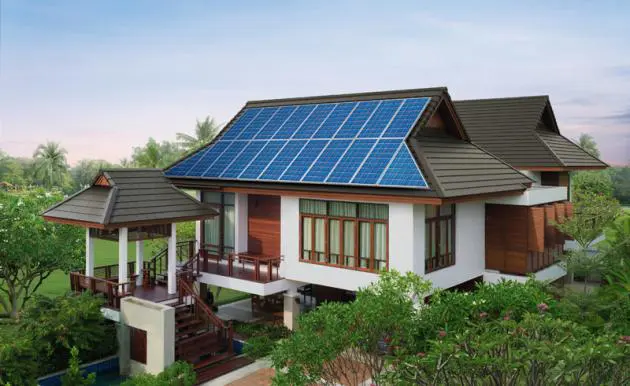
Although generic solar panels can be installed on all types of roof, their fixed, rectangular shape is a restriction that devaluates roof aesthetics. SCG’s SolarEco system that can be configured to different shapes of roof faces. There are four options based on the most popular roof shapes
nThe gable roof is widely used and is well suited to Thailand’s tropical climate. A gable roof has two sides that slope downwards and forms a high triangular portion of walls between the edges – a design that facilitates heat ventilation underneath and draining of rainwater from the roof surface. The roof pitch varies according to design and homeowner’s liking. With large roofing faces, a gable roof allows for easy installation of solar panels and full-space installation can be applied on the side that faces the sun.
nThe hip roof is a familiar sight in residential projects as well as resort style homes. A very popular type of roof today, all four sides of the roof slope downwards to the front, back, left and right walls of the house and it has a gentler pitch than the gable roof. To minimise devaluation of design aesthetics, solar panels can be installed on only one face of the roof by having the shape of panel formation agreeably configured to the shape of the roof face.
nThe lean-to roof is a single-pitched roof. With one end pitched towards the sky and the opposite towards the ground, the roof looks elegant and modern. Despite its large roofing face that eases solar panel installation, a special caution is possible leakage, which can be prevented through roof design with a high pitch degree to drain away rainwater quickly.
nA gablet or Dutch gable roof is a roof with a small gable at the top of a hip roof and thus combines the advantages of gable roof and hip roof with an added focus on creativity on the top part. This is a popular type of roof for country style and contemporary homes because it subtly fuses Thai sense with modernity. Suggested place of solar panel installation is on hip part of the roof by configuring shape of the solar panels to that part.
BRIGHTEN LIFE UP
For details, visit www.Trachang.co.th or call SCG Contact Centre (02) 586 2222.
