
Empty threat or reality? Cambodian workers flee amid fears
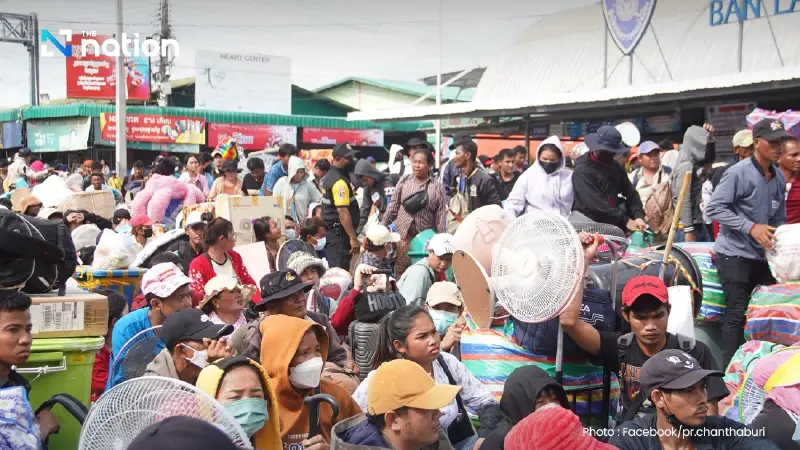


Over 200,000 Cambodian workers return home amid threats of land seizure and citizenship revocation, raising concerns over the impact on Thailand’s economy.
- Over 200,000 Cambodian migrant workers are fleeing Thailand amid fears of having their land confiscated and losing their citizenship if they fail to return home.
- The threats, reportedly made by Senate President Hun Sen, are being spread by local officials in Cambodia who pressure families to call their relatives back from Thailand.
- The mass exodus has led to thousands of workers crowding border crossings with their families and belongings, causing closures of Cambodian-owned businesses in Thailand.
- Despite the widespread panic, the article notes there is no official mandate for the return, and some long-term residents are unconcerned, highlighting the uncertainty over whether the threat is real.
A wave of uncertainty has swept through Cambodia, with over 200,000 migrant workers in Thailand rushing back to their homeland amid growing fears of land confiscation and loss of citizenship.
The threats, reportedly made by Senate President Hun Sen, have led to widespread panic among the workforce, with many fleeing Thailand in haste.
The most glaring evidence comes from a post shared by a Thai employer, referenced by the Facebook page "Than Pao." The post describes a Cambodian worker named "Sa," who had worked in Thailand for over ten years.
Sa revealed that the village head had been calling every day, warning that if Sa did not return home by a certain date, their land and house would be seized.

What stands out in the post is the employer’s concern, as they arranged to purchase a year's worth of medication for Sa, who suffers from a skin condition. The employer expressed uncertainty about whether Sa would ever be able to return to Thailand to work again.
The situation has become increasingly dire in recent days. At several border crossings, including the Ban Laem border in Chanthaburi, Klong Luek in Sa Kaeo, and Hat Lek in Trat, thousands of Cambodian workers, along with their families and belongings, have crowded together, waiting to cross back into Cambodia.
At the Ban Laem border alone, over 10,000 workers have been seen, with many businesses, particularly those owned by Cambodians, closing down.
Some workers have been waiting at the border since August 4, carrying heavy loads, including household appliances like refrigerators and washing machines, while they await their turn to leave Thailand.
According to surveys, 90% of the workers expressed deep concern about the threats, stating they feared losing their homes and land and being erased from Cambodia’s population registry if they failed to return by August 13.


The situation is further compounded by reports of officials spreading information to families back in Cambodia, urging them to pressure their relatives in Thailand to return home. Many workers now find themselves in a dilemma, knowing that if they go back, they will have no work waiting for them.
Rattawit Tangkiatphatchara, President of the Thai-Cambodian Border Trade and Tourism Association in Chanthaburi, revealed that approximately 200,000 Cambodian workers have already returned to Cambodia. He stressed the need for the Ministry of Labour to acknowledge the ripple effects on various sectors, particularly those that rely on this workforce.
“The number of returning workers is significant. It’s not just 20,000, as some might believe. Cambodian workers will continue to return home due to family pressure, as parents are urging them to go back,” said Rattawit. He highlighted the chain reaction, where families in Cambodia call on their relatives in Thailand to return, which further amplifies the exodus.
The mass return of workers is poised to disrupt key industries, agriculture, and services in Thailand that depend heavily on this workforce. At the Rong Kluea market in Sa Kaeo, one Cambodian trader confirmed that the threat of losing citizenship is genuine. "The leaders want citizens to show their allegiance to either Cambodia or Thailand, but there’s no official mandate forcing people to return," she explained.
However, some traders who have lived in Thailand for decades are unconcerned, as they believe their livelihoods are firmly established here. This reflects the differing perspectives on the issue. Some workers face direct pressure from their families, while others are completely unaware of the situation.
This raises the important question: In an age where information spreads rapidly, how can accurate information reach those directly affected?
The situation surrounding Cambodian workers is not just a bilateral issue between two countries; it is a matter of human rights, family separations, shifting livelihoods, and interconnected economies.
We must ask: How can we establish clear, transparent communication mechanisms to ensure that accurate and timely information reaches all parties involved?
Furthermore, how can we sustain the positive relationship between the people of both nations, and what long-term effects will this situation have on Thai-Cambodian relations and our labour sectors?
Nation STORY
