
Thai Army rebuts Cambodian protest over law enforcement in disputed border zone
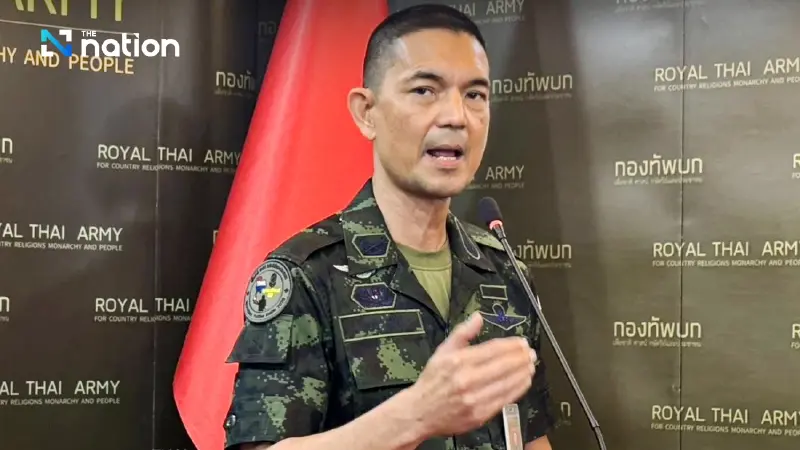


The Royal Thai Army has rejected Cambodia’s accusation that Thailand was unlawfully applying domestic law to Cambodian nationals in disputed territory.
- The Thai Army asserts the area in question is sovereign Thai territory, not a disputed zone, giving it the right and duty to enforce its domestic laws.
- Thailand counters that it is Cambodia that has violated the UN Charter and a 2000 border agreement by deploying troops, planting landmines, and allowing construction in the area.
- The army spokesperson rejected claims of escalating tensions, instead accusing Cambodia of organizing its citizens to provoke violence against Thai police officers.
- Thailand claims it has filed over 500 formal protests against Cambodian breaches of the 2000 MOU, which it says have been ignored for over 20 years.
The response followed a statement issued by Cambodia’s protest on September 20, which claimed Thailand had asserted the right to prosecute Cambodian citizens in the villages of Chouk Chey and Prey Chan, O Bei Chorn commune, O Chrov district, Banteay Meanchey province.
Phnom Penh argued that such actions violated the UN Charter (Articles 2(3) and 2(4)), breached the 2000 Memorandum of Understanding on land boundary demarcation, and undermined the mandate of the Joint Boundary Commission.
Cambodia urged Thailand to halt activities it said were escalating tensions in violation of the ceasefire agreement.
Maj Gen Winthai Suwaree, the army’s spokesperson, dismissed the allegations, saying Thailand has both the right and the duty to enforce its domestic laws on individuals within Thai territory. “This is a universally recognised principle,” he said, stressing that the area in question lies entirely within Thailand’s sovereignty and is not subject to overlapping claims as Cambodia has suggested.
Winthai added that the enforcement of Thai law in the area was therefore legitimate and consistent with the state’s sovereign authority.
Winthai added that Cambodia itself has repeatedly violated the very principles it accuses Thailand of breaching under the UN Charter.
He noted that Article 2(3), which obliges member states to settle disputes peacefully to safeguard international peace and security, has been disregarded by Cambodia through actions such as incitement, staging incidents, and using civilians to provoke violence.
Similarly, he said Cambodia has breached Article 2(4), which prohibits the threat or use of force against the territorial integrity of another state. “It is Cambodia that has violated this principle by deploying armed troops on Thai sovereign soil and secretly planting PMN-2 anti-personnel mines inside Thai territory, even after the ceasefire agreement was in place,” Winthai stated.
On the claim that Thailand violated the 2000 Memorandum of Understanding (MOU) on land boundary demarcation and the mandate of the Joint Boundary Commission, Winthai argued that it was Cambodia which had in fact breached the MOU. He cited decades of neglect and insincerity, pointing out that Cambodian authorities had allowed the construction of buildings, facilities and even residential communities in areas under dispute as well as inside Thailand’s sovereign territory.
“Thailand has filed more than 500 formal protests under the 2000 MOU along the Thai-Cambodian border, but Cambodia has ignored them and failed to take corrective action for over 20 years,” the spokesman said.
The army spokesman further rejected Cambodia’s demand that Thailand cease activities allegedly undermining efforts to ease tensions under the ceasefire agreement. He countered that it was, in fact, Cambodia that had covertly encouraged and organised gatherings of its nationals in the area, often adopting aggressive behaviour and resorting to violence against Thai police officers operating on Thai sovereign soil. Several Thai officers were reported injured as a result.
He reaffirmed Thailand’s commitment to resolving border issues through peaceful means. “Thailand has no intention of using force against anyone. All necessary measures taken are strictly within international norms and Thai law, aimed at safeguarding sovereignty and defending against Cambodian provocations,” the spokesman said.
