
Cambodian villagers return to protest at Sa Kaeo border sites
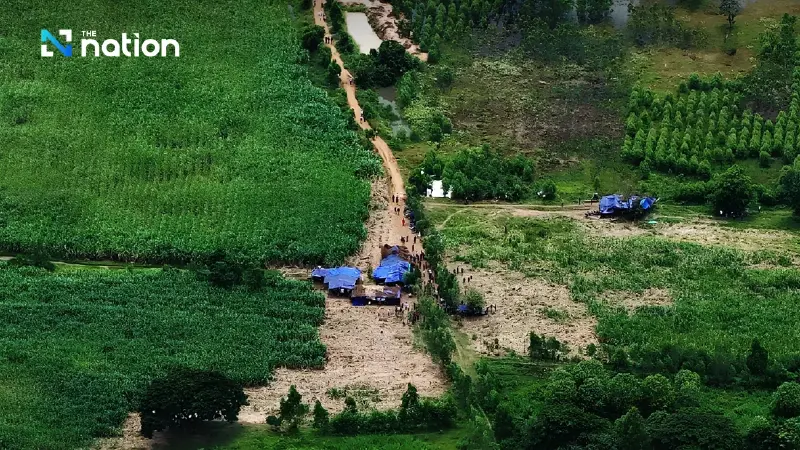


Border tensions flared again in Sa Kaeo as Cambodian groups staged fresh protests at Ban Nong Chan and Ban Nong Ya Kaeo, drawing security scrutiny.
- Cambodian villagers have resumed protests at border sites in Sa Kaeo province, specifically at Prey Chan (Ban Nong Ya Kaeo area) and Ban Nong Chan.
- The demonstrators are demanding that Thailand respect a 2000 boundary demarcation agreement and are trying to hold onto land and houses that Thailand claims as its territory.
- Crowd sizes were estimated between 50 and 200 people, with Cambodian soldiers seen mingling with protesters at one location.
- The protests have prompted counter-rallies by Thai villagers, who are supporting their own troops and calling for the government to reclaim the disputed land.
Cambodian villagers gathered once again on Sunday (September 21) at Prey Chan, part of the Ban Nong Ya Kaeo area, beginning around noon.
Aerial footage showed large numbers of vehicles parked throughout the village, suggesting that outsiders had joined local residents.
Protesters converged at the same spot along the barbed-wire and tyre barricade where they previously displayed placards demanding that Thailand respect the 2000 MOU on boundary demarcation.
Security officials estimated the crowd at about 50 people, who approached close to the fence, despite it being a major Buddhist merit-making day in Cambodia.

At Ban Nong Chan in Non Mak Mun subdistrict, a flashpoint where Cambodians are trying to hold onto land and 35 houses encroaching inside Thai territory, demonstrations resumed after nearly a week of shifting activity to Ban Nong Ya Kaeo.
By Sunday, groups of villagers and protesters had returned and set up camp behind Border Marker 46, about 200 metres inside Cambodian territory.
Cars were parked along Highway 58, with villagers then walking to a makeshift tented site where the protest was held. Cambodian soldiers were also seen mingling with the villagers.
Security sources estimated the number of demonstrators at around 200, with some arriving prepared with motorcycle helmets.
The area is particularly symbolic as it is home to village headman Ree. Only a day earlier, Um Reatrey, governor of Banteay Meanchey, had accused Thai forces of occupying 17 Cambodian houses there and demanded that Bangkok allow residents to return.
News of the gathering near Border Marker 46 prompted Thai villagers from Ban Nong Chan and nearby provinces to rally in response, joining soldiers in asserting Thai sovereignty and calling for the land to be reclaimed.
Thai people said government will be ‘heroes’ if land is reclaimed
A Thai citizen who had travelled from Lat Krabang, Bangkok , to support Thai troops told reporters they came because they were distressed by the ongoing border tensions and the injuries sustained by Thai soldiers. They criticised the government’s “soft approach,” arguing that Cambodia had ignored warnings because it knew Thailand would not act decisively.
“The talks on October 10 won’t matter if our government remains weak. If they cannot resolve this, they’ve lost legitimacy and should step aside for someone else,” the citizen said, adding that overlapping and inconsistent decision-making left ordinary people uncertain about who to trust.
They urged the prime minister to intervene directly: “Even though you’ve just taken office, you must show results. Bring back our land. If you succeed, people will praise you. If you do nothing, no one will vote for you again. Any government that can solve this problem will be seen as a hero.”
Thai Villagers urge Hun Sen to relocate Cambodians off Thai land
Residents of Ban Nong Chan, who have been volunteering to cook meals for Thai soldiers stationed at the border, appealed to the government not to yield to Cambodian demands. They said they sympathised with troops “sleeping on the ground and eating in harsh conditions” and called on the authorities to act decisively, noting that Cambodian groups had staged provocations at three separate locations.
In remarks directed at Cambodians, some villagers said in Khmer: “Don’t believe Hun Sen . He sleeps well while soldiers here survive on half-boiled eggs. Don’t let ordinary people be used as human shields. Go home, don’t be misled.”
They also sent a pointed message to the former Cambodian prime minister himself: “If you want Cambodians to move off Thai soil, then allocate land for them in Poipet or Phnom Penh. There is plenty of space there. We understand the plight of villagers, but Hun Sen, as the leader, must look after his own people. Only then will this conflict end.”
In Khok Sung district, Sa Kaeo province, Thai residents continued to gather on Sunday to cook meals for soldiers stationed at the frontier while discussing how and when the tense border standoff might end after the governor of Sa Kaeo has again sent a letter to Um Reytai, governor of Banteay Meanchey, demanding a clear evacuation plan by October 10, ahead of the General Border Committee (GBC) meeting.

The situation was further inflamed by a statement posted by Cambodian leader Hun Sen, who dismissed Thai military maps identifying Ban Nong Ya Kaeo as undisputed Thai territory under the 2000 MOU, claiming instead that such reports were “fake news.”
In response, residents of Ban Nong Ya Kaeo angrily declared that the land in question “is 100% Thai,” lying behide boundary markers 41 and 42. They insisted there was no point in further talks with Phnom Penh, urging Bangkok to act immediately, warning that if the government fails to do so, locals will mobilise to take matters into their own hands.
Among those affected is Ran, a Ban Nong Ya Kaeo villager of Cambodian origin who fled the Khmer Rouge 25 years ago and married a Thai national. She said her husband owns 14 rai (5.5 acres) of farmland but has been unable to cultivate it because Cambodian authorities seized the land. “Now we have no land of our own to farm,” she said.
