
Thai Army clarifies border situation: Not a public conflict, but repeated Cambodian violations of MOU
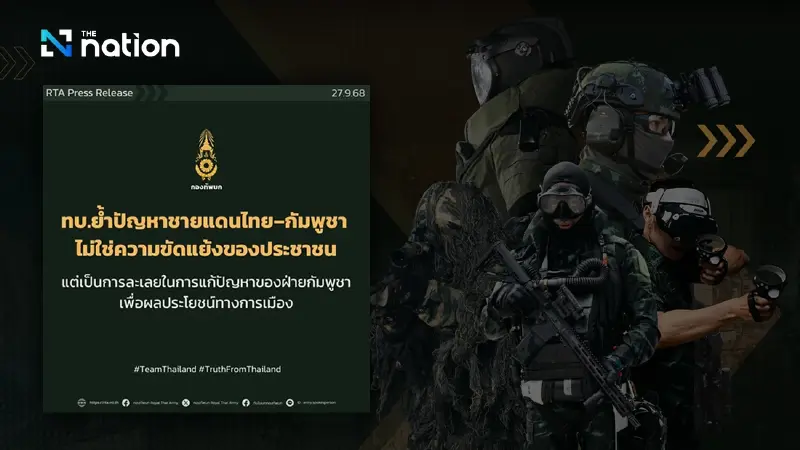


The Royal Thai Army stresses that tensions along the Thailand-Cambodia border stem from repeated Cambodian actions for political gain, not local disputes, highlighting violations of MOU agreements.
The Royal Thai Army (RTA) has clarified that the tensions along the Thailand-Cambodia border are not a result of conflict among local residents but arise from neglect and deliberate actions by Cambodia to create recurring problems for political advantage.
This follows comments made on September 26 by Cambodian Prime Minister Hun Manet regarding border demarcation in Sa Kaeo Province, which contained several inaccurate claims contradicting Thailand’s official statements and potentially causing public confusion.
Maj Gen Winthai Suvaree, RTA spokesperson, explained that while some of Hun Manet’s statements are factual, many were selective assertions reflecting Cambodia’s perspective, unfairly implicating Thailand.
Regarding Hun Manet’s claim that “under this MOU, both parties agreed to maintain the status quo until the border demarcation is complete,” the RTA emphasised that Cambodia itself has repeatedly altered the area over the past 20 years by constructing homes and establishing communities. This encroachment extends beyond overlapping claims and areas specified under the MOU, infringing on Thai territory.

Winthai said aerial photographs comparing past and present conditions clearly show the extent of Cambodian violations. Thailand has lodged over 500 formal protests in line with the MOU, yet Cambodia has failed to address these breaches.
In contrast, several Thai border areas, such as Chong Bok in Ubon Ratchathani, have seen clear Cambodian encroachment, including excavation for military routes and settlement expansions in Sa Kaeo Province, which have contributed to the current conflict. Hun Manet notably avoided mentioning these incursions.
Winthai also stated that accusations of Thailand unilaterally redrawing the border are false. The spokesperson explained that along the Thailand-Cambodia border, mountainous areas are delineated by watershed ridges, while flat terrain uses survey markers agreed upon by both countries’ joint boundary committees. These markers do not require advanced mapping technology but rely on honesty and straightforward procedures to determine boundaries, reducing the time needed for the Joint Boundary Commission (JBC) to resolve disputes.
All 74 boundary markers have been surveyed and recorded by the joint survey committee of both countries, with documentation clearly noting agreed and disputed coordinates. Disputed areas are those claimed by both sides, and the MOU stipulates that no changes to the terrain are allowed.
“Therefore, the claim that Thailand drew the border lines independently is incorrect. Cambodia is fully aware of each marker’s coordinates, and the straight lines connecting markers merely serve as references for boundary demarcation in flat areas, not unilateral line drawing by Thailand,” said Winthai.
In the case of markers 42 to 43, connecting the agreed position of marker 43 to marker 42—whether using Cambodia’s or Thailand’s claimed position—reveals overlapping claims. Importantly, the disputed areas of Ban Nong Ya Kaew and Ban Nong Chan, which Thailand insists Cambodian residents must vacate according to Sa Kaeo provincial notices, are firmly within Thai territory and not overlapping claims.
The spokesperson emphasised that border disputes do not arise from local populations but from neglect and deliberate inaction over the years. Thailand remains committed to resolving boundary issues with Cambodia peacefully, in line with international law, respecting sovereignty and territorial integrity, and urges Cambodia to fully respect Thailand’s sovereignty and territorial rights.
