
U.S. e-waste wreaks havoc on Southeast Asia’s environment, report finds
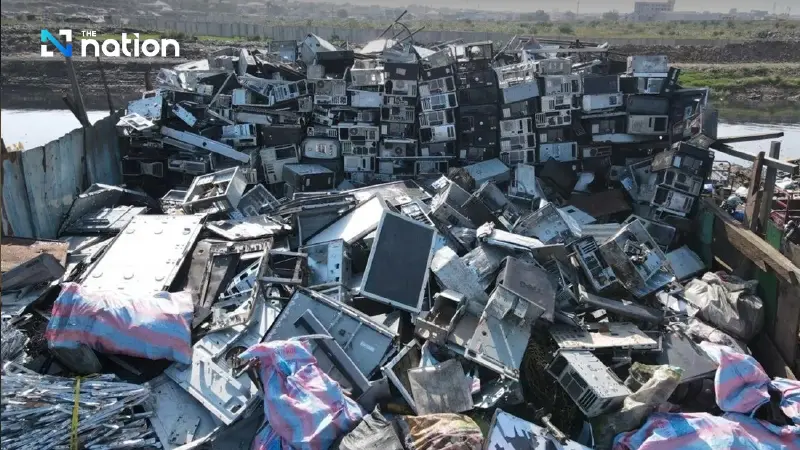


U.S. exports millions of tons of electronic waste to Southeast Asia, worsening environmental damage and public health, says Basel Action Network
A new report by the Basel Action Network (BAN) has revealed that millions of tons of electronic waste (e-waste) from the United States are being shipped abroad, mostly to developing countries in Southeast Asia. These countries are not prepared to manage such hazardous waste safely, causing significant risks to both the environment and public health.
The investigation, which spanned two years, uncovered that at least 10 US companies were involved in sending used electronics to Asia and the Middle East. Although the e-waste trade is lucrative for the electronics recycling industry, these discarded devices are often processed in dangerous, unregulated conditions in Southeast Asia.
E-waste includes discarded devices such as phones and computers, containing both valuable materials and toxic metals like lead, cadmium, and mercury. With shorter product lifespans and frequent upgrades, the global volume of e-waste is growing five times faster than formal recycling rates.
In 2022, the world produced a record 62 million tons of e-waste, and it is expected to reach 82 million tons by 2030, according to the International Telecommunication Union (ITU) and UNITAR.
The US has contributed significantly to the e-waste burden in Asia, which already produces nearly half of the world’s e-waste. Much of it is sent to landfills, leaching toxic chemicals into the environment. Some of it ends up in informal scrapyards, where workers manually burn or dismantle the devices without protection, releasing toxic fumes.
The report notes that approximately 2,000 containers—around 33,000 tons—of used electronics leave US ports every month. The companies behind these shipments, known as "e-waste brokers," typically do not recycle the waste themselves but instead send it to developing countries for further processing.
The companies identified in the report include Attan Recycling, Corporate eWaste Solutions (CEWS), Creative Metals Group, EDM, First America Metal, GEM Iron and Metal, Greenland Resource, IQA Metals, PPM Recycling, and Semsotai. Six of the companies did not immediately respond to requests for comment. Semsotai stated that it only exports reusable components, not scrap, and accused BAN of bias.
The report estimates that between January 2023 and February 2025, the 10 companies will export over 10,000 containers of potentially toxic e-waste, valued at over $1 billion. Industry-wide, the trade could reach up to $200 million a month.
Despite having R2V3 certifications, which are meant to ensure the safe and responsible recycling of electronics, many of the companies involved in this trade are raising questions about the value of such certifications. Moreover, many containers of e-waste are being shipped to countries that have banned such imports under the Basel Convention—a treaty that bars the trade of hazardous waste from non-signatories, such as the US.
The report highlights the issue of misclassification in trade records. E-waste is often declared under trade codes such as "commodity materials" or "recyclable goods" to avoid detection. This misclassification has raised concerns, as it contradicts the way companies publicly describe their operations.
Tony R. Walker, an expert in global waste trade from Dalhousie University, stated that he was not surprised by the continued evasion of regulations. While some devices can be legally traded if they are still functional, most of the exports to developing countries are broken or obsolete, ending up in landfills where they pollute the environment.
One example is Malaysia, a signatory to the Basel Convention, which has become a primary destination for US e-waste despite the country's efforts to control such imports. Walker noted that Malaysia is being overwhelmed by foreign waste, further exacerbating its domestic pollution problems.
The report also found that the US continues to export e-waste to Indonesia, Thailand, the Philippines, and the UAE, despite the Basel Convention and national laws banning such imports.
Authorities in Thailand and Malaysia have stepped up their efforts to curb illegal imports of US e-waste. In May 2025, Thai authorities seized 238 tons of US e-waste at the Port of Bangkok. In June, Malaysian authorities confiscated e-waste worth $118 million during nationwide raids.
SiPeng Wong from Malaysia’s Centre to Combat Corruption & Cronyism stated that most of the facilities in Malaysia are illegal and lack environmental safeguards. She also pointed out that the export of e-waste from wealthy nations to developing countries is creating a form of "waste colonialism."
