
Regional Truce: Enhanced Ceasefire Signed by Thai and Cambodian PMs at ASEAN Summit, Trump Witnesses
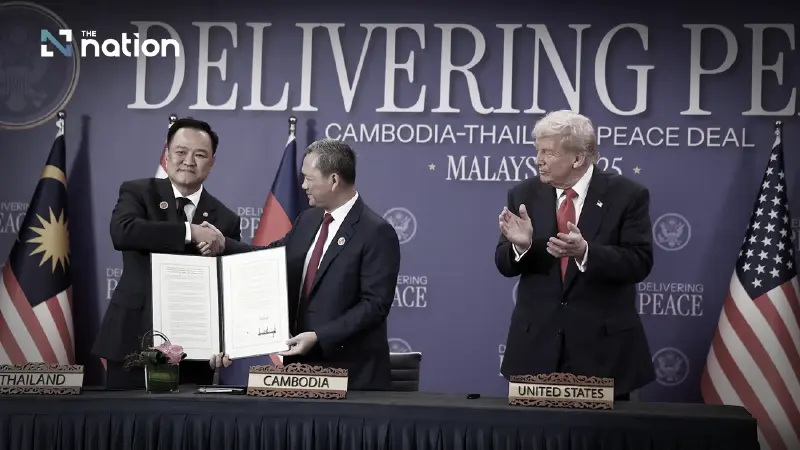


US President Donald Trump oversaw the signing of an expanded ceasefire agreement at the ASEAN Summit, formally ending the recent deadly border conflict and paving the way for de-escalation
- At the ASEAN Summit, the Prime Ministers of Thailand and Cambodia signed an enhanced ceasefire agreement to formally end a recent deadly border conflict.
- The signing was witnessed by U.S. President Donald Trump, who had personally intervened and used the threat of freezing trade talks to help broker the truce.
- The agreement establishes an ASEAN Observer Team to monitor the ceasefire, mandates the release of Cambodian prisoners of war, and requires the removal of heavy weapons from the border.
US President Donald Trump oversaw the signing of an expanded ceasefire agreement at the ASEAN Summit, formally ending the recent deadly border conflict and paving the way for de-escalation.
The leaders of Thailand and Cambodia signed a comprehensive peace accord on Sunday at the 47th ASEAN Summit, bringing a formal end to the deadly five-day border conflict that erupted between the two countries in July.
According to Reuters, the signing ceremony, which took place shortly after the arrival of US President Donald Trump in Kuala Lumpur, was the culmination of international efforts initiated by the US President and Malaysian Prime Minister Anwar Ibrahim.
The agreement builds upon a shaky truce brokered three months ago, following personal intervention by President Trump, who had reportedly urged the two nations to halt hostilities or face potential freezes in their respective trade talks with Washington.
"Both countries are agreeing to cease all hostilities and work to build good, neighbourly relationships," President Trump said at the signing ceremony, which was witnessed by Malaysian Prime Prime Minister Anwar Ibrahim, Cambodian Prime Minister Hun Manet, and Thai Prime Minister Anutin Charnvirakul.

Observer Team and Prisoner Release
The agreement, formalised in a joint declaration, establishes an ASEAN Observer Team (AOT) to monitor and verify the ceasefire’s full implementation.
The AOT will deploy personnel from ASEAN member states to ensure the peace "prevails and endures," as announced by President Trump.
In a key step towards reconciliation, the accord includes the prompt release of 18 Cambodian prisoners of war by Thailand, intended as a gesture of confidence and trust.

The US President openly linked the diplomatic success to trade relationships: "We do a lot of business with both of them. We have to use that business to make sure they don't get into wars, but this is going to be a very long peace," he stated.
Trump also said at the ceasefire ceremony that the U.S. would soon sign critical minerals deals with Thailand and Malaysia, while a wider trade deal with Cambodia was also in the works.
Cambodian Prime Minister Hun Manet thanked President Trump for his efforts, stating he had nominated the US President for the Nobel Peace Prize "in reflection of the gratitude of his people.”
Thai Prime Minister Anutin Charnvirakul praised the accord, saying it "reflects our collective will to resolve differences peacefully and with full respect for sovereignty and territorial integrity."

Core Commitments of the Deal
The joint declaration details concrete steps agreed by the two nations:
Military De-escalation: Both sides agreed to the removal of heavy and destructive weapons from the border and their return to regular military installations, to be verified by the AOT.
Media and Dialogue: Both nations committed to refrain from disseminating false information or "harmful rhetoric" to foster an environment conducive to peaceful dialogue.
De-mining: They committed to coordinated humanitarian de-mining in the border areas to protect civilian lives and contribute to socio-economic development.
Border Management: Both sides reaffirmed their commitment to settling the border dispute and demarcation through peaceful means and international law, utilising bilateral mechanisms such as the Joint Boundary Commission (JBC).

The agreement aims to resolve a conflict over undemarcated points along the 817-kilometre (508-mile) land border, which flared up into deadly fighting in July, killing at least 48 people and temporarily displacing hundreds of thousands—the worst fighting in decades.
Disputes often revolve around a 1907 map drawn under French colonial rule.
The most violent clashes have repeatedly occurred near the 1,000-year-old Preah Vihear temple, an area whose sovereignty was awarded to Cambodia by the International Court of Justice in 1962 and reaffirmed in 2013, a ruling that continues to be an irritant for Thailand.

