
Manila Must Capitalise on Kuala Lumpur’s Diplomatic Gains
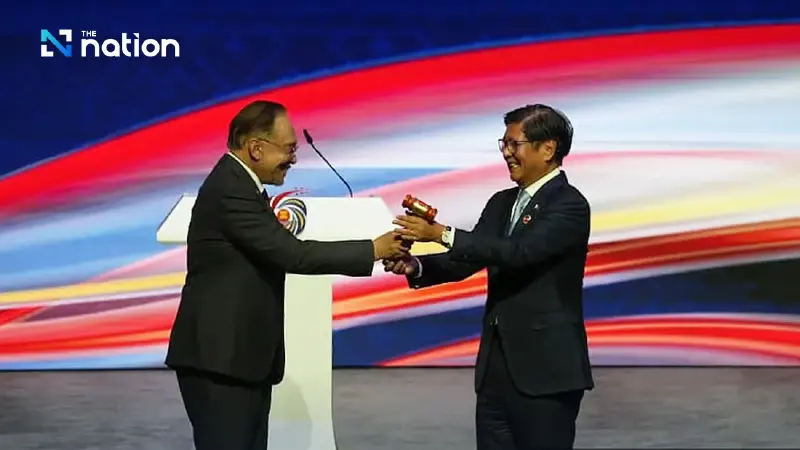


Analysts stress vital continuity on South China Sea, Myanmar crisis, and ambitious economic initiatives as Manila takes over the rotational chairmanship
- As the new ASEAN chair, the Philippines is urged to continue Malaysia's diplomatic work on key regional issues, particularly the South China Sea and the Myanmar crisis.
- Analysts recommend Manila push for the appointment of a permanent special envoy for Myanmar, an initiative explored during Malaysia's term, to ensure continuity in mediation.
- The Philippines should advance ambitious economic plans started by Malaysia, such as the ASEAN Geo-Economic Task Force, by developing clear roadmaps and funding to move them from concept to reality.
- Manila is advised to maintain the momentum of new diplomatic forums, like the ASEAN–Gulf Cooperation Council–China trilateral summit, to strengthen regional cooperation.
Analysts stress vital continuity on South China Sea, Myanmar crisis, and ambitious economic initiatives as Manila takes over the rotational chairmanship.
As the Philippines formally assumes the chairmanship of the Association of Southeast Asian Nations (ASEAN), analysts are cautioning that continuity and sustained momentum will be paramount to securing the region’s peace and prosperity.
Experts are calling on Manila to build upon the strategic and diplomatic breakthroughs initiated during Malaysia’s recent tenure, particularly regarding contentious geopolitical issues and ambitious economic reform plans.
Faiz Abdullah, chairman of Malaysia’s Institute of Strategic and International Studies (ISIS), highlighted the imperative of preventing the recent diplomatic successes from fading.
He specifically pointed to the first-ever ASEAN–Gulf Cooperation Council (GCC)–China trilateral summit, which he argued had the potential to redefine regional cooperation and development, provided its progress is maintained.
“You have a combination of dynamic forces at play. ASEAN and the GCC are already formidable, and with China in the picture, there’s a lot more depth,” Faiz said on ISIS Malaysia’s Asean Moment podcast.
He added that China’s technological advancements and financial infrastructure complement the GCC’s deep resources.
Veteran diplomat Ilango Karuppannan, Malaysia’s former ambassador to Singapore, told FMT that the Philippines must capitalise on Malaysia’s progress in tackling the complex issues of the South China Sea and the Myanmar crisis.
He stressed that these matters must be handled within a unified ASEAN framework, free from external interference.
“The Philippines has a major role to play. It won’t be easy, but Malaysia and the others are ready to help,” Ilango noted, adding that Malaysia remains the ASEAN–China relations coordinator until 2027.
On Myanmar, both Ilango and Faiz stressed that the effectiveness of ASEAN’s mediation is undermined by the current policy of an annually rotating special envoy.
The analysts reiterated a proposal, explored during Malaysia’s chairmanship, to appoint a permanent special envoy to mediate between Myanmar’s warring factions and coordinate the five-point consensus peace framework.
“Perhaps under the Philippines, we could agree to have a permanent envoy – someone who serves for several years and provides continuity,” Ilango suggested.
Faiz agreed, calling continuity a “major issue.” He added: “Just as things begin to settle (after a year), the envoy is replaced by someone new. Resolving that should be one of the Philippines’ key priorities.”
Echoing the call for sustained effort, Joanne Lin, senior fellow at Singapore’s ISEAS–Yusof Ishak Institute, acknowledged Malaysia’s “ambitious” chairmanship and its major milestones. However, she noted that important initiatives remained incomplete.
“The ASEAN Geo-Economic Task Force and Industrial Strategy were important steps, but they’re still at a conceptual stage,” Lin explained.
She called for “greater follow-through” to operationalise them through clear sectoral roadmaps, funding mechanisms, and direct private sector engagement.
Lin further suggested that Manila could bolster ASEAN’s collective voice on emerging trade and technology issues, particularly in response to US tariffs and China’s industrial policies.
She urged the Philippines to push for an “actionable blueprint,” citing an ASEAN semiconductor roadmap or a digital infrastructure fund as examples, to move the region “from coordination to execution.”
While experts broadly praised Malaysia’s strategic leadership, both Faiz and Lin identified areas where the bloc’s performance could improve.
Faiz lamented the lack of progress in revitalising the East Asia Summit, branding it a “Jurassic institution” that now features scripted speeches instead of genuine strategic engagement.
Meanwhile, Lin expressed concern that internal issues, such as recent unrest in Indonesia, the Thai-Cambodia border dispute, and the slow response to Myanmar, risked undermining the bloc's legitimacy among ordinary citizens.
“It shows how far ASEAN still is from achieving its own aspirations, as outlined in the ASEAN Community Vision 2045,” she stated.
To restore public confidence, Lin argued that ASEAN must make its people-centred agenda more tangible by closing the communication gap, allowing citizens to clearly see how regional cooperation directly supports jobs, education, and community resilience.
